AQA · GCSE · Biology
Course version: 8461 · Version from Sept 2018
Students should be able to understand the principles of sampling as…
Full specification wording
The effect of lifestyle on some non-communicable diseases: Students should be able to understand the principles of sampling as applied to scientific data in terms of risk factors.
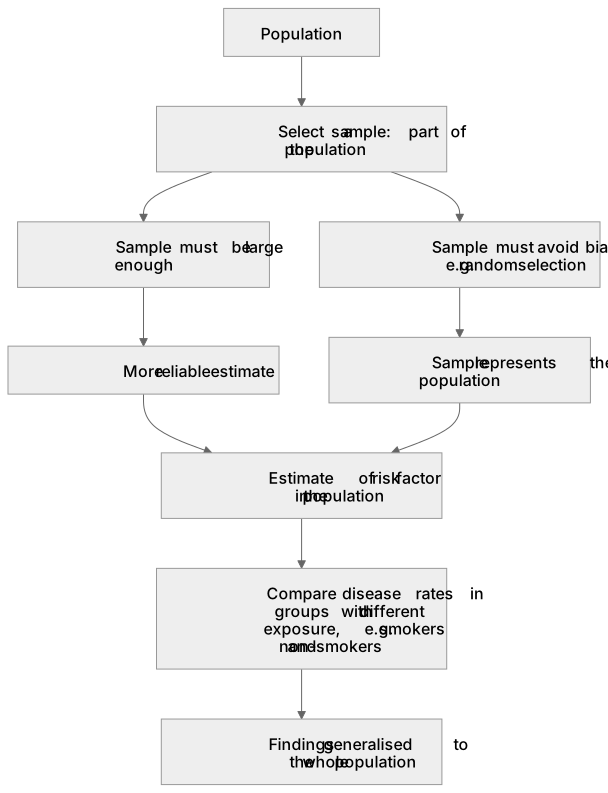
Sampling means studying a subset of a population to estimate a characteristic of the whole population, such as the proportion of people exposed to a risk factor.
Checked against the AQA 8461 specification (opens in a new tab) on .
- Point 7 of 9
- 4 key terms
Study notes
From the checked teaching notes for this specification point.
The idea
Sampling means studying a subset of a population to estimate a characteristic of the whole population, such as the proportion of people exposed to a risk factor. A sample must be large enough and selected without bias, for example by random selection, so that the estimate is reliable. If a sample is small or biased, the estimated risk may be inaccurate. In risk-factor studies, scientists compare disease rates in groups with different exposures, such as smokers and non-smokers, and use samples to estimate how strongly a factor such as smoking is linked to a non-communicable disease. The sample should represent the whole population, so findings can be generalised.
What earns the marks
- Defines sampling as selecting and studying part of a population to draw conclusions about the whole population.
- Explains that sample size affects reliability: larger samples usually give more reliable estimates than very small samples.
- Explains that sampling must avoid bias, for example by random selection, so the sample represents the population.
- Applies sampling ideas to risk factors by comparing disease occurrence in groups with different levels of exposure.
- Recognises that a sample gives an estimate, not a certain value for the whole population.
- Uses a specific example, such as comparing lung cancer rates in a sample of smokers and a sample of non-smokers.
Common mistakes and how to put them right
Thinking a sample must include the whole population.
Put it right by stating that a sample is a subset used to estimate population values.
Assuming any sample is valid regardless of size.
Put it right by explaining that small samples can give unreliable estimates.
Ignoring bias, for example selecting only volunteers.
Put it right by explaining that random selection helps the sample represent the population.
Exam tips
- Link sampling directly to risk factors by naming a factor such as smoking, diet or exercise and the disease it affects.
- Use comparative language such as higher, lower, greater risk or reduced risk when describing sample results.
- If asked to improve a study, suggest increasing sample size or using random selection rather than repeating the same method.
Try the lesson
The start of the The effect of lifestyle on some non-communicable diseases: Students should be able to understand the principles of sampling as applied to scientific data in terms of risk factors. lesson, made from checked teaching notes for this specification point.
Have a go first
A scientist wants to find out whether eating a lot of salt is a risk factor for high blood pressure. Which group of people should the scientist study to get the most useful data?
Listen
Sampling means studying a subset of a population to estimate a characteristic of the whole population, such as the proportion of people exposed to a risk factor. A sample must be large enough and selected without bias, for example by random selection, so that the estimate is reliable. If a sample is small or biased, the estimated risk may be inaccurate. In risk-factor studies, scientists compare disease rates in groups with different exposures, such as smokers and non-smokers, and use samples to estimate how strongly a factor such as smoking is linked to a non-communicable disease. The sample should represent the whole population, so findings can be generalised. A strong answer earns marks for these points. Defines sampling as selecting and studying part of a population to draw conclusions about the whole population. Explains that sample size affects reliability: larger samples usually give more reliable estimates than very small samples. Explains that sampling must avoid bias, for example by random selection, so the sample represents the population. Applies sampling ideas to risk factors by comparing disease occurrence in groups with different levels of exposure. A common slip: Thinking a sample must include the whole population. Instead, stating that a sample is a subset used to estimate population values. Exam tip: Link sampling directly to risk factors by naming a factor such as smoking, diet or exercise and the disease it affects.
See it
Key words
Say what each word means before you turn the card.
Sampling
Try answering aloud or in your head before turning the card.
Reliability and sample size
Try answering aloud or in your head before turning the card.
Bias and random selection
Try answering aloud or in your head before turning the card.
Risk factors and non-communicable disease
Try answering aloud or in your head before turning the card.
See every definition
- Sampling
- Selecting and studying part of a population to draw conclusions about the whole population, such as the proportion of people exposed to a risk factor.
- Reliability and sample size
- A sample must be large enough so that the estimate is reliable, because larger samples usually give more reliable estimates than very small samples.
- Bias and random selection
- A sample must be selected without bias, for example by random selection, so that the sample represents the population.
- Risk factors and non-communicable disease
- Scientists compare disease rates in groups with different exposures, such as smokers and non-smokers, and use samples to estimate how strongly a factor such as smoking is linked to a non-communicable disease.
Label the diagram
Some boxes have lost their names. Pick the right name for each number.
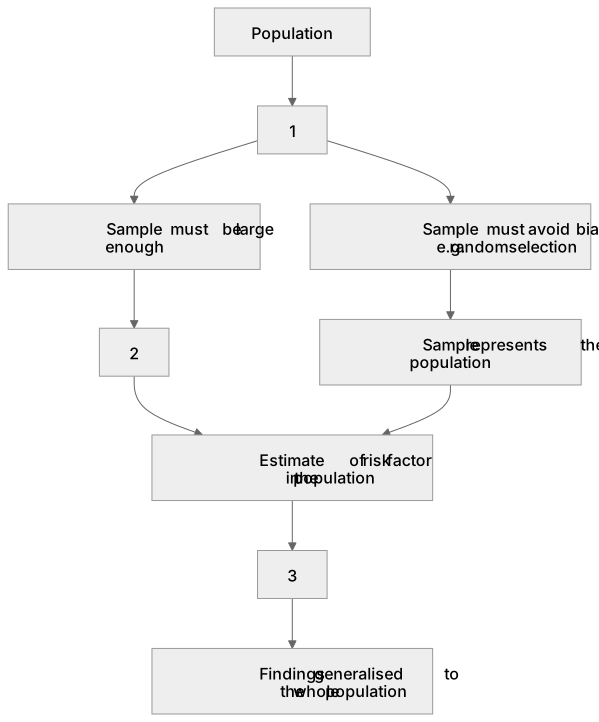
1Box 1
2Box 2
3Box 3
There is more to this lesson
The full lesson goes on to check your understanding and help you earn the marks. Create a free account to carry on, with your progress saved.
A week of Premium from your first lesson · Then the free plan continues · No card, no charge
Test your understanding of The effect of lifestyle on some non-communicable diseases: Students should be able to understand the principles of sampling as applied to scientific data in terms of risk factors.
Active recall beats re-reading. Take an instant quiz now to test what you’ve learned and lock it into long-term memory.
A week of Premium from your first lesson · Then the free plan continues · No card, no charge