AQA · GCSE · Biology
Course version: 8461 · Version from Sept 2018
In Vitro Fertilisation (IVF) treatment.
Full specification wording
The use of hormones to treat infertility (HT only): In Vitro Fertilisation (IVF) treatment.
In Vitro Fertilisation, usually shortened to IVF, is a fertility treatment in which eggs are fertilised by sperm outside the woman's body.
Checked against the AQA 8461 specification (opens in a new tab) on .
- Point 3 of 7
Study notes
From the checked teaching notes for this specification point.
The idea
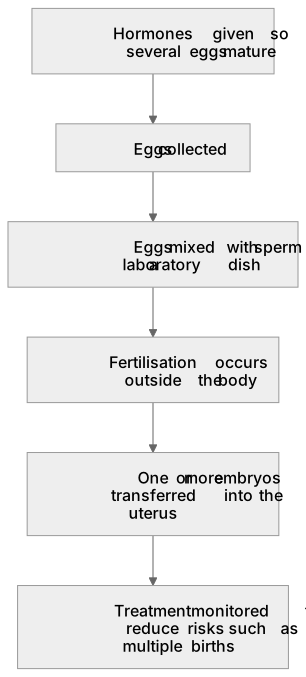
In Vitro Fertilisation, usually shortened to IVF, is a fertility treatment in which eggs are fertilised by sperm outside the woman's body. The word 'in vitro' means 'in glass', referring to the dish or tube used in the laboratory. IVF is used when the fallopian tubes are blocked or damaged, when other fertility treatments have not worked, or when a male partner has a low sperm count. The woman is given hormones so that several eggs mature, the eggs are collected and mixed with sperm, and the resulting embryos are placed into the uterus. Because several embryos may be transferred, IVF carries a higher chance of multiple births, so careful monitoring and counselling are part of the process.
What earns the marks
- IVF stands for In Vitro Fertilisation, meaning fertilisation occurs outside the body.
- Hormones are used to stimulate the ovaries so that several eggs mature before collection.
- Eggs are collected and mixed with sperm in a laboratory dish so that fertilisation occurs outside the body.
- One or more embryos are transferred into the uterus to develop, and the treatment is monitored to reduce risks such as multiple births.
Common mistakes and how to put them right
Thinking that fertilisation happens inside the woman's body during IVF.
Put it right: Fertilisation occurs outside the body, and only the embryo is placed in the uterus.
Believing IVF is the first treatment tried for all infertility.
Put it right: Simpler treatments such as fertility drugs may be used first, depending on the cause.
Assuming IVF always produces a single baby.
Put it right: Transferring more than one embryo can lead to multiple births, which is why monitoring is important.
Exam tips
- Explain the meaning of 'in vitro' to show why IVF is described as fertilisation outside the body.
- Give a named cause of infertility, such as blocked fallopian tubes, to justify why IVF is used.
- Sequence the stages clearly: hormone stimulation, egg collection, fertilisation in the laboratory, embryo transfer.
Try the lesson
The start of the The use of hormones to treat infertility (HT only): In Vitro Fertilisation (IVF) treatment. lesson, made from checked teaching notes for this specification point.
Have a go first
Which statement describes what happens during In Vitro Fertilisation (IVF) treatment?
Listen
In Vitro Fertilisation, usually shortened to IVF, is a fertility treatment in which eggs are fertilised by sperm outside the woman's body. The word 'in vitro' means 'in glass', referring to the dish or tube used in the laboratory. IVF is used when the fallopian tubes are blocked or damaged, when other fertility treatments have not worked, or when a male partner has a low sperm count. The woman is given hormones so that several eggs mature, the eggs are collected and mixed with sperm, and the resulting embryos are placed into the uterus. Because several embryos may be transferred, IVF carries a higher chance of multiple births, so careful monitoring and counselling are part of the process. A strong answer earns marks for these points. IVF stands for In Vitro Fertilisation, meaning fertilisation occurs outside the body. Hormones are used to stimulate the ovaries so that several eggs mature before collection. Eggs are collected and mixed with sperm in a laboratory dish so that fertilisation occurs outside the body. One or more embryos are transferred into the uterus to develop, and the treatment is monitored to reduce risks such as multiple births. A common slip: Thinking that fertilisation happens inside the woman's body during IVF. Instead, fertilisation occurs outside the body, and only the embryo is placed in the uterus. Exam tip: Explain the meaning of 'in vitro' to show why IVF is described as fertilisation outside the body.
See it
Put it in order
Put these steps in the order they happen.
- 1. Eggs mixed with sperm in a laboratory dish
- 2. Eggs collected
- 3. Hormones given so several eggs mature
- 4. Treatment monitored to reduce risks such as multiple births
- 5. One or more embryos transferred into the uterus
- 6. Fertilisation occurs outside the body
Label the diagram
Some boxes have lost their names. Pick the right name for each number.
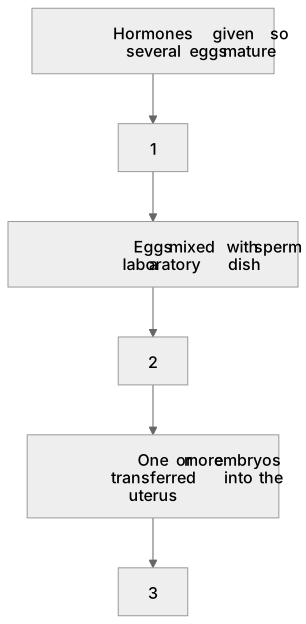
1Box 1
2Box 2
3Box 3
There is more to this lesson
The full lesson goes on to check your understanding and help you earn the marks. Create a free account to carry on, with your progress saved.
A week of Premium from your first lesson · Then the free plan continues · No card, no charge
Test your understanding of The use of hormones to treat infertility (HT only): In Vitro Fertilisation (IVF) treatment.
Active recall beats re-reading. Take an instant quiz now to test what you’ve learned and lock it into long-term memory.
A week of Premium from your first lesson · Then the free plan continues · No card, no charge