AQA · GCSE · Biology
Course version: 8461 · Version from Sept 2018
IVF involves giving a mother FSH and LH to stimulate the maturation of…
Full specification wording
The use of hormones to treat infertility (HT only): IVF involves giving a mother FSH and LH to stimulate the maturation of several eggs.
In In Vitro Fertilisation (IVF), a mother is given fertility drugs containing both Follicle Stimulating Hormone (FSH) and Luteinising Hormone (LH).
Checked against the AQA 8461 specification (opens in a new tab) on .
- Point 4 of 7
- 4 key terms
Study notes
From the checked teaching notes for this specification point.
The idea
In In Vitro Fertilisation (IVF), a mother is given fertility drugs containing both Follicle Stimulating Hormone (FSH) and Luteinising Hormone (LH). According to the specification, these hormones are administered together to stimulate the maturation of several eggs in the ovaries. Normally, only one egg matures per cycle, but providing extra FSH and LH ensures multiple eggs mature simultaneously. For example, a patient might produce ten mature eggs instead of one. These mature eggs are then collected from the mother's ovaries before they are naturally released. Collecting multiple eggs is crucial because it increases the chances of successfully fertilising at least one in the laboratory to develop into an embryo, thereby improving the overall success rate of the fertility treatment.
What earns the marks
- The purpose of giving these hormones is to stimulate the maturation of several eggs in the ovaries.
- Maturing multiple eggs is necessary so that a larger number can be collected prior to natural ovulation.
- Collecting several eggs increases the probability of successful fertilisation in the laboratory and subsequent embryo development.
Common mistakes and how to put them right
Stating that LH is given to trigger ovulation in IVF.
Put it right by specifying that in IVF, both FSH and LH are given to stimulate the maturation of several eggs before they are collected.
Confusing the roles of IVF hormones with contraception.
Put it right by remembering that IVF uses FSH and LH to increase egg maturation, whereas contraceptives often use oestrogen and progesterone to inhibit FSH production.
Thinking the hormones are given to the father.
Put it right by stating that FSH and LH are given to the mother to act on her ovaries.
Exam tips
- Always state that both FSH and LH are used to stimulate the maturation of several eggs; do not just say they make eggs grow.
- If asked why multiple eggs are needed, explain that it increases the chance of successful fertilisation and embryo development in the laboratory.
Try the lesson
The start of the The use of hormones to treat infertility (HT only): IVF involves giving a mother FSH and LH to stimulate the maturation of several eggs. lesson, made from checked teaching notes for this specification point.
Have a go first
In IVF treatment, which hormone is given mainly to stimulate several eggs to mature at the same time?
Listen
In In Vitro Fertilisation (IVF), a mother is given fertility drugs containing both Follicle Stimulating Hormone (FSH) and Luteinising Hormone (LH). According to the specification, these hormones are administered together to stimulate the maturation of several eggs in the ovaries. Normally, only one egg matures per cycle, but providing extra FSH and LH ensures multiple eggs mature simultaneously. For example, a patient might produce ten mature eggs instead of one. These mature eggs are then collected from the mother's ovaries before they are naturally released. Collecting multiple eggs is crucial because it increases the chances of successfully fertilising at least one in the laboratory to develop into an embryo, thereby improving the overall success rate of the fertility treatment. A strong answer earns marks for these points. The purpose of giving these hormones is to stimulate the maturation of several eggs in the ovaries. Maturing multiple eggs is necessary so that a larger number can be collected prior to natural ovulation. Collecting several eggs increases the probability of successful fertilisation in the laboratory and subsequent embryo development. A common slip: Stating that LH is given to trigger ovulation in IVF. Instead, specifying that in IVF, both FSH and LH are given to stimulate the maturation of several eggs before they are collected. Exam tip: Always state that both FSH and LH are used to stimulate the maturation of several eggs; do not just say they make eggs grow.
See it
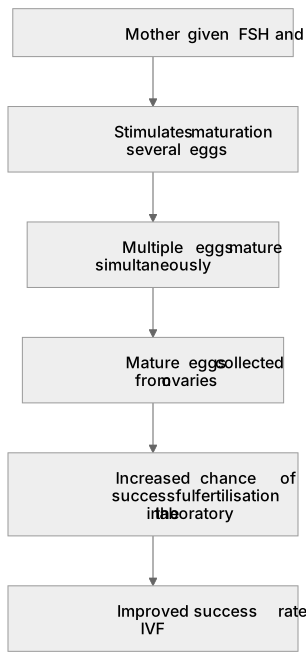
Put it in order
Put these steps in the order they happen.
- 1. Multiple eggs mature simultaneously
- 2. Stimulates maturation of several eggs
- 3. Mother given FSH and LH
- 4. Improved success rate of IVF
- 5. Increased chance of successful fertilisation in the laboratory
- 6. Mature eggs collected from ovaries
Key words
Say what each word means before you turn the card.
IVF
Try answering aloud or in your head before turning the card.
FSH and LH
Try answering aloud or in your head before turning the card.
Maturation of several eggs
Try answering aloud or in your head before turning the card.
Collection of eggs
Try answering aloud or in your head before turning the card.
See every definition
- IVF
- A treatment in which a mother is given FSH and LH to stimulate the maturation of several eggs.
- FSH and LH
- Hormones given together to the mother to stimulate the maturation of several eggs in the ovaries.
- Maturation of several eggs
- The process stimulated by giving FSH and LH, ensuring multiple eggs mature simultaneously rather than only one per cycle.
- Collection of eggs
- Mature eggs are collected from the mother's ovaries before they are naturally released, increasing the chances of successful fertilisation in the laboratory.
Label the diagram
Some boxes have lost their names. Pick the right name for each number.
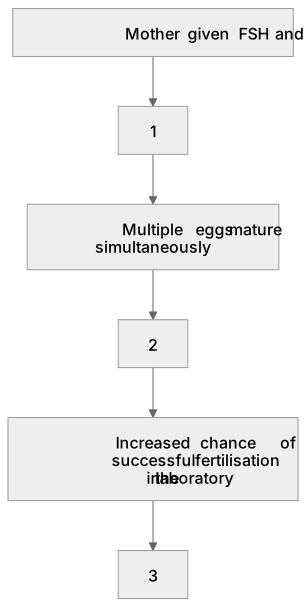
1Box 1
2Box 2
3Box 3
There is more to this lesson
The full lesson goes on to check your understanding and help you earn the marks. Create a free account to carry on, with your progress saved.
A week of Premium from your first lesson · Then the free plan continues · No card, no charge
Test your understanding of The use of hormones to treat infertility (HT only): IVF involves giving a mother FSH and LH to stimulate the maturation of several eggs.
Active recall beats re-reading. Take an instant quiz now to test what you’ve learned and lock it into long-term memory.
A week of Premium from your first lesson · Then the free plan continues · No card, no charge