OCR · GCSE · Biology
Course version: J247 · Version from Sept 2018
Cell structures: use estimations and explain when they should be used
Estimations provide rapid, sensible approximations of cell dimensions and populations when exact measurements are impractical.
- Point 2 of 6
- 3 key terms
Study notes
From the teaching notes for this specification point.
The idea
Estimations provide rapid, sensible approximations of cell dimensions and populations when exact measurements are impractical. Under a light microscope, field of view diameter can be measured using a stage micrometer or clear graticule. By counting how many cells fit end-to-end across this diameter, the average length of a single cell is estimated by dividing field diameter by cell count. Estimations are also used to verify whether calculated answers are physiologically reasonable, rounding values to one or two significant figures. This prevents unrealistic claims, such as calculating a human cheek cell diameter as several centimeters.
What earns the marks
- Dividing the measured field of view diameter by the number of cells spanning it.
- Stating that estimations assess whether calculated dimensions are biologically realistic.
- Rounding approximate biological values appropriately to one or two significant figures.
Common mistakes and how to put them right
Dividing total cells visible in the entire circular field of view rather than cells spanning the diameter line.
Giving an estimated value to excessive decimal places rather than appropriate significant figures.
Exam tips
- State the formula used: average cell size equals diameter of field of view divided by number of cells across diameter.
- Use estimations to check your calculations; an answer of 20 mm for cell diameter is an immediate clue that unit conversion went wrong.
Try the lesson
The start of the Cell structures: use estimations and explain when they should be used lesson, made from teaching notes for this specification point.
Have a go first
When is it most appropriate to use an estimation rather than an exact measurement?
Listen
Estimations provide rapid, sensible approximations of cell dimensions and populations when exact measurements are impractical. Under a light microscope, field of view diameter can be measured using a stage micrometer or clear graticule. By counting how many cells fit end-to-end across this diameter, the average length of a single cell is estimated by dividing field diameter by cell count. Estimations are also used to verify whether calculated answers are physiologically reasonable, rounding values to one or two significant figures. This prevents unrealistic claims, such as calculating a human cheek cell diameter as several centimeters. A strong answer earns marks for these points. dividing the measured field of view diameter by the number of cells spanning it. stating that estimations assess whether calculated dimensions are biologically realistic. rounding approximate biological values appropriately to one or two significant figures. Exam tip: State the formula used: average cell size equals diameter of field of view divided by number of cells across diameter.
See it
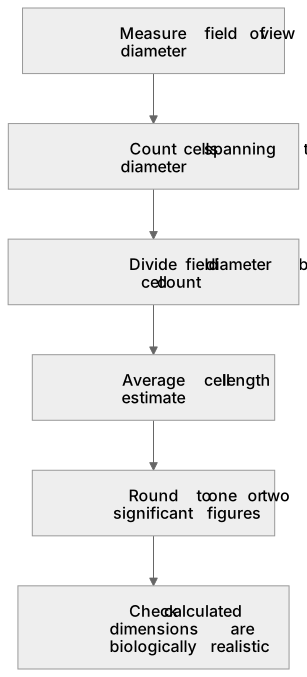
Put it in order
Put these steps in the order they happen.
- 1. Divide field diameter by cell count
- 2. Count cells spanning the diameter
- 3. Measure field of view diameter
- 4. Check calculated dimensions are biologically realistic
- 5. Round to one or two significant figures
- 6. Average cell length estimate
Key words
Say what each word means before you turn the card.
estimation
Try answering aloud or in your head before turning the card.
field of view
Try answering aloud or in your head before turning the card.
approximation
Try answering aloud or in your head before turning the card.
See every definition
- estimation
- A rapid, sensible approximation of cell dimensions and populations used when exact measurements are impractical, and to verify whether calculated answers are physiologically reasonable.
- field of view
- The circular area seen under a light microscope, whose diameter can be measured using a stage micrometer or clear graticule.
- approximation
- A sensible value produced by estimation, rounded to one or two significant figures rather than excessive decimal places.
Label the diagram
Some boxes have lost their names. Pick the right name for each number.
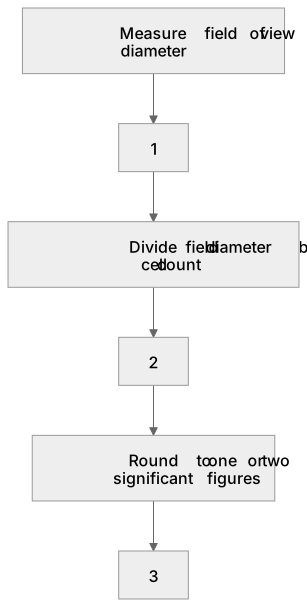
1Box 1
2Box 2
3Box 3
There is more to this lesson
The full lesson goes on to check your understanding and help you earn the marks. Create a free account to carry on, with your progress saved.
A week of Premium from your first lesson · Then the free plan continues · No card, no charge
Test your understanding of Cell structures: use estimations and explain when they should be used
Active recall beats re-reading. Take an instant quiz now to test what you’ve learned and lock it into long-term memory.
A week of Premium from your first lesson · Then the free plan continues · No card, no charge