OCR · GCSE · Biology
Course version: J247 · Version from Sept 2018
Describe some of the different ways in which people use plant hormones to…
Full specification wording
Coordination and control – the endocrine system: describe some of the different ways in which people use plant hormones to control plant growth (to include: selective herbicides, root cuttings, seedless fruit (parthenocarpic fruit development), altering dormancy) (content found only in the biology separate science qualification) (Higher tier only)
Synthetic and natural plant hormones are widely exploited in commercial agriculture and horticulture to manipulate crop development.
- Point 11 of 11
- 4 key terms
Study notes
From the teaching notes for this specification point.
The idea
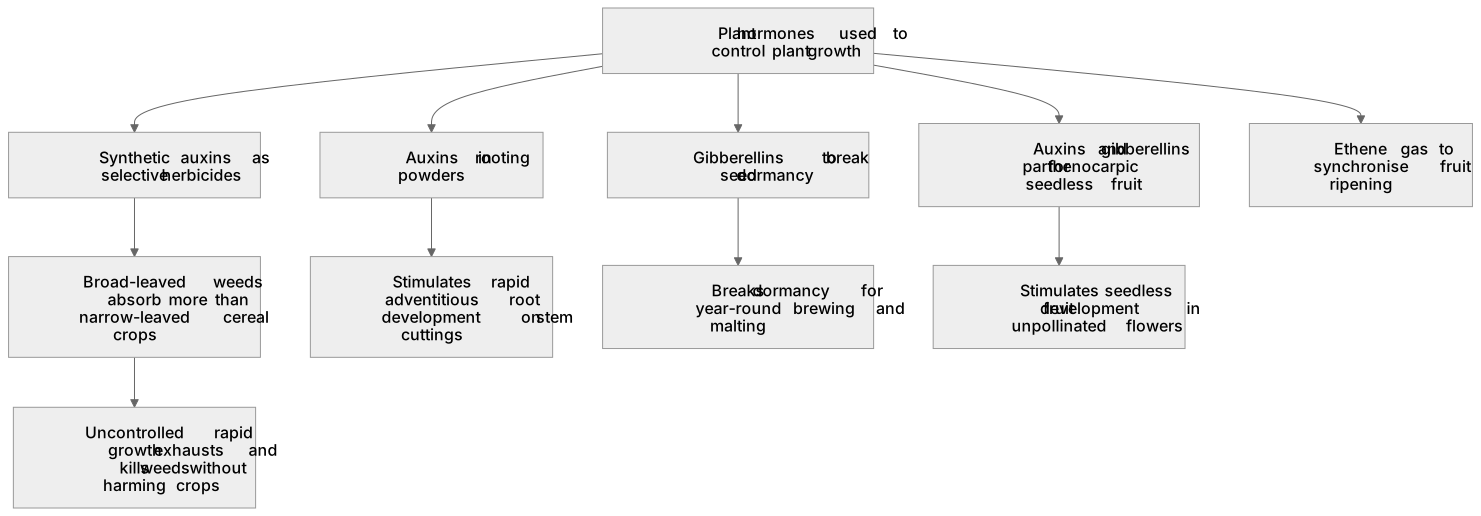
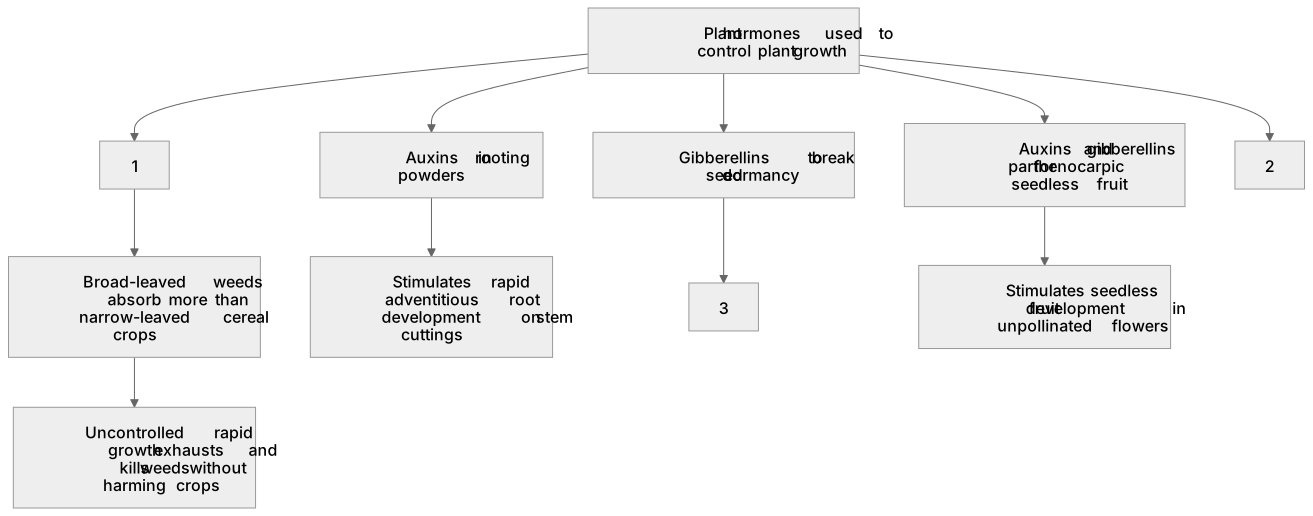
Synthetic and natural plant hormones are widely exploited in commercial agriculture and horticulture to manipulate crop development. Synthetic auxins are formulated into selective herbicides; because broad-leaved weeds absorb higher quantities than narrow-leaved cereal crops, the synthetic auxins induce uncontrolled rapid growth that exhausts the weeds and causes death without harming food crops. Auxins are also incorporated into rooting powders, stimulating cut stems to develop adventitious roots rapidly for vegetative propagation. Gibberellins are sprayed to break seed dormancy in commercial brewing and induce parthenocarpic development of seedless fruit in unpollinated flowers. Ethene gas is applied in transit to synchronise fruit ripening.
What earns the marks
- Explain how synthetic auxins act as selective weedkillers by stimulating rapid, unsustainable growth in broad-leaved weeds.
- Describe the use of auxin rooting powder to stimulate rapid adventitious root development on stem cuttings.
- Describe how gibberellins are used commercially to break seed dormancy for year-round brewing or malting.
- Explain the application of auxins and gibberellins in stimulating parthenocarpic development of seedless fruits in unpollinated crops.
Common mistakes and how to put them right
Stating that selective weedkillers poison broad-leaved plants directly, rather than disrupting natural growth through hormone overload.
Believing seedless fruits are produced without plant hormones, unaware that synthetic auxins or gibberellins mimic pollination signals.
Confusing the commercial uses of ethene (ripening control) with gibberellins (dormancy breaking).
Exam tips
- State clearly that selective weedkillers kill broad-leaved weeds while leaving narrow-leaved grass and cereal crops unaffected.
- For rooting powders, name auxin as the active ingredient and explain that it enables successful propagation from cuttings.
Try the lesson
The start of the Coordination and control – the endocrine system: describe some of the different ways in which people use plant hormones to control plant growth (to include: selective herbicides, root cuttings, seedless fruit (parthenocarpic fruit development), altering dormancy) (content found only in the biology separate science qualification) (Higher tier only) lesson, made from teaching notes for this specification point.
Have a go first
Which use of plant hormones involves applying a hormone to a cutting so that roots develop before the plant is potted?
Listen
Synthetic and natural plant hormones are widely exploited in commercial agriculture and horticulture to manipulate crop development. Synthetic auxins are formulated into selective herbicides; because broad-leaved weeds absorb higher quantities than narrow-leaved cereal crops, the synthetic auxins induce uncontrolled rapid growth that exhausts the weeds and causes death without harming food crops. Auxins are also incorporated into rooting powders, stimulating cut stems to develop adventitious roots rapidly for vegetative propagation. Gibberellins are sprayed to break seed dormancy in commercial brewing and induce parthenocarpic development of seedless fruit in unpollinated flowers. Ethene gas is applied in transit to synchronise fruit ripening. A strong answer earns marks for these points. explain how synthetic auxins act as selective weedkillers by stimulating rapid, unsustainable growth in broad-leaved weeds. describe the use of auxin rooting powder to stimulate rapid adventitious root development on stem cuttings. describe how gibberellins are used commercially to break seed dormancy for year-round brewing or malting. explain the application of auxins and gibberellins in stimulating parthenocarpic development of seedless fruits in unpollinated crops. Exam tip: State clearly that selective weedkillers kill broad-leaved weeds while leaving narrow-leaved grass and cereal crops unaffected.
See it
Key words
Say what each word means before you turn the card.
selective herbicides
Try answering aloud or in your head before turning the card.
rooting powder
Try answering aloud or in your head before turning the card.
seedless fruit
Try answering aloud or in your head before turning the card.
commercial horticulture
Try answering aloud or in your head before turning the card.
See every definition
- selective herbicides
- Synthetic auxins formulated to make broad-leaved weeds absorb higher quantities than narrow-leaved cereal crops, inducing uncontrolled rapid growth that exhausts the weeds and causes death without harming food crops.
- rooting powder
- A product into which auxins are incorporated, stimulating cut stems to develop adventitious roots rapidly for vegetative propagation.
- seedless fruit
- Produced by spraying gibberellins to induce parthenocarpic development in unpollinated flowers.
- commercial horticulture
- One of the areas where synthetic and natural plant hormones are widely exploited to manipulate crop development.
Label the diagram
Some boxes have lost their names. Pick the right name for each number.
1Box 1
2Box 2
3Box 3
There is more to this lesson
The full lesson goes on to check your understanding and help you earn the marks. Create a free account to carry on, with your progress saved.
A week of Premium from your first lesson · Then the free plan continues · No card, no charge
Test your understanding of Coordination and control – the endocrine system: describe some of the different ways in which people use plant hormones to control plant growth (to include: selective herbicides, root cuttings, seedless fruit (parthenocarpic fruit development), altering dormancy) (content found only in the biology separate science qualification) (Higher tier only)
Active recall beats re-reading. Take an instant quiz now to test what you’ve learned and lock it into long-term memory.
A week of Premium from your first lesson · Then the free plan continues · No card, no charge