OCR · GCSE · Biology
Course version: J247 · Version from Sept 2018
Describe cancer as the result of changes in cells that lead to…
Full specification wording
Monitoring and maintaining health: describe cancer as the result of changes in cells that lead to uncontrolled growth and division
Cancer arises from genetic mutations in cells that disrupt normal cell cycle regulation, causing cells to undergo uncontrolled growth and mitotic division, forming an abnormal tissue mass called a…
- Point 26 of 29
- 4 key terms
Study notes
From the teaching notes for this specification point.
The idea
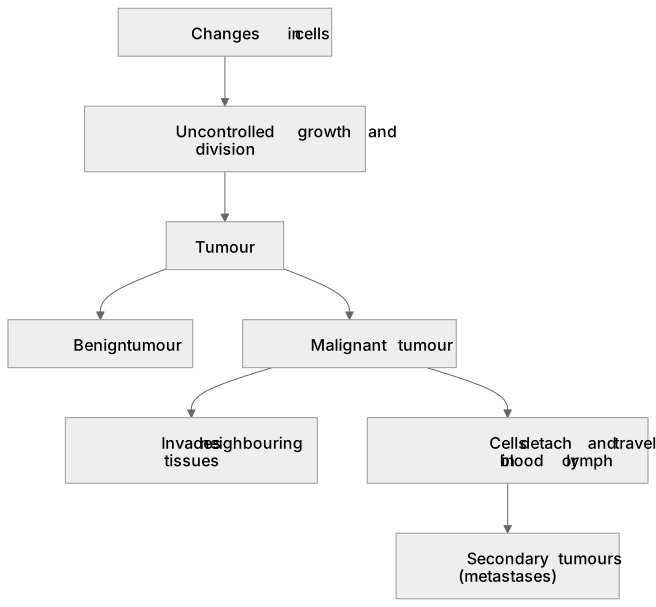
Cancer arises from genetic mutations in cells that disrupt normal cell cycle regulation, causing cells to undergo uncontrolled growth and mitotic division, forming an abnormal tissue mass called a tumour. Tumours are classified as benign or malignant. Benign tumours remain contained within a fibrous capsule at the original site, do not invade neighbouring tissues, and do not spread around the body. Malignant tumours are cancerous: their cells invade neighbouring healthy tissues and can detach, travelling through the bloodstream or lymphatic system to establish secondary tumours (metastases) in distant organs. Carcinogens such as tobacco tar, ultraviolet radiation, and ionising radiation increase mutation rates.
What earns the marks
- Describe cancer as resulting from mutations in cells that cause uncontrolled growth and mitotic division, forming a tumour.
- Describe benign tumours: abnormal cell masses contained within a membrane that do not invade surrounding tissues or spread.
- Describe malignant tumours: cancerous cells that invade surrounding tissues, break off, and travel via blood or lymph to form secondary tumours (metastases).
- Identify carcinogens, such as UV radiation, ionising radiation, and chemicals in tobacco smoke, as agents causing cancer mutations.
Common mistakes and how to put them right
Calling all tumours cancerous, failing to recognize that benign tumours are non-cancerous and do not metastasize.
Claiming cancer cells spread by walking or floating through the body, rather than travelling through blood vessels or lymph vessels.
Exam tips
- Clearly distinguish benign from malignant: benign tumours remain localized within a membrane; malignant tumours invade tissues and spread via blood to form secondary tumours.
- Always state that cancer involves uncontrolled cell division by MITOSIS.
Try the lesson
The start of the Monitoring and maintaining health: describe cancer as the result of changes in cells that lead to uncontrolled growth and division lesson, made from teaching notes for this specification point.
Have a go first
What happens to cells to cause a cancer?
Listen
Cancer arises from genetic mutations in cells that disrupt normal cell cycle regulation, causing cells to undergo uncontrolled growth and mitotic division, forming an abnormal tissue mass called a tumour. Tumours are classified as benign or malignant. Benign tumours remain contained within a fibrous capsule at the original site, do not invade neighbouring tissues, and do not spread around the body. Malignant tumours are cancerous: their cells invade neighbouring healthy tissues and can detach, travelling through the bloodstream or lymphatic system to establish secondary tumours (metastases) in distant organs. Carcinogens such as tobacco tar, ultraviolet radiation, and ionising radiation increase mutation rates. A strong answer earns marks for these points. Describe cancer as resulting from mutations in cells that cause uncontrolled growth and mitotic division, forming a tumour. Describe benign tumours: abnormal cell masses contained within a membrane that do not invade surrounding tissues or spread. Describe malignant tumours: cancerous cells that invade surrounding tissues, break off, and travel via blood or lymph to form secondary tumours (metastases). Identify carcinogens, such as UV radiation, ionising radiation, and chemicals in tobacco smoke, as agents causing cancer mutations. Exam tip: Clearly distinguish benign from malignant: benign tumours remain localized within a membrane; malignant tumours invade tissues and spread via blood to form secondary tumours.
See it
Key words
Say what each word means before you turn the card.
cancer
Try answering aloud or in your head before turning the card.
benign tumours
Try answering aloud or in your head before turning the card.
malignant tumours
Try answering aloud or in your head before turning the card.
carcinogens
Try answering aloud or in your head before turning the card.
See every definition
- cancer
- A condition resulting from changes in cells that lead to uncontrolled growth and division, forming a tumour.
- benign tumours
- Abnormal cell masses contained within a membrane that do not invade surrounding tissues or spread.
- malignant tumours
- Cancerous cells that invade surrounding tissues, break off, and travel via blood or lymph to form secondary tumours.
- carcinogens
- Agents such as UV radiation, ionising radiation, and chemicals in tobacco smoke that cause cancer mutations.
Label the diagram
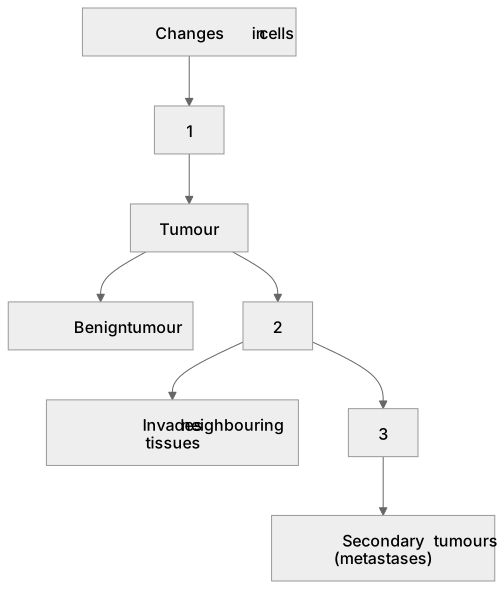
Some boxes have lost their names. Pick the right name for each number.
1Box 1
2Box 2
3Box 3
There is more to this lesson
The full lesson goes on to check your understanding and help you earn the marks. Create a free account to carry on, with your progress saved.
A week of Premium from your first lesson · Then the free plan continues · No card, no charge
Test your understanding of Monitoring and maintaining health: describe cancer as the result of changes in cells that lead to uncontrolled growth and division
Active recall beats re-reading. Take an instant quiz now to test what you’ve learned and lock it into long-term memory.
A week of Premium from your first lesson · Then the free plan continues · No card, no charge