OCR · GCSE · Biology
Course version: J247 · Version from Sept 2018
Describe photosynthetic organisms as the main producers of food and…
Full specification wording
Photosynthesis: describe photosynthetic organisms as the main producers of food and therefore biomass for life on Earth
Photosynthetic organisms, including terrestrial green plants, freshwater algae, and marine phytoplankton, function as autotrophic producers.
- Point 6 of 15
- 4 key terms
Study notes
From the teaching notes for this specification point.
The idea
Photosynthetic organisms, including terrestrial green plants, freshwater algae, and marine phytoplankton, function as autotrophic producers. By harnessing solar radiant energy, they convert inorganic carbon dioxide and water into energy-rich glucose sugar. Plants convert this synthesized glucose into complex organic macromolecules including starch, cellulose, lipids, and proteins, which form new biological tissues termed biomass. Because heterotrophic animals cannot synthesize organic compounds from inorganic precursors, photosynthetic biomass forms the energetic base (trophic level 1) of nearly all ecosystems.
What earns the marks
- Defining photosynthetic organisms as autotrophic producers that synthesize organic molecules from CO₂ and H₂O.
- Stating that synthesized glucose is converted into biological macromolecules to generate biomass.
- Explaining that plant biomass provides the foundation and primary food source for higher trophic levels.
Common mistakes and how to put them right
Thinking plants obtain food or biomass from the soil rather than synthesizing it via photosynthesis.
Confusing producers (autotrophs) with consumers or decomposers in food chains.
Exam tips
- Use the term biomass explicitly to mean the mass of biological material synthesized by organisms.
- Emphasize that all food chains rely on producers capturing solar energy to support life on Earth.
Try the lesson
The start of the Photosynthesis: describe photosynthetic organisms as the main producers of food and therefore biomass for life on Earth lesson, made from teaching notes for this specification point.
Have a go first
Which organisms are the main producers of food and biomass for life on Earth?
Listen
Photosynthetic organisms, including terrestrial green plants, freshwater algae, and marine phytoplankton, function as autotrophic producers. By harnessing solar radiant energy, they convert inorganic carbon dioxide and water into energy-rich glucose sugar. Plants convert this synthesized glucose into complex organic macromolecules including starch, cellulose, lipids, and proteins, which form new biological tissues termed biomass. Because heterotrophic animals cannot synthesize organic compounds from inorganic precursors, photosynthetic biomass forms the energetic base (trophic level 1) of nearly all ecosystems. A strong answer earns marks for these points. defining photosynthetic organisms as autotrophic producers that synthesize organic molecules from CO₂ and H₂O. stating that synthesized glucose is converted into biological macromolecules to generate biomass. explaining that plant biomass provides the foundation and primary food source for higher trophic levels. Exam tip: Use the term biomass explicitly to mean the mass of biological material synthesized by organisms.
See it
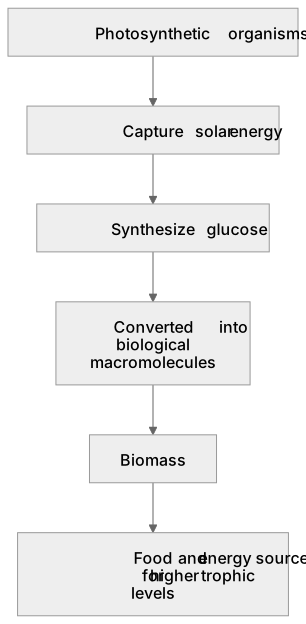
Put it in order
Put these steps in the order they happen.
- 1. Synthesize glucose
- 2. Capture solar energy
- 3. Photosynthetic organisms
- 4. Food and energy source for higher trophic levels
- 5. Biomass
- 6. Converted into biological macromolecules
Key words
Say what each word means before you turn the card.
producers
Try answering aloud or in your head before turning the card.
biomass
Try answering aloud or in your head before turning the card.
autotrophs
Try answering aloud or in your head before turning the card.
trophic levels
Try answering aloud or in your head before turning the card.
See every definition
- producers
- Photosynthetic organisms that synthesize organic molecules from carbon dioxide and water and form the base of food chains.
- biomass
- The mass of biological material synthesized by organisms, formed as glucose is converted into biological macromolecules.
- autotrophs
- Organisms that synthesize organic compounds from inorganic precursors and function as producers.
- trophic levels
- The levels of an ecosystem at which organisms feed, with producers forming trophic level 1.
Label the diagram
Some boxes have lost their names. Pick the right name for each number.
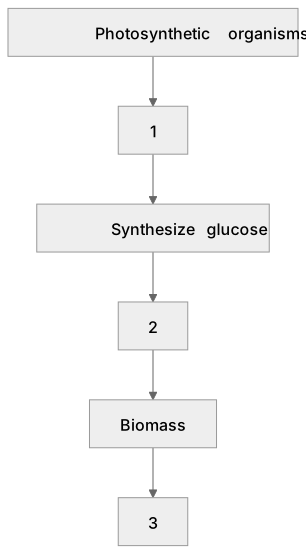
1Box 1
2Box 2
3Box 3
There is more to this lesson
The full lesson goes on to check your understanding and help you earn the marks. Create a free account to carry on, with your progress saved.
A week of Premium from your first lesson · Then the free plan continues · No card, no charge
Test your understanding of Photosynthesis: describe photosynthetic organisms as the main producers of food and therefore biomass for life on Earth
Active recall beats re-reading. Take an instant quiz now to test what you’ve learned and lock it into long-term memory.
A week of Premium from your first lesson · Then the free plan continues · No card, no charge