OCR · GCSE · Biology
Course version: J247 · Version from Sept 2018
Use of appropriate techniques and qualitative reagents to identify…
Full specification wording
Testing for biological molecules: Use of appropriate techniques and qualitative reagents to identify biological molecules and processes in more complex and problem-solving contexts including continuous sampling in an investigation.
Qualitative reagents identify macromolecules in food and track digestive breakdown.
- Point 2 of 2
- 4 key terms
Study notes
From the teaching notes for this specification point.
The idea
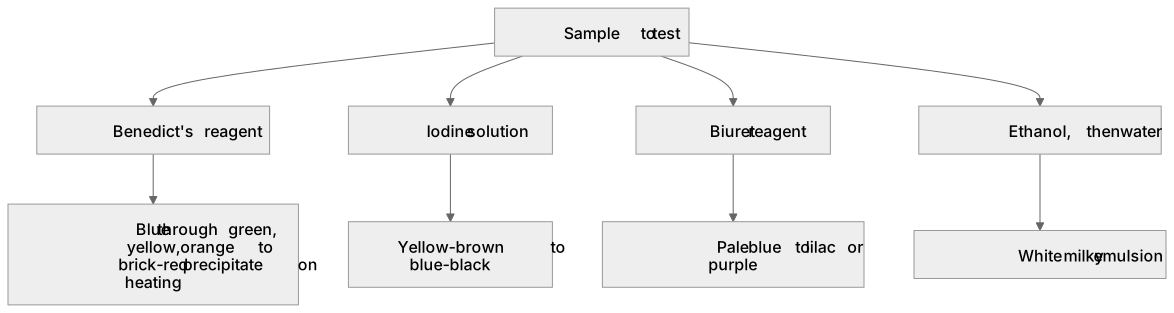
Qualitative reagents identify macromolecules in food and track digestive breakdown. Benedict's reagent tests for reducing sugars, turning from blue through green, yellow and orange to brick-red precipitate on heating, depending on concentration. Iodine solution tests for starch, changing from yellow-brown to blue-black. Biuret reagent tests for proteins, changing from pale blue to lilac or purple. The emulsion test with ethanol and water identifies lipids, forming a white milky emulsion. In continuous sampling, such as amylase breaking down starch, aliquots are removed at fixed intervals, for example every 30 seconds, and added to iodine drops on a spotting tile until the mixture stays yellow-brown, showing the end point of starch digestion.
What earns the marks
- Identify reducing sugars with Benedict's reagent (blue to brick-red precipitate on heating) and starch with iodine solution (yellow-brown to blue-black).
- Detect proteins using Biuret reagent (pale blue turning purple or lilac) and lipids using the ethanol emulsion test (forming a cloudy white emulsion).
- Conduct continuous sampling by withdrawing aliquots at fixed time intervals, e.g. every 30 seconds, into spotting tile depressions containing reagent.
- Determine the end point of enzymatic starch digestion when the sampled mixture no longer turns iodine blue-black and remains yellow-brown.
- Interpret results in problem-solving contexts, for example using a series of food tests to identify an unknown sample or explaining why a test gives a negative result.
Common mistakes and how to put them right
Confusing Biuret reagent (tests for protein) with Benedict's reagent (tests for reducing sugars), or omitting the heating step for Benedict's.
Put it right by matching each reagent to its target molecule and heating only Benedict's.
Describing the positive result for Benedict's as merely a single colour change rather than a colour spectrum linked to sugar concentration.
Put it right by stating the range from green to brick-red.
In the lipid emulsion test, adding water before ethanol or heating the mixture, which destroys the emulsion.
Put it right by adding ethanol first, then water, and not heating.
In continuous sampling, using irregular time intervals or a contaminated tile.
Put it right by sampling at fixed intervals and using a fresh drop of reagent for each sample.
Exam tips
- Remember that Benedict's test is semi-quantitative: green indicates a low concentration of reducing sugar, yellow/orange moderate, and brick-red high.
- In continuous sampling questions, emphasise the importance of regular, fixed sampling intervals and using a fresh drop of reagent for each sample.
Try the lesson
The start of the Testing for biological molecules: Use of appropriate techniques and qualitative reagents to identify biological molecules and processes in more complex and problem-solving contexts including continuous sampling in an investigation. lesson, made from teaching notes for this specification point.
Have a go first
A student tests a clear protein solution using Biuret reagent. What colour change indicates a positive result for protein?
Listen
Qualitative reagents identify macromolecules in food and track digestive breakdown. Benedict's reagent tests for reducing sugars, turning from blue through green, yellow and orange to brick-red precipitate on heating, depending on concentration. Iodine solution tests for starch, changing from yellow-brown to blue-black. Biuret reagent tests for proteins, changing from pale blue to lilac or purple. The emulsion test with ethanol and water identifies lipids, forming a white milky emulsion. In continuous sampling, such as amylase breaking down starch, aliquots are removed at fixed intervals, for example every 30 seconds, and added to iodine drops on a spotting tile until the mixture stays yellow-brown, showing the end point of starch digestion. A strong answer earns marks for these points. Identify reducing sugars with Benedict's reagent (blue to brick-red precipitate on heating) and starch with iodine solution (yellow-brown to blue-black). Detect proteins using Biuret reagent (pale blue turning purple or lilac) and lipids using the ethanol emulsion test (forming a cloudy white emulsion). Conduct continuous sampling by withdrawing aliquots at fixed time intervals, e.g. every 30 seconds, into spotting tile depressions containing reagent. Determine the end point of enzymatic starch digestion when the sampled mixture no longer turns iodine blue-black and remains yellow-brown. A common slip: Confusing Biuret reagent (tests for protein) with Benedict's reagent (tests for reducing sugars), or omitting the heating step for Benedict's. Instead, matching each reagent to its target molecule and heating only Benedict's. Exam tip: Remember that Benedict's test is semi-quantitative: green indicates a low concentration of reducing sugar, yellow/orange moderate, and brick-red high.
See it
Key words
Say what each word means before you turn the card.
qualitative reagents
Try answering aloud or in your head before turning the card.
continuous sampling
Try answering aloud or in your head before turning the card.
end point
Try answering aloud or in your head before turning the card.
emulsion test
Try answering aloud or in your head before turning the card.
See every definition
- qualitative reagents
- Substances used to identify biological molecules by colour changes, such as Benedict's reagent, iodine solution, Biuret reagent and the ethanol emulsion test.
- continuous sampling
- Withdrawing aliquots at fixed intervals, for example every 30 seconds, and adding them to reagent on a spotting tile to follow a process such as starch digestion.
- end point
- The stage of starch digestion when the sampled mixture no longer turns iodine blue-black and remains yellow-brown.
- emulsion test
- A test using ethanol and water that identifies lipids by forming a white milky emulsion.
Label the diagram
Some boxes have lost their names. Pick the right name for each number.
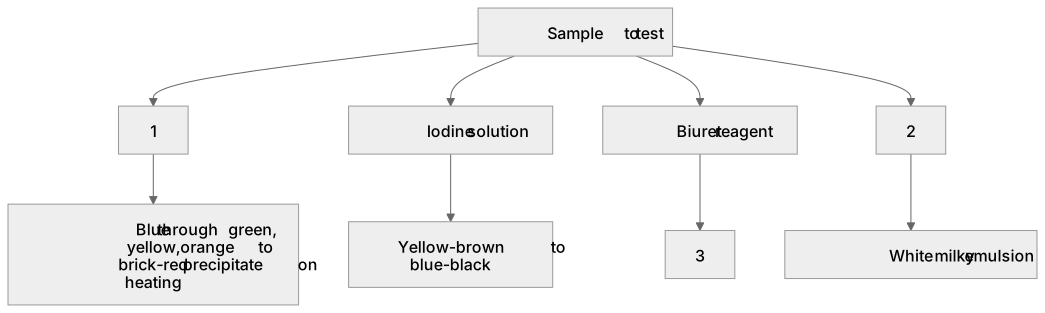
1Box 1
2Box 2
3Box 3
There is more to this lesson
The full lesson goes on to check your understanding and help you earn the marks. Create a free account to carry on, with your progress saved.
A week of Premium from your first lesson · Then the free plan continues · No card, no charge
Test your understanding of Testing for biological molecules: Use of appropriate techniques and qualitative reagents to identify biological molecules and processes in more complex and problem-solving contexts including continuous sampling in an investigation.
Active recall beats re-reading. Take an instant quiz now to test what you’ve learned and lock it into long-term memory.
A week of Premium from your first lesson · Then the free plan continues · No card, no charge