OCR · GCSE · Biology
Course version: J247 · Version from Sept 2018
The challenges of size: calculate surface area : volume ratios
Calculating surface area to volume (SA:V) ratios demonstrates how geometry changes with organism size.
- Point 1 of 14
- 3 key terms
Study notes
From the teaching notes for this specification point.
The idea
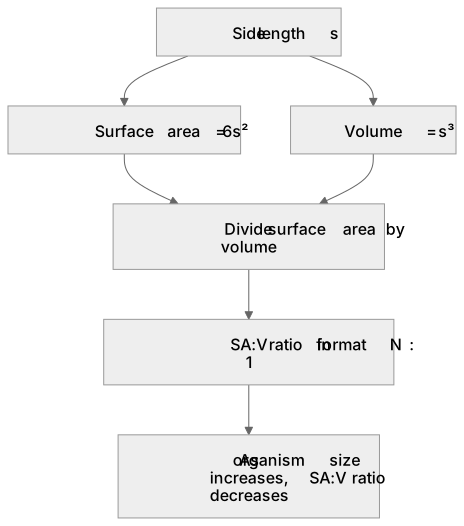
Calculating surface area to volume (SA:V) ratios demonstrates how geometry changes with organism size. For model cuboidal organisms of side length s, surface area is calculated as 6s² while volume is calculated as s³. Dividing surface area by volume yields the SA:V ratio, which is conventionally simplified to the format N : 1. As an organism increases in linear dimensions, volume expands as the cube of length while surface area increases only as the square. Consequently, larger organisms possess a substantially smaller SA:V ratio than smaller organisms, profoundly affecting heat loss and gas exchange.
What earns the marks
- Calculating total surface area correctly (such as 6 × side² for a cube).
- Calculating volume correctly (such as side³ for a cube).
- Expressing the surface area to volume ratio in the simplified format N : 1.
- Stating that as organism size increases, the surface area to volume ratio decreases.
Common mistakes and how to put them right
Reversing the ratio as volume to surface area instead of surface area to volume.
Failing to simplify the final ratio to the standard form N.
Put it right: 1 by dividing through by the volume.
Exam tips
- Always write out your steps: calculate total SA, calculate Volume, write SA:V, and divide both numbers by the Volume.
- Remember that smaller objects always have a larger SA:V ratio than larger objects of the same shape.
Try the lesson
The start of the The challenges of size: calculate surface area : volume ratios lesson, made from teaching notes for this specification point.
Have a go first
A cube-shaped block of agar has sides of length 4 mm. Calculate the surface area to volume ratio of the block in its simplest form.
Listen
Calculating surface area to volume (SA:V) ratios demonstrates how geometry changes with organism size. For model cuboidal organisms of side length s, surface area is calculated as 6s² while volume is calculated as s³. Dividing surface area by volume yields the SA:V ratio, which is conventionally simplified to the format N : 1. As an organism increases in linear dimensions, volume expands as the cube of length while surface area increases only as the square. Consequently, larger organisms possess a substantially smaller SA:V ratio than smaller organisms, profoundly affecting heat loss and gas exchange. A strong answer earns marks for these points. calculating total surface area correctly (such as 6 × side² for a cube). calculating volume correctly (such as side³ for a cube). expressing the surface area to volume ratio in the simplified format N : 1. stating that as organism size increases, the surface area to volume ratio decreases. Exam tip: Always write out your steps: calculate total SA, calculate Volume, write SA:V, and divide both numbers by the Volume.
See it
Key words
Say what each word means before you turn the card.
surface area to volume ratio
Try answering aloud or in your head before turning the card.
geometric calculations
Try answering aloud or in your head before turning the card.
scaling laws
Try answering aloud or in your head before turning the card.
See every definition
- surface area to volume ratio
- Dividing surface area by volume yields this ratio, which is conventionally simplified to the format N : 1.
- geometric calculations
- For model cuboidal organisms of side length s, surface area is calculated as 6s² while volume is calculated as s³.
- scaling laws
- As an organism increases in linear dimensions, volume expands as the cube of length while surface area increases only as the square.
Label the diagram
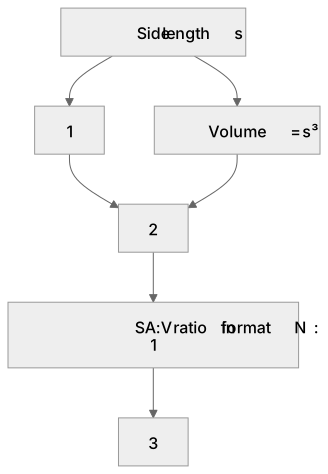
Some boxes have lost their names. Pick the right name for each number.
1Box 1
2Box 2
3Box 3
There is more to this lesson
The full lesson goes on to check your understanding and help you earn the marks. Create a free account to carry on, with your progress saved.
A week of Premium from your first lesson · Then the free plan continues · No card, no charge
Test your understanding of The challenges of size: calculate surface area : volume ratios
Active recall beats re-reading. Take an instant quiz now to test what you’ve learned and lock it into long-term memory.
A week of Premium from your first lesson · Then the free plan continues · No card, no charge