OCR · GCSE · Biology
Course version: J247 · Version from Sept 2018
Explain the effect of a variety of environmental factors on the rate of…
Full specification wording
The challenges of size: explain the effect of a variety of environmental factors on the rate of water uptake by a plant (to include: light intensity, air movement, and temperature)
Environmental factors directly modify transpiration rate, thereby altering the rate of root water uptake.
- Point 13 of 14
- 4 key terms
Study notes
From the teaching notes for this specification point.
The idea
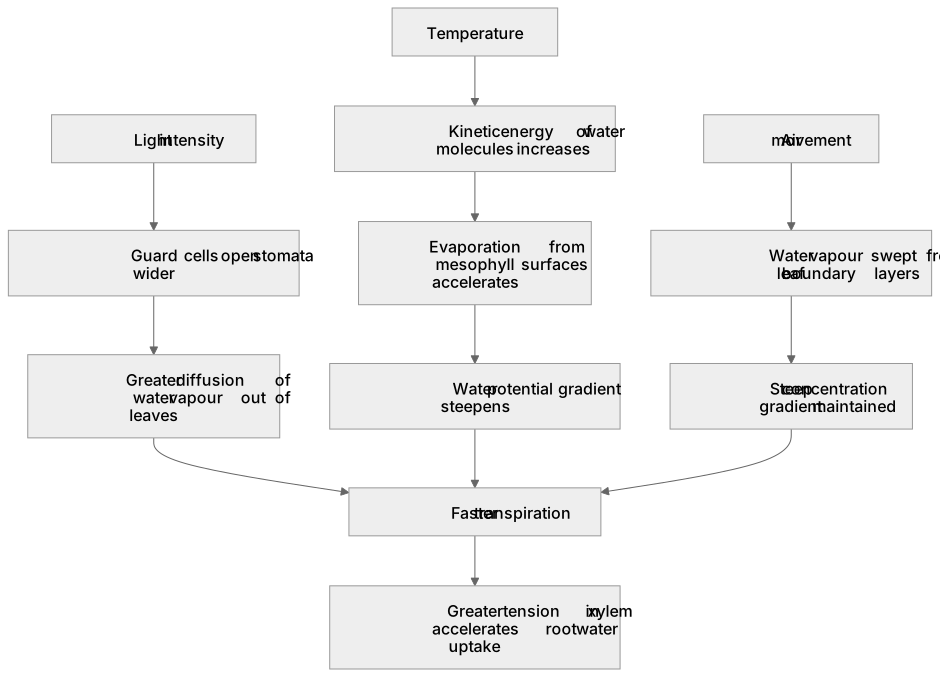
Environmental factors directly modify transpiration rate, thereby altering the rate of root water uptake. Increasing light intensity stimulates guard cells to open stomata wider to absorb carbon dioxide for photosynthesis, facilitating greater diffusion of water vapor out of leaves. Elevated temperature increases the kinetic energy of water molecules, accelerating evaporation from mesophyll surfaces and lowering surrounding relative humidity, steepening the water potential gradient. Increased air movement sweeps away accumulating water vapor from leaf boundary layers, maintaining a steep concentration gradient and driving faster transpiration.
What earns the marks
- Explaining that higher light intensity opens stomata wider, increasing water vapor diffusion and water uptake.
- Explaining that higher temperature increases kinetic energy and evaporation rate, steepening the diffusion gradient.
- Explaining that increased air movement removes water vapor from the leaf surface, maintaining a steep concentration gradient.
- Explaining that increased transpiration creates greater tension in xylem, accelerating root water uptake.
Common mistakes and how to put them right
Claiming wind dries out the plant without explaining the mechanism.
Put it right: Maintaining a steep concentration gradient.
Forgetting that light affects transpiration primarily by controlling stomatal opening and closure.
Exam tips
- Always explain the mechanism for each factor: light affects stomatal aperture; temperature increases kinetic energy; wind maintains steep gradient.
- Link transpiration rate directly to root water uptake: faster leaf water loss pulls more water into roots via xylem tension.
Try the lesson
The start of the The challenges of size: explain the effect of a variety of environmental factors on the rate of water uptake by a plant (to include: light intensity, air movement, and temperature) lesson, made from teaching notes for this specification point.
Have a go first
Which environmental factor would increase the rate of water uptake by a plant when it becomes brighter?
Listen
Environmental factors directly modify transpiration rate, thereby altering the rate of root water uptake. Increasing light intensity stimulates guard cells to open stomata wider to absorb carbon dioxide for photosynthesis, facilitating greater diffusion of water vapor out of leaves. Elevated temperature increases the kinetic energy of water molecules, accelerating evaporation from mesophyll surfaces and lowering surrounding relative humidity, steepening the water potential gradient. Increased air movement sweeps away accumulating water vapor from leaf boundary layers, maintaining a steep concentration gradient and driving faster transpiration. A strong answer earns marks for these points. explaining that higher light intensity opens stomata wider, increasing water vapor diffusion and water uptake. explaining that higher temperature increases kinetic energy and evaporation rate, steepening the diffusion gradient. explaining that increased air movement removes water vapor from the leaf surface, maintaining a steep concentration gradient. explaining that increased transpiration creates greater tension in xylem, accelerating root water uptake. Exam tip: Always explain the mechanism for each factor: light affects stomatal aperture; temperature increases kinetic energy; wind maintains steep gradient.
See it
Key words
Say what each word means before you turn the card.
transpiration rate
Try answering aloud or in your head before turning the card.
stomatal aperture
Try answering aloud or in your head before turning the card.
water potential gradient
Try answering aloud or in your head before turning the card.
boundary layer
Try answering aloud or in your head before turning the card.
See every definition
- transpiration rate
- The rate at which water vapour diffuses out of the leaves, which alters the rate of root water uptake.
- stomatal aperture
- The opening of the stomata, which light intensity alters by stimulating guard cells to open them wider.
- water potential gradient
- The gradient that is steepened when higher temperature lowers surrounding relative humidity, driving faster transpiration.
- boundary layer
- The layer at the leaf surface from which increased air movement sweeps away accumulating water vapour, maintaining a steep concentration gradient.
Label the diagram
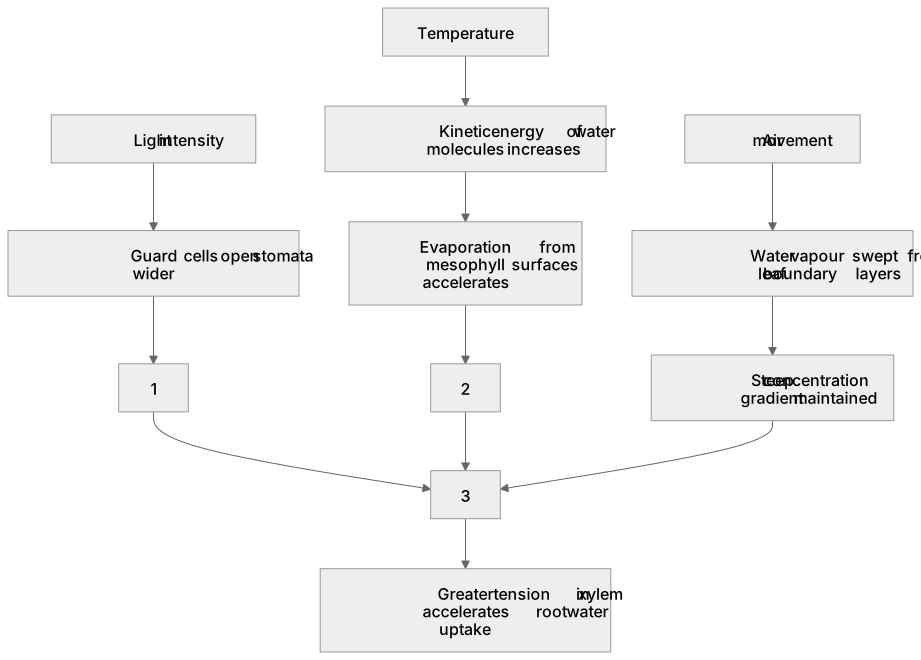
Some boxes have lost their names. Pick the right name for each number.
1Box 1
2Box 2
3Box 3
There is more to this lesson
The full lesson goes on to check your understanding and help you earn the marks. Create a free account to carry on, with your progress saved.
A week of Premium from your first lesson · Then the free plan continues · No card, no charge
Test your understanding of The challenges of size: explain the effect of a variety of environmental factors on the rate of water uptake by a plant (to include: light intensity, air movement, and temperature)
Active recall beats re-reading. Take an instant quiz now to test what you’ve learned and lock it into long-term memory.
A week of Premium from your first lesson · Then the free plan continues · No card, no charge