Study Notes
Overview
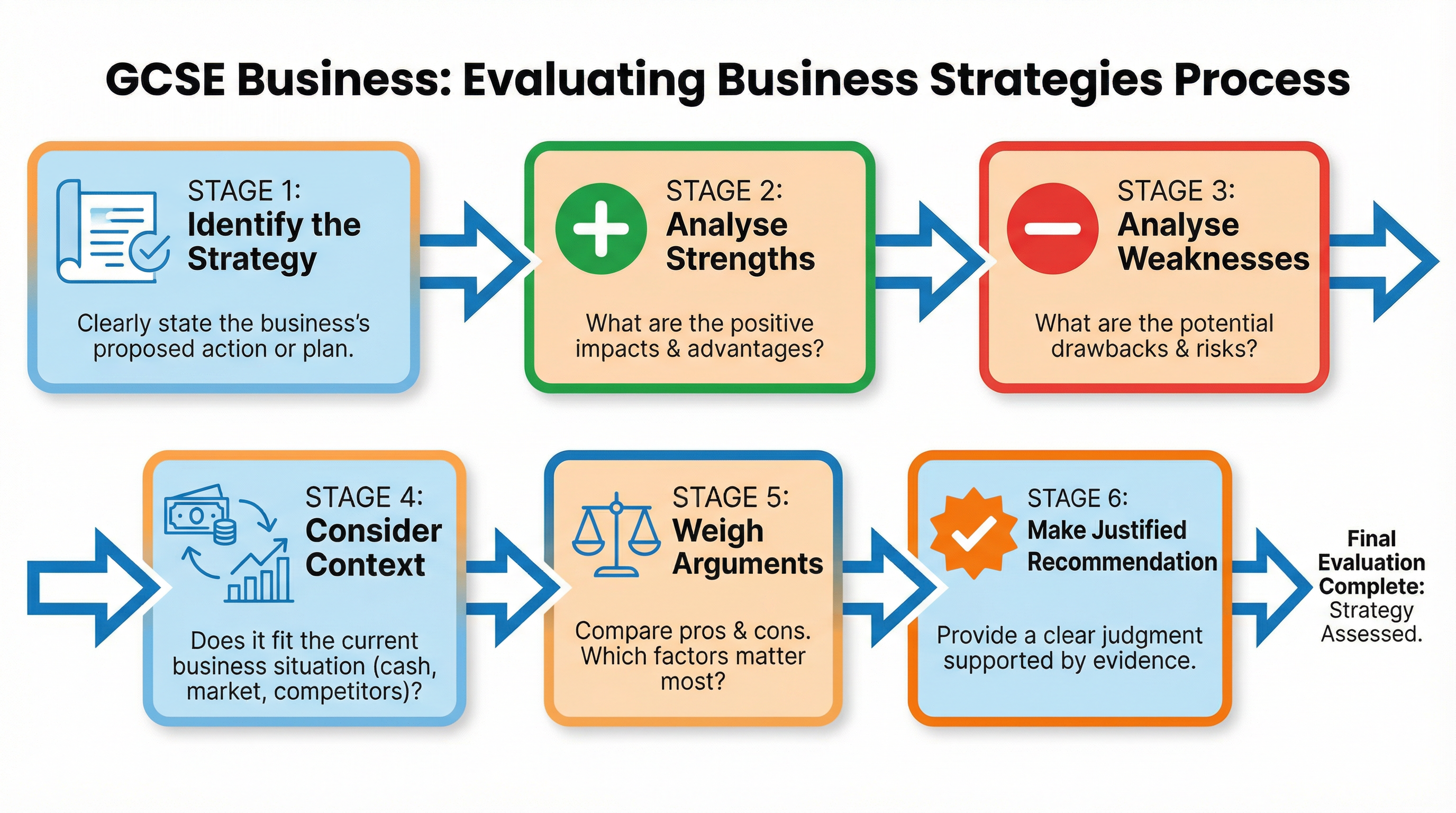
Analysing business strategy is a cornerstone of the AQA GCSE Business specification. It's not just about knowing the theories; it's about applying them to real-world scenarios presented in the exam's case studies (Items). Examiners are looking for candidates who can act like business consultants: dissecting a situation, weighing up the pros and cons of a proposed strategy, and providing a clear, justified recommendation. This involves a deep understanding of strategic models, the ability to connect actions to functional areas like finance and marketing (AO2), and the skill to build a logical, persuasive argument (AO3). This guide will equip you with the frameworks, techniques, and examiner insights needed to deconstruct any business strategy question and construct a Level 4 response.
Key Strategic Frameworks
SWOT Analysis
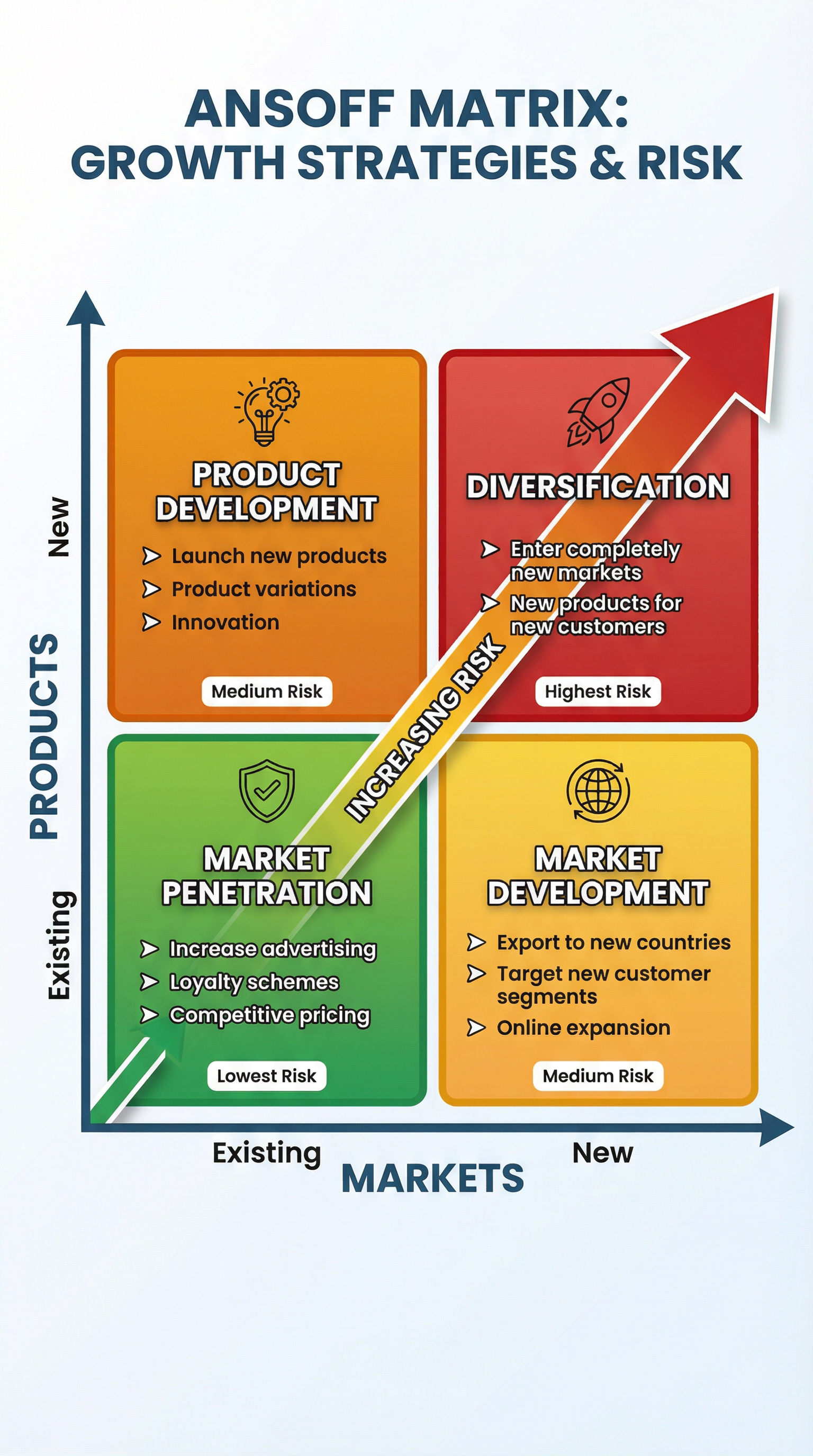
What it is: A framework for identifying a business's internal Strengths and Weaknesses, and the external Opportunities and Threats it faces. It is a foundational tool for strategic planning.
Why it matters: Examiners expect you to use the information in the case study to perform a SWOT analysis. You must categorise information correctly (internal vs. external) and then use this analysis to evaluate a strategic choice. For example, a strategy that plays to a business's strengths and exploits an opportunity is likely to be a good choice. Conversely, a strategy that exposes a key weakness to a major threat is likely to be a poor choice.
Specific Knowledge: You must be able to confidently distinguish between the four elements. Strengths and Weaknesses are about the business itself (e.g., its brand, finances, staff). Opportunities and Threats are about the world outside the business (e.g., the economy, competitors, technology, laws).
Ansoff Matrix
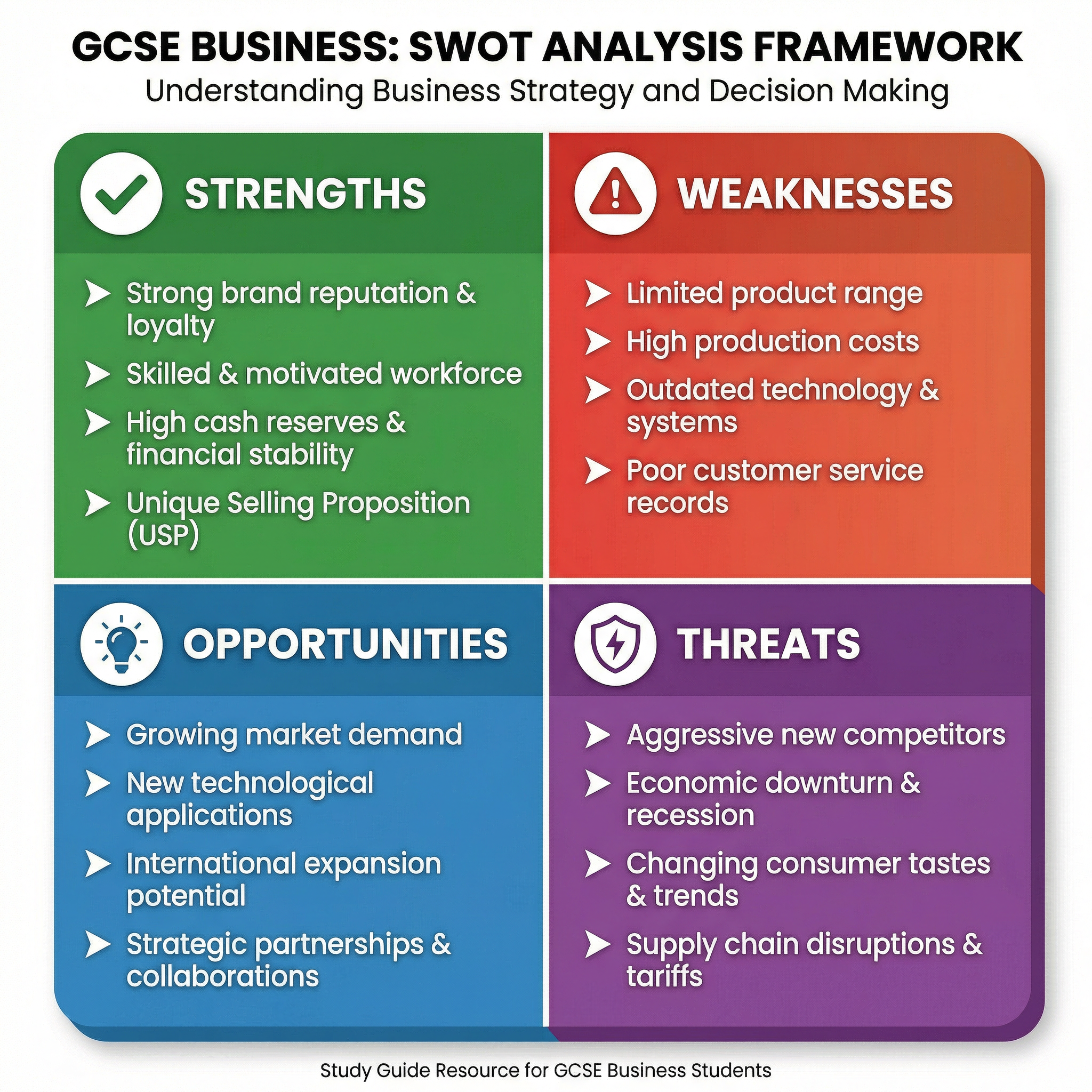
What it is: A growth matrix that outlines four potential strategies for business expansion, based on whether the business is offering new or existing products to new or existing markets.
Why it matters: This is the primary model for analysing growth strategies at GCSE. Questions will often centre on a business choosing one of these four paths. You need to understand the relative risks and rewards of each quadrant and apply them to the specific context of the business in the case study.
Specific Knowledge: Know the four quadrants by heart: Market Penetration (existing products, existing markets), Product Development (new products, existing markets), Market Development (existing products, new markets), and Diversification (new products, new markets). Crucially, you must understand the escalating risk associated with moving from penetration to diversification.
Second-Order Concepts in Strategy
Causation
Strategy is about cause and effect. A strategic decision (the cause) is expected to lead to a desired outcome (the effect), such as increased profit or market share. Your analysis must explain this chain of events. For example, launching a new marketing campaign (cause) doesn't automatically lead to higher profit. It leads to increased customer awareness, which may lead to higher sales volume, which increases revenue, and if the costs of the campaign are less than the additional profit generated, then overall profit will rise. You must connect these dots.
Consequence
A single strategic move can have multiple consequences, both positive and negative, across different parts of the business. For instance, a decision to lower prices (a cost leadership strategy) might boost sales volume (a positive consequence for the marketing function) but could also trigger a price war with competitors (a negative consequence) and reduce the gross profit margin on each unit sold (a negative consequence for the finance function). High-level analysis considers these conflicting consequences.
Change & Continuity
Strategic decisions are agents of change. They are designed to alter the business's position. However, some things may stay the same. A business might change its marketing strategy completely but keep its production methods the same (continuity). Understanding what is changing and what is not helps in evaluating the scale and risk of the strategy.
Significance
In evaluation, you must judge the significance of your arguments. Is a potential strength of a strategy more significant than its weakness? For example, the opportunity to gain a 'first-mover advantage' in a new market might be significant enough to outweigh the high initial costs. You must weigh these factors to reach a justified conclusion.
Source Skills for Strategy Questions
The primary source in a business exam is the Case Study or Item. This is not a historical document but a fictionalised business scenario packed with data and clues.
- Mine the Data: The case study is your evidence. Your answer MUST be grounded in it. If it mentions the business has £500,000 in the bank, you must use that fact when analysing a strategy that costs £400,000. This is how you score AO2 (Application) marks.
- Identify the Hooks: Look for specific details. Is it a Private Limited Company (Ltd)? This affects its ability to raise finance. Is it located in an area of high unemployment? This affects recruitment and wage costs. These are the 'hooks' you use to anchor your theoretical knowledge to the specific context.
- Read Between the Lines: Sometimes the case study implies things. If it says 'sales have been flat for three years', it implies that a strategy of market penetration might be difficult and a new approach is needed. This is inference, and it demonstrates a higher level of understanding.