Constructing and interpreting cash flow forecasts — AQA GCSE study guide illustration

    Constructing and interpreting cash flow forecasts

    AQA
    GCSE
    Business

    Mastering cash flow forecasts is your key to unlocking top marks in AQA GCSE Business. This guide will equip you with the skills to not only construct forecasts with precision but also to interpret them like a senior examiner, ensuring you can analyze business liquidity and evaluate solutions with confidence.

    5
    Min Read
    3
    Examples
    4
    Questions
    8
    Key Terms
    🎙 Podcast Episode
    Constructing and interpreting cash flow forecasts
    0:00-0:00

    Study Notes

    Mastering Cash Flow Forecasts for Exam Success

    Overview

    Cash flow forecasting is a fundamental skill in business management and a topic that AQA examiners scrutinize closely. A cash flow forecast is a forward-looking statement that predicts the cash movements (inflows and outflows) of a business over a future period. It is not just a mathematical exercise; it is a vital tool for decision-making, identifying potential liquidity problems, and ensuring business survival. Candidates are expected to demonstrate precision in constructing forecasts and, crucially, to provide insightful analysis of what the figures mean for the business. High marks are awarded to students who can distinguish between cash and profit, diagnose the causes of cash flow problems, and evaluate the suitability of different solutions within a specific business context. This guide will equip you to tackle calculation and analysis questions with confidence.

    The Core Components: Building a Cash Flow Forecast

    A cash flow forecast is built from several key components. Mastering these is the first step to earning marks.

    1. Cash Inflows

    What they are: All sources of cash received by the business. This is the money coming in.
    Examples:

    • Cash from sales to customers
    • Payments from debtors (customers who bought on credit)
    • Bank loans received
    • Owner's capital investment
    • Sale of assets

    2. Cash Outflows

    What they are: All cash payments made by the business. This is the money going out.
    Examples:

    • Payments to suppliers for materials
    • Rent, rates, and utility bills
    • Wages and salaries
    • Marketing costs
    • Purchasing new equipment (capital expenditure)
    • Loan repayments

    3. Net Cash Flow

    What it is: The difference between total cash inflows and total cash outflows for a specific period.
    The Formula: Net Cash Flow = Total Inflows - Total Outflows
    A positive net cash flow means more cash came in than went out. A negative net cash flow means the opposite, which can be a warning sign.

    4. Opening and Closing Balances

    Opening Balance: The amount of cash the business has at the start of the period.
    Closing Balance: The amount of cash the business has at the end of the period.
    The Crucial Formula: Closing Balance = Opening Balance + Net Cash Flow
    Examiner's Tip: The closing balance of one month becomes the opening balance for the next month. Forgetting this is a very common mistake that costs candidates easy marks.
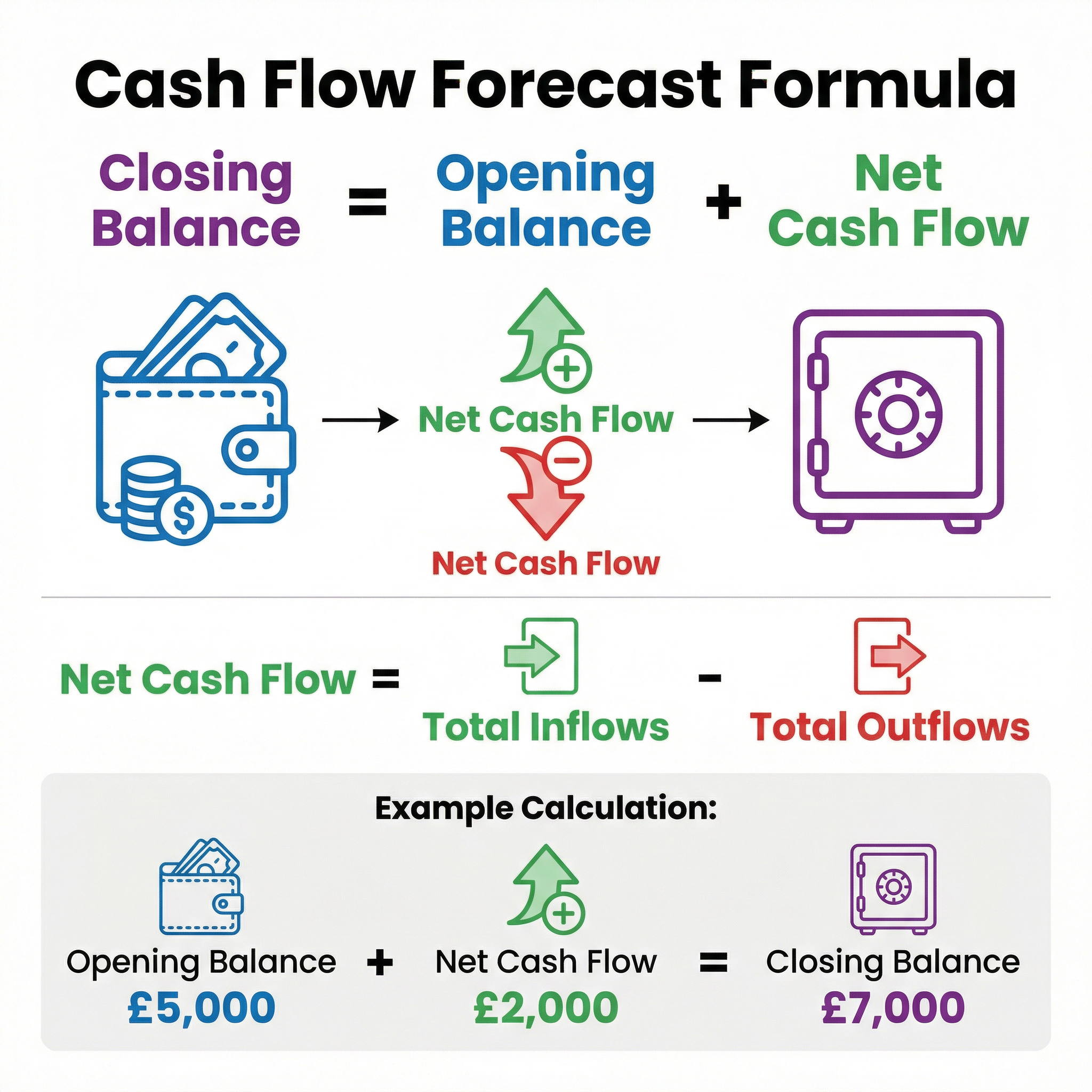
    The Core Cash Flow Formulas

    Cash vs. Profit: The Essential Distinction

    This is a concept that frequently separates high-achieving candidates from the rest. Examiners love to test this.
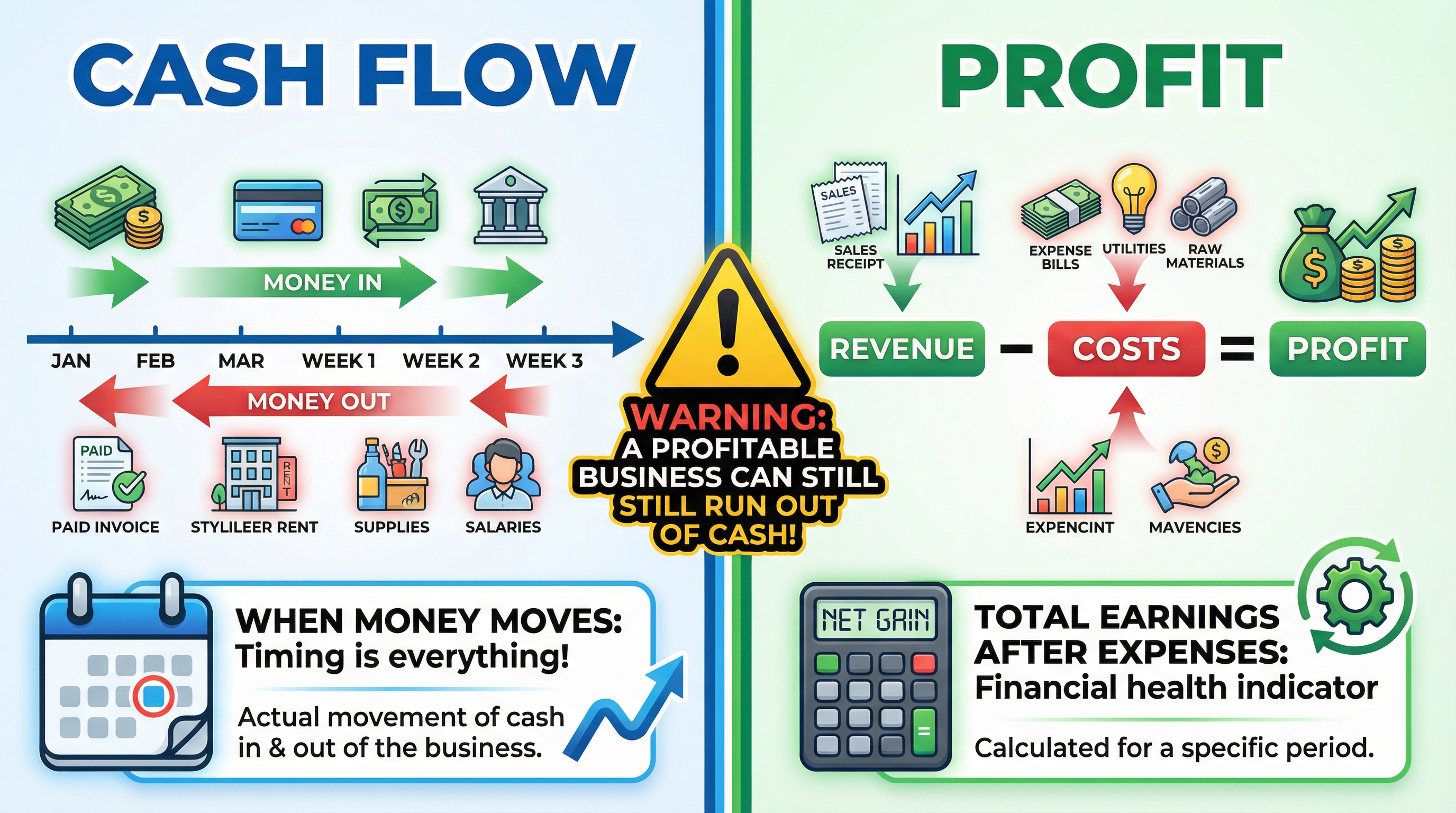
    Cash Flow vs. Profit: A Critical Distinction

    FeatureCash FlowProfit
    What it measuresThe actual movement of money in and out of a bank account.The surplus of revenue over costs (Revenue - Costs).
    TimingRecords money when it is actually received or paid.Records sales when they are made, not necessarily when the cash arrives (e.g., credit sales).
    FocusLiquidity and the ability to pay bills.Financial performance and efficiency.
    Key QuestionCan the business survive day-to-day?Is the business model successful over the long term?

    A business can be highly profitable but still face insolvency if it runs out of cash. For example, if it makes a large credit sale, profit is recorded immediately, but if the customer doesn't pay for 90 days, the business has no cash from that sale to pay its own bills.

    The Risk of Insolvency
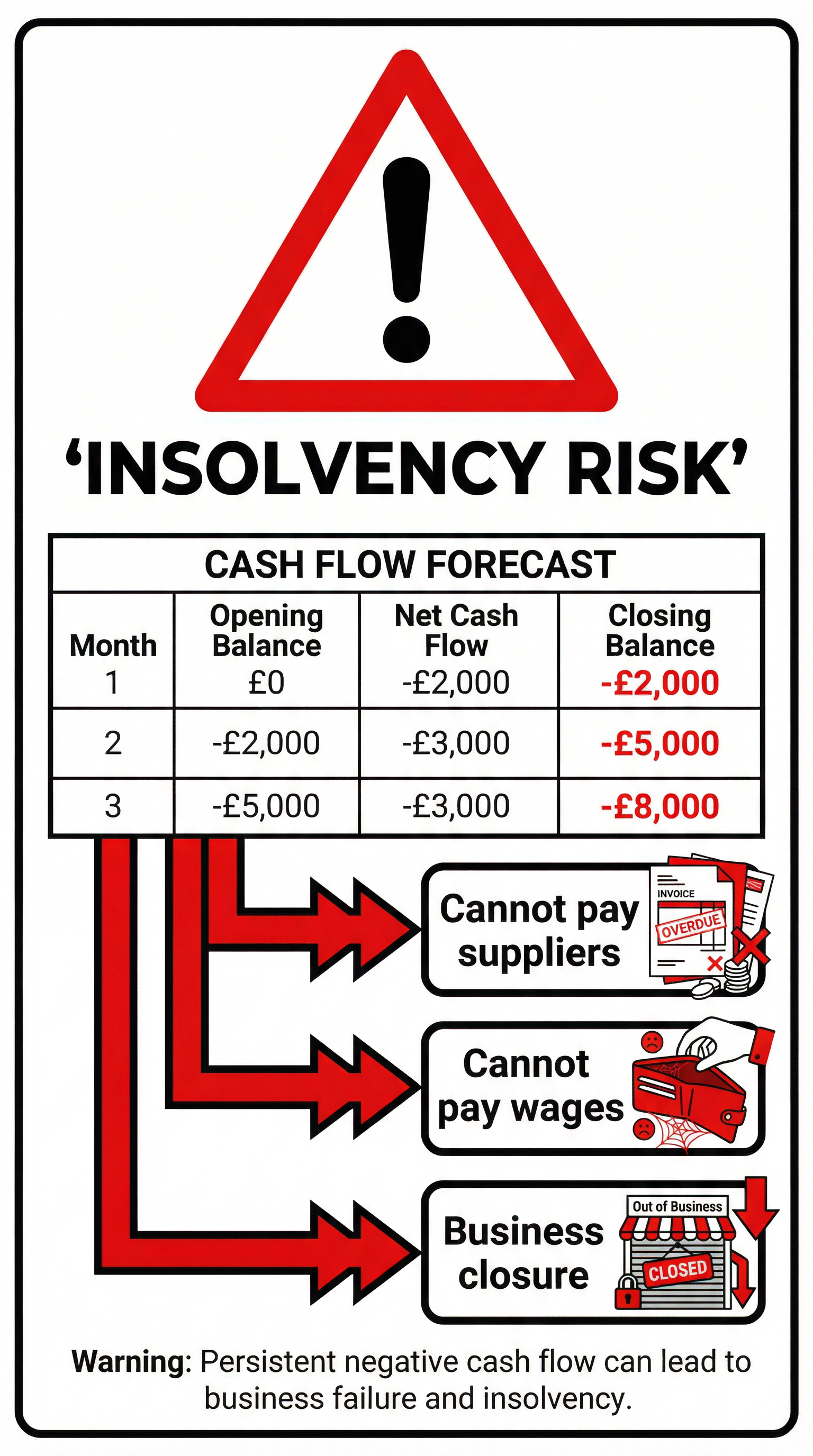
    Warning: The Risk of Insolvency

    When a business has persistent negative net cash flow and its closing balance becomes negative, it faces a liquidity crisis. If it cannot find the cash to pay its debts (like wages or supplier bills) as they fall due, it is insolvent. This is a primary cause of business failure. Examiners expect you to link a poor cash flow position directly to the risk of insolvency and business failure.

    Improving Cash Flow

    When a forecast predicts a cash shortfall, the business must act. Candidates need to suggest and evaluate suitable solutions.

    Reducing Outflows

    • Delay payments to suppliers: Negotiate for longer credit terms.
    • Cut costs: Reduce variable costs (e.g., find cheaper suppliers) or fixed costs (e.g., move to cheaper premises).
    • Lease instead of buy: Leasing assets reduces large initial cash outflows.
    • Reduce stock levels: Less cash is tied up in inventory (only for businesses holding stock).

    Increasing Inflows

    • Chase debtors: Encourage customers who owe money to pay faster.
    • Increase sales: Run a promotion to boost cash sales.
    • Arrange an overdraft: A short-term, flexible loan from the bank to cover temporary shortfalls.
    • Factoring: Sell invoices (debtors) to a factoring company for immediate cash, though at a discount.
    • Sell surplus assets: Generate cash from assets the business no longer needs.

    GCSE Business Revision Podcast: Cash Flow Forecasts

    Worked Examples

    3 detailed examples with solutions and examiner commentary

    Practice Questions

    Test your understanding — click to reveal model answers

    Q1

    A new coffee shop is due to open. In its first month (April), it forecasts sales revenue of £8,000. It expects to pay £3,000 for rent and £2,000 for supplies. The owner has invested £5,000 of their own money as an opening balance. Calculate the closing balance for April. (4 marks)

    4 marks
    standard

    Hint: Remember to calculate Net Cash Flow first, then use the closing balance formula. Don't forget the owner's investment is an inflow!

    Q2

    Explain one reason why a profitable business might run out of cash. (3 marks)

    3 marks
    standard

    Hint: Think about the timing difference between making a sale and receiving the money.

    Q3

    Analyse two impacts on a business of having a negative closing balance on its cash flow forecast. (6 marks)

    6 marks
    standard

    Hint: Think about the consequences for the business's relationships with its employees and suppliers.

    Q4

    A business has a negative net cash flow. Justify one method the business could use to improve its cash flow. (9 marks)

    9 marks
    hard

    Hint: Choose a method, explain how it works, apply it to a business context, and then evaluate its pros and cons to reach a justified conclusion.

    Key Terms

    Essential vocabulary to know

    More Business Study Guides

    View all

    Problems of growth

    WJEC
    GCSE

    This guide dissects the critical challenges businesses face during expansion, a key topic for WJEC GCSE Business. It moves beyond the simple idea that 'growth is good' to explore the real-world problems of diseconomies of scale and overtrading, providing the analytical skills needed to secure top marks.

    The role of technology in production

    OCR
    GCSE

    This study guide provides a comprehensive, exam-focused breakdown of the role of technology in production for OCR GCSE Business (J204). It moves beyond generic statements to deliver the specific analysis, evaluation, and contextual understanding required to achieve top marks.

    Extended Writing (Arguments, Judgements, Recommendations)

    Edexcel
    GCSE

    This study guide is your key to mastering the high-stakes extended writing questions in Edexcel GCSE Business. We'll deconstruct the 9-mark 'Justify' and 12-mark 'Evaluate' questions, giving you the examiner's perspective on how to build arguments, apply context, and make winning judgements to secure top marks.

    Evaluating Business Decisions

    Edexcel
    GCSE

    Master the art of making justified business decisions and ace your Edexcel GCSE Business exam. This guide breaks down the essential evaluation skills, from building powerful arguments to securing top marks in 12-mark questions, turning complex scenarios into a clear path to success.

    Making Operational Decisions

    Edexcel
    GCSE

    Making Operational Decisions is the practical heart of business operations, where candidates learn how businesses balance cost, quality, and speed to deliver goods and services. This topic is critical for Edexcel exams because it demands application to real business contexts and evaluation of trade-offs—skills that secure AO2 and AO3 marks worth 65% of your grade.

    Setting business aims and objectives

    OCR
    GCSE

    Setting business aims and objectives is the foundation of strategic planning and operational success. This topic explores how businesses translate broad ambitions into measurable targets using SMART criteria, how objectives vary by ownership type and life cycle stage, and how financial goals often conflict with non-financial priorities. Mastering this distinction is essential for exam success, as OCR examiners consistently reward candidates who apply context-specific objectives and demonstrate analytical chains of reasoning.