
Study Notes

Overview
Welcome to the study of Making Human Resource Decisions, a cornerstone of Edexcel GCSE Business Theme 2.5. This topic explores the critical role that employees play in a business and how managing them effectively is a key driver of success. Examiners expect candidates to move beyond simple definitions and demonstrate a strong understanding of how HR strategies directly impact operational efficiency, employee performance, and ultimately, profitability. You will be required to analyze the trade-offs of different HR approaches, such as the cost of an extensive training program versus the long-term benefit of increased productivity. The key to high marks is applying your knowledge specifically to the business context provided in the exam paper, using evidence to build a clear chain of reasoning and make justified evaluations.
Key Concepts & Developments
Organisational Structures
What it is: The way a business arranges its staff to represent authority and communication. This includes concepts like chain of command, span of control, and delegation.
Why it matters: The structure of a business dictates how efficiently it operates. A poor structure can lead to slow communication, low morale, and unclear roles. Examiners will test your ability to analyze the pros and cons of different structures and recommend changes based on a business's situation.
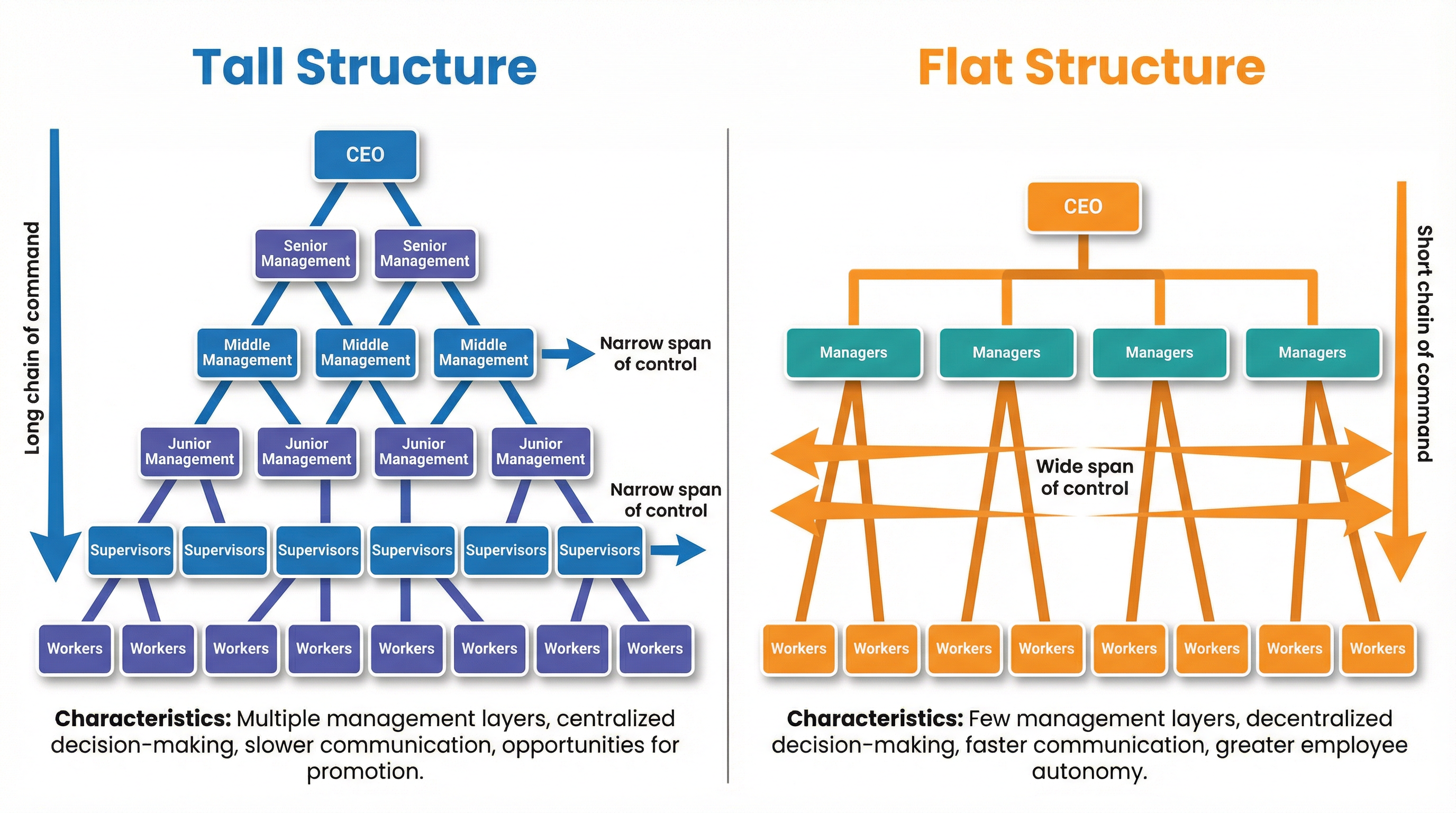
Specific Knowledge: You must be able to distinguish between tall and flat structures. A tall structure has many layers of management (a long chain of command) and a narrow span of control. A flat structure has few layers and a wide span of control. Delayering is the process of removing layers of management to create a flatter structure.
Recruitment and Selection
What it is: The process of finding and hiring the best candidate for a job. This involves creating job descriptions, advertising vacancies, shortlisting applicants, and conducting interviews.
Why it matters: Getting recruitment wrong is costly. A poor hire can lead to low productivity, poor customer service, and high staff turnover. Effective recruitment ensures the business has the right people with the right skills.
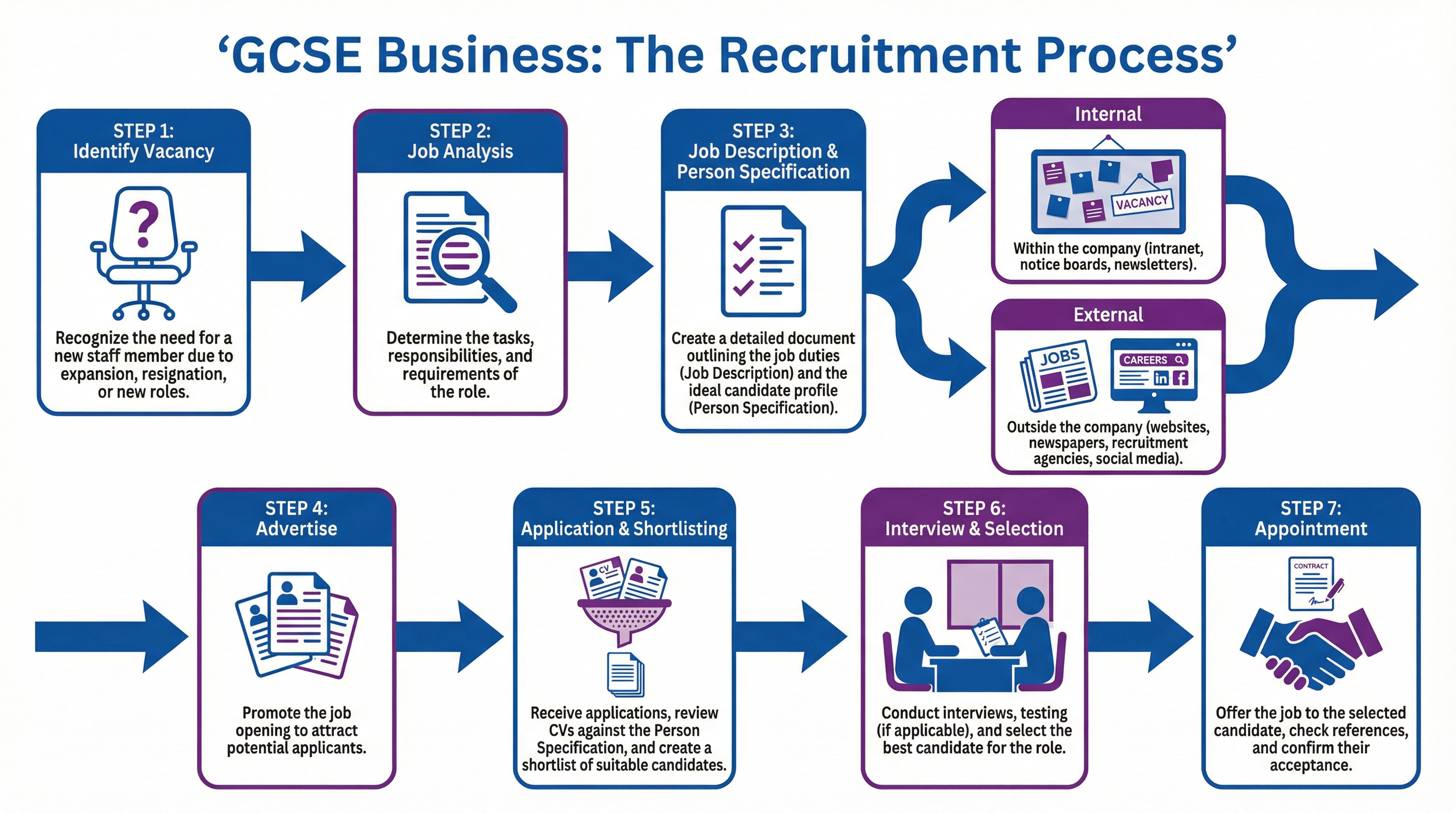
Specific Knowledge: You must know the difference between internal recruitment (hiring from within the business) and external recruitment (hiring from outside). You should also understand the key stages of the recruitment process, from identifying a vacancy to making an appointment.
Training and Development
What it is: The process of improving an employee's skills and knowledge. This can be done through on-the-job training (e.g., mentoring, shadowing) or off-the-job training (e.g., courses, qualifications).
Why it matters: Training is an investment. A well-trained workforce is more productive, makes fewer mistakes, and provides better customer service. It also increases employee motivation and retention. Examiners will expect you to weigh the costs of training against its benefits.
Specific Knowledge: Be able to compare and contrast on-the-job and off-the-job training methods, analyzing their suitability for different business scenarios. Understand that training is not just for new employees but is an ongoing process of development.
Motivation
What it is: The factors that influence the way a person behaves. In a business context, it's about encouraging employees to work hard and effectively.
Why it matters: A motivated workforce is a productive workforce. Motivated employees are more engaged, more committed, and more likely to go the extra mile for the business. This leads to higher output, better quality, and increased profitability.
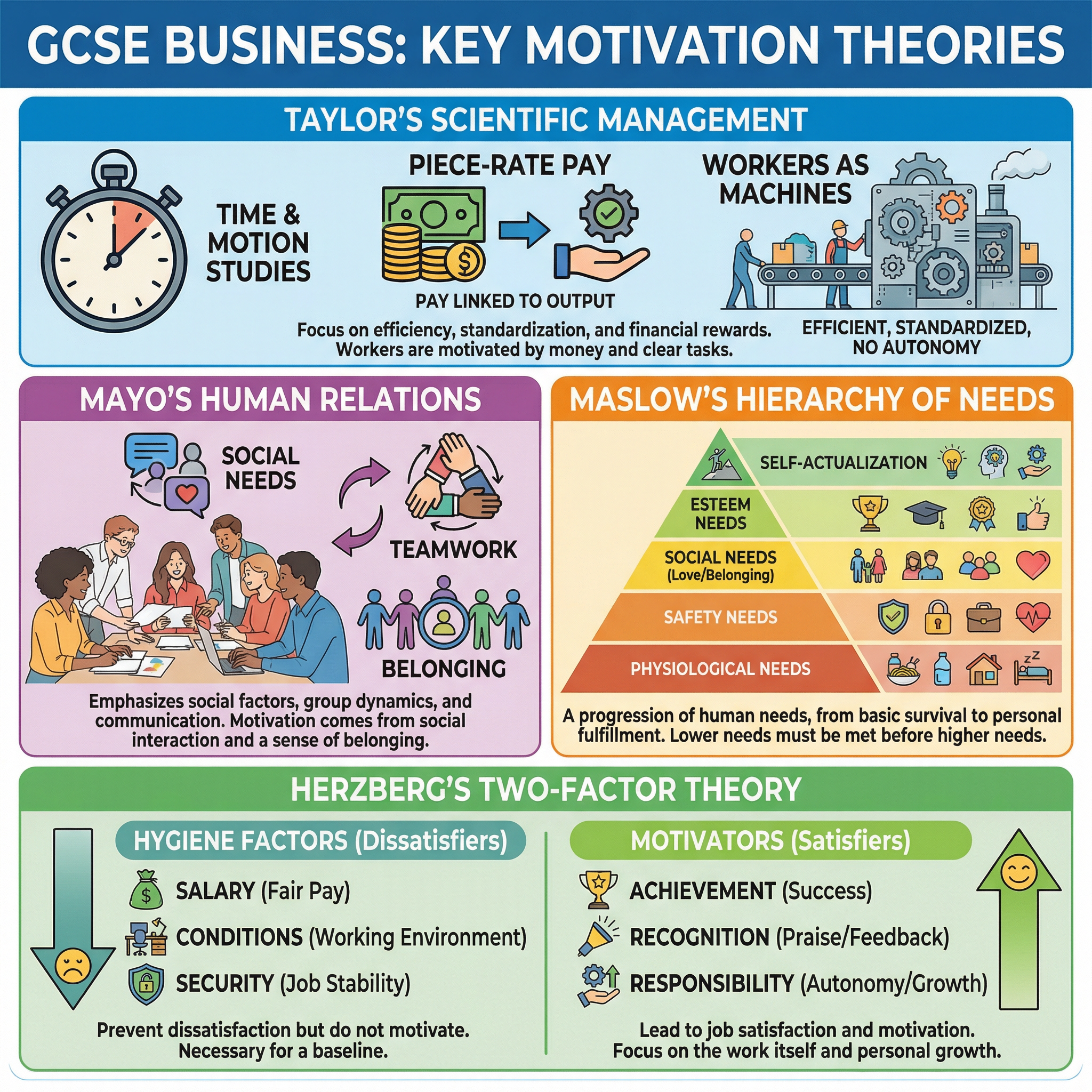
Specific Knowledge: You must be familiar with key motivation theories: Taylor (Scientific Management - motivation through pay), Mayo (Human Relations - motivation through social factors), Maslow (Hierarchy of Needs), and Herzberg (Two-Factor Theory). You also need to be able to analyze various financial (e.g., salary, bonus, commission) and non-financial (e.g., job rotation, autonomy, praise) methods of motivation.
Second-Order Concepts
Causation
HR decisions are a chain of cause and effect. For example, a decision to delayer (cause) leads to a wider span of control for managers (effect). This can cause managers to become overworked (cause), leading to a fall in team morale and productivity (effect). Your analysis must connect these chains of reasoning.
Consequence
Every HR decision has both positive and negative consequences. External recruitment brings in new ideas but is expensive. On-the-job training is cheap but can pass on bad habits. Your evaluation must weigh these consequences to reach a justified conclusion.
Change & Continuity
Businesses are constantly changing, and their HR needs change with them. A small startup may have a very informal, flat structure, but as it grows, it may need to introduce more formal structures and processes. However, the fundamental need to motivate and retain good staff remains constant.
Significance
Why does HR matter so much? Because in most businesses, employees are both the biggest cost and the biggest asset. Effective HR management can be a significant source of competitive advantage. A business that can recruit, train, and motivate the best people will outperform its rivals.
Named Example Bank
-
Amazon Warehouses - Piece-Rate Pay: Amazon has used performance metrics and productivity targets in its warehouses, closely aligned with Taylor's Scientific Management. Workers are monitored on speed and accuracy, with pay linked to output. This has led to high productivity but also criticism over working conditions and employee wellbeing.
-
Google - Non-Financial Motivation: Google is famous for its employee perks and focus on non-financial motivation methods. These include flexible working, creative workspaces, opportunities for personal projects (20% time), and a focus on autonomy and innovation. This aligns with Herzberg's motivators and has helped Google attract and retain top talent.
-
John Lewis Partnership - Employee Ownership: John Lewis operates as a partnership where all employees are co-owners. This creates strong motivation through profit-sharing and a sense of belonging. Staff turnover is significantly lower than the retail industry average, demonstrating the power of non-financial motivation.
-
McDonald's - Structured Training Programme: McDonald's uses a combination of on-the-job training (learning by doing in restaurants) and off-the-job training (Hamburger University for management development). This ensures consistency across thousands of locations worldwide and provides clear career progression paths.
-
Zappos - Cultural Fit Recruitment: The online retailer Zappos is known for its rigorous recruitment process that prioritizes cultural fit over skills. They even offer new hires $2,000 to quit after the first week if they don't feel the culture is right. This external recruitment strategy ensures only highly motivated, culturally aligned employees stay with the business.