
Making the Business Effective — Edexcel GCSE study guide illustration

    Making the Business Effective

    Edexcel
    GCSE
    Business

    Master the financial heart of any business with this guide to Edexcel GCSE Business Topic 2.4: Making the Business Effective. This guide will equip you with the essential skills to calculate and interpret key financial ratios, turning you into a sharp, analytical business mind who can justify strategic decisions and secure top marks in your exam.

    4
    Min Read
    3
    Examples
    5
    Questions
    6
    Key Terms
    🎙 Podcast Episode
    Making the Business Effective
    0:00-0:00

    Study Notes

    Making the Business Effective: Key Financial Indicators

    Overview

    Welcome to one of the most critical topics in your GCSE Business course: Making the Business Effective. This section, part of Edexcel Theme 2, moves beyond ideas and into the numbers that prove whether a business is truly successful. Examiners expect candidates to demonstrate strong financial literacy, not just by calculating key ratios, but by using them to analyze performance and evaluate strategic options. You will be expected to calculate and interpret Gross Profit Margin (GPM), Net Profit Margin (NPM), and Average Rate of Return (ARR). A strong performance in this area requires you to connect the numbers to the business context (AO2) and use them to build persuasive arguments (AO3). This guide will break down these concepts, provide clear worked examples, and show you how to think like a senior examiner to maximize your marks.

    Key Concepts: Profitability Ratios

    Gross Profit and Gross Profit Margin (GPM)

    What it is: Gross Profit is the profit a business makes from buying and selling goods, before any other costs are taken into account. The Gross Profit Margin (GPM) turns this into a percentage, showing how much gross profit is generated for every £1 of revenue.

    Formula: Gross Profit = Revenue - Cost of Sales
    Formula: GPM = (Gross Profit / Revenue) * 100

    Why it matters: GPM is a crucial indicator of a business's core operational efficiency. It reveals how well a company is managing the direct costs associated with producing its goods or services. A falling GPM might indicate that the cost of raw materials is rising, or that the business has been forced to lower its prices due to competitive pressure. Examiners award credit for candidates who can identify these specific operational causes.
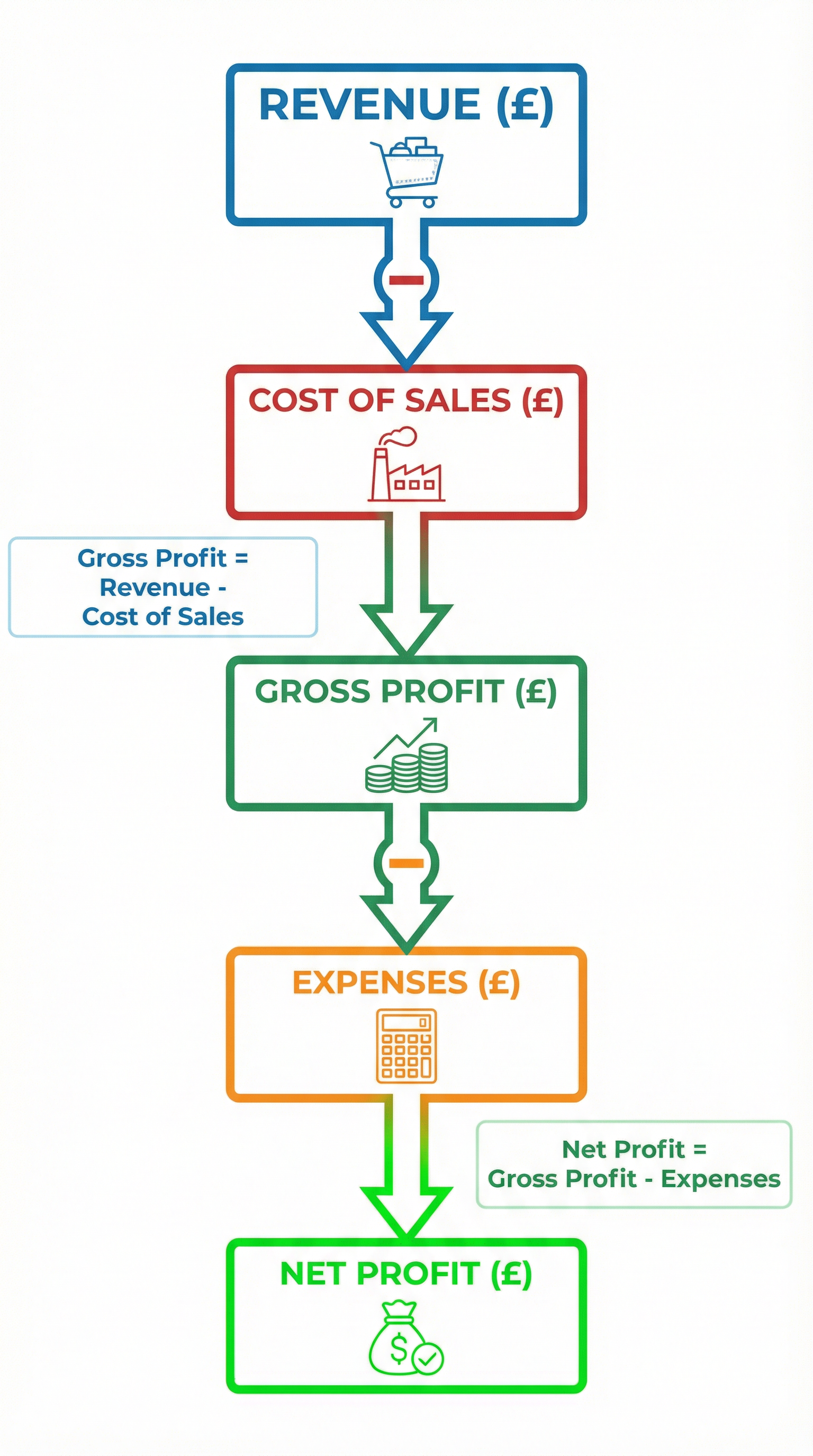
    From Revenue to Net Profit

    Net Profit and Net Profit Margin (NPM)

    What it is: Net Profit is the final profit left after all costs—including operating expenses, interest, and taxes—have been deducted from revenue. The Net Profit Margin (NPM) expresses this as a percentage of revenue.

    Formula: Net Profit = Gross Profit - Other Operating Expenses and Interest
    Formula: NPM = (Net Profit / Revenue) * 100

    Why it matters: NPM provides a comprehensive measure of a business's overall profitability. While GPM focuses on production efficiency, NPM accounts for all aspects of a company's financial health, including its management of overheads like rent, marketing, and administrative salaries. A business could have a healthy GPM but a poor NPM, indicating that its operating expenses are too high. Examiners look for this kind of nuanced analysis.
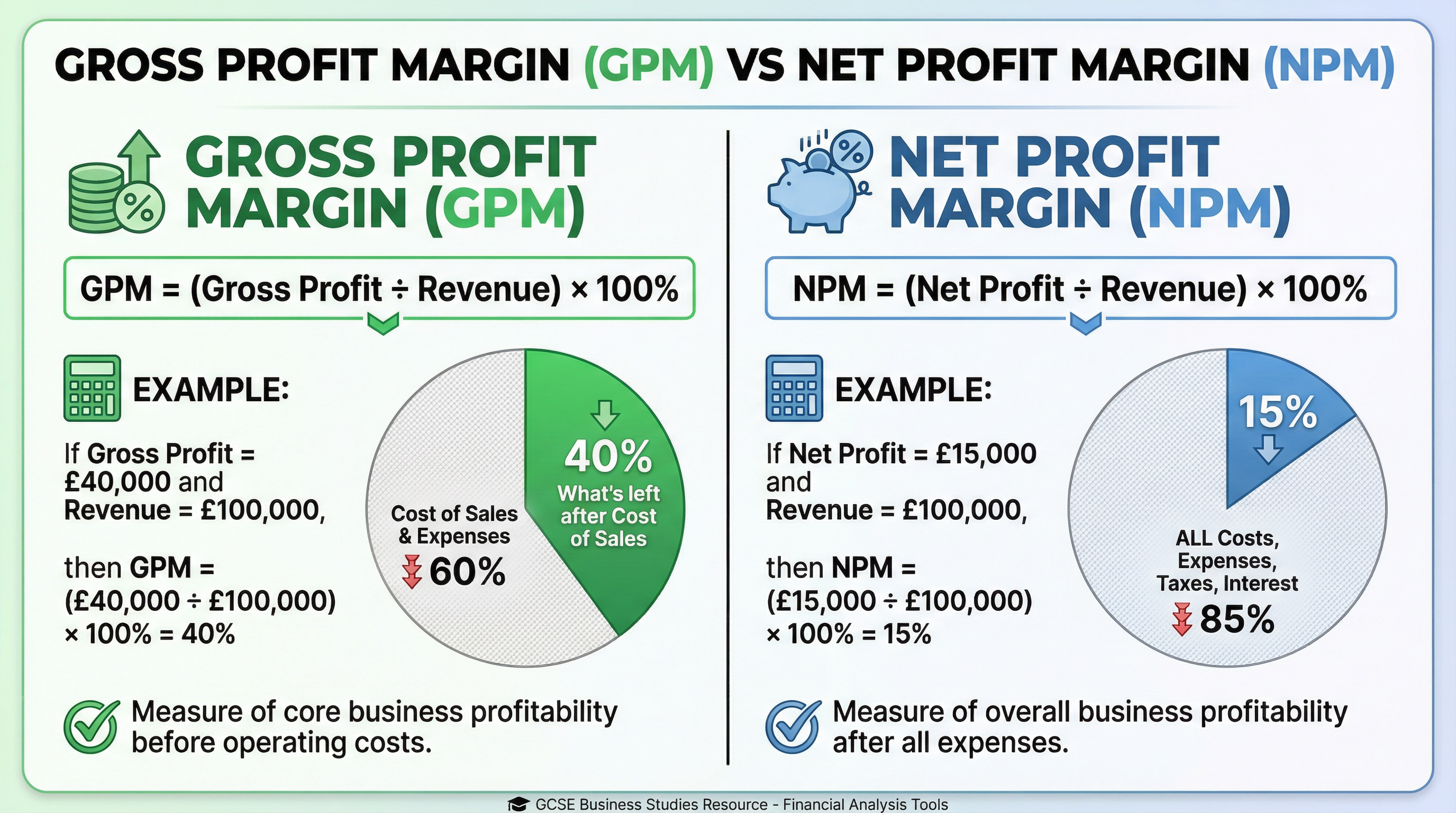
    GPM vs NPM: What's the Difference?

    Key Concepts: Investment Appraisal

    Average Rate of Return (ARR)

    What it is: ARR is a method used to assess the profitability of a potential investment. It calculates the average annual profit an investment is expected to generate as a percentage of the initial cost of that investment.

    Formula: ARR = (Average Annual Profit / Initial Investment) * 100
    To find Average Annual Profit, you calculate: (Total Profit over the project's life) / (Number of years)

    Why it matters: Businesses use ARR to compare different investment opportunities and decide which one is likely to be the most profitable. For your exam, you will be expected to calculate ARR for different scenarios and use your findings to justify a choice. However, a high-level evaluation (for 9- and 12-mark questions) will also consider the limitations of ARR. For instance, it doesn't account for the timing of cash flows (unlike the Net Present Value method you might encounter at A-Level) and it relies on profit forecasts, which can be inaccurate.
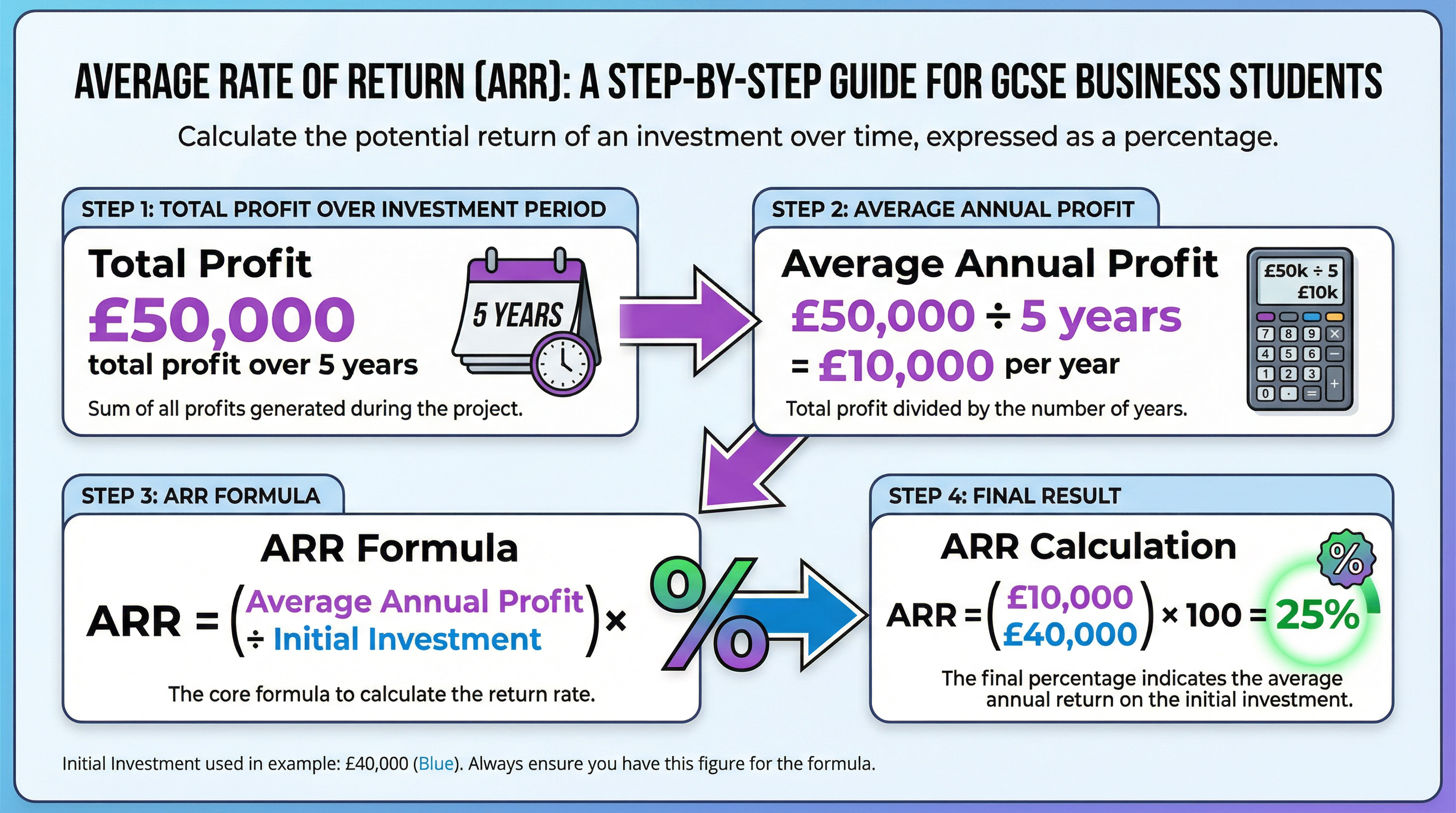
    How to Calculate Average Rate of Return (ARR)

    Worked Examples

    3 detailed examples with solutions and examiner commentary

    Practice Questions

    Test your understanding — click to reveal model answers

    Q1

    In 2022, a business had revenue of £500,000, gross profit of £200,000 and net profit of £50,000. Calculate the Gross Profit Margin and Net Profit Margin for 2022. (4 marks)

    4 marks
    standard

    Hint: Remember to use the correct formulas and express your answers as percentages.

    Q2

    A business is forecast to have a GPM of 30% and an NPM of 28%. Comment on these figures. (3 marks)

    3 marks
    hard

    Hint: Think about the relationship between the two margins.

    Q3

    Explain two strategies a business could use to improve its Net Profit Margin. (4 marks)

    4 marks
    standard

    Hint: Think about both increasing revenue and decreasing costs (both direct and indirect).

    Q4

    An investment of £50,000 is expected to yield total profits of £30,000 over a 5-year period. What is the ARR? (3 marks)

    3 marks
    standard

    Hint: This is a two-step calculation. First find the average annual profit.

    Q5

    Evaluate the usefulness of ARR as a method of investment appraisal for a new start-up business. (12 marks)

    12 marks
    hard

    Hint: Consider both the strengths and weaknesses of ARR, especially in the context of a start-up.

    Key Terms

    Essential vocabulary to know

    More Business Study Guides

    View all

    Problems of growth

    WJEC
    GCSE

    This guide dissects the critical challenges businesses face during expansion, a key topic for WJEC GCSE Business. It moves beyond the simple idea that 'growth is good' to explore the real-world problems of diseconomies of scale and overtrading, providing the analytical skills needed to secure top marks.

    The role of technology in production

    OCR
    GCSE

    This study guide provides a comprehensive, exam-focused breakdown of the role of technology in production for OCR GCSE Business (J204). It moves beyond generic statements to deliver the specific analysis, evaluation, and contextual understanding required to achieve top marks.

    Extended Writing (Arguments, Judgements, Recommendations)

    Edexcel
    GCSE

    This study guide is your key to mastering the high-stakes extended writing questions in Edexcel GCSE Business. We'll deconstruct the 9-mark 'Justify' and 12-mark 'Evaluate' questions, giving you the examiner's perspective on how to build arguments, apply context, and make winning judgements to secure top marks.

    Evaluating Business Decisions

    Edexcel
    GCSE

    Master the art of making justified business decisions and ace your Edexcel GCSE Business exam. This guide breaks down the essential evaluation skills, from building powerful arguments to securing top marks in 12-mark questions, turning complex scenarios into a clear path to success.

    Making Operational Decisions

    Edexcel
    GCSE

    Making Operational Decisions is the practical heart of business operations, where candidates learn how businesses balance cost, quality, and speed to deliver goods and services. This topic is critical for Edexcel exams because it demands application to real business contexts and evaluation of trade-offs—skills that secure AO2 and AO3 marks worth 65% of your grade.

    Setting business aims and objectives

    OCR
    GCSE

    Setting business aims and objectives is the foundation of strategic planning and operational success. This topic explores how businesses translate broad ambitions into measurable targets using SMART criteria, how objectives vary by ownership type and life cycle stage, and how financial goals often conflict with non-financial priorities. Mastering this distinction is essential for exam success, as OCR examiners consistently reward candidates who apply context-specific objectives and demonstrate analytical chains of reasoning.