OCR · GCSE · Business
Course version: J204 · Version from Sept 2019
The economic climate
Master the economic climate—the external 'weather' that businesses cannot control but must survive. Learn exactly how changing consumer incomes and unemployment levels dictate business strategy, demand, and survival, securing crucial marks in your GCSE Business exam.
- 4 min read
- 3 worked examples
- 5 practice questions
- 6 key terms
Check what you remember
Read the wording for your board, then hide it and explain Economic Climate in your own words. Rough notes are fine. This is a self-check, with no mark or grade.
Reference: OCR
The overall state of the economy, including factors like employment levels, consumer income, and inflation.
Study Notes
Overview
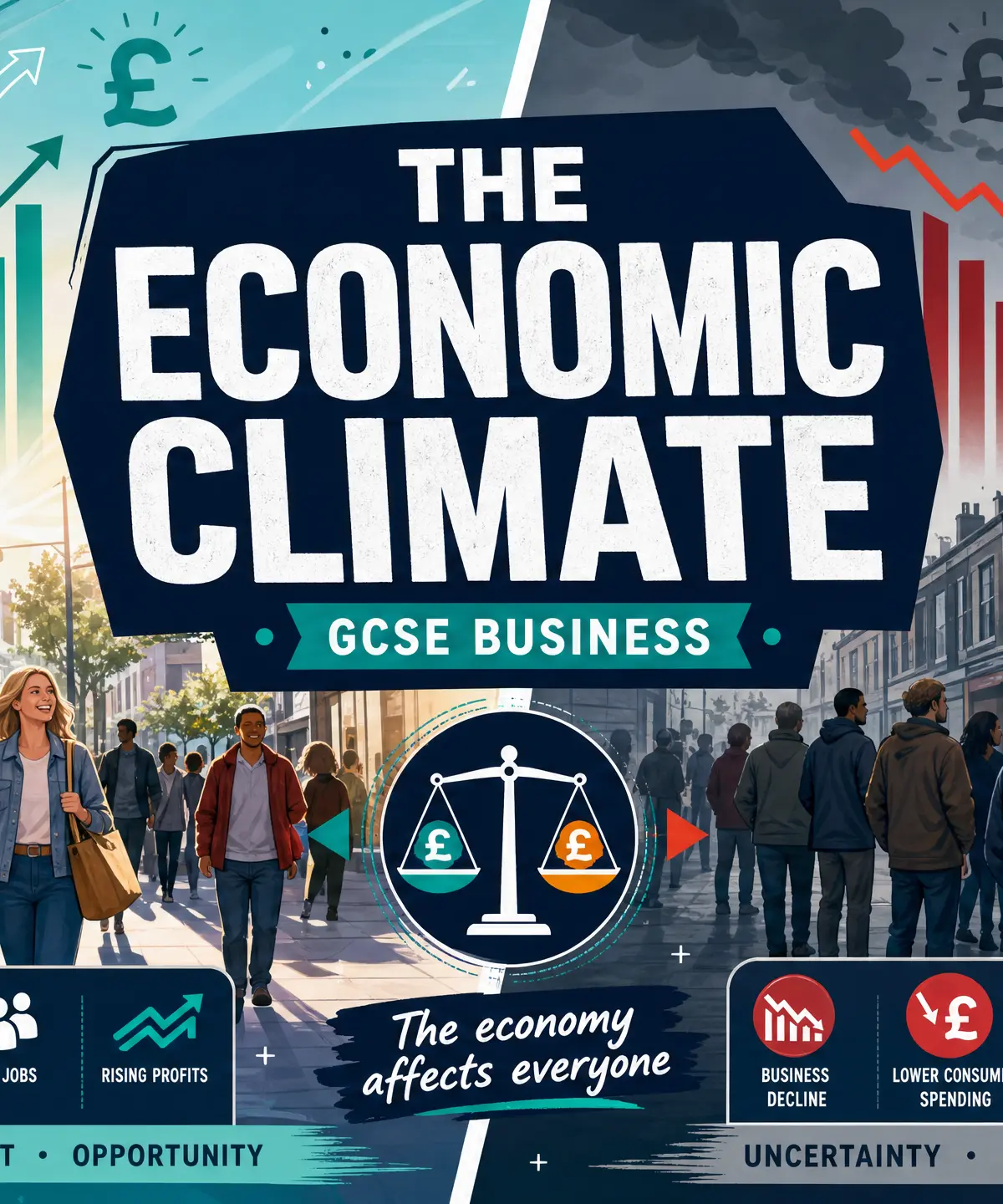
The economic climate is a vital external influence on business activity. Just as a ship's captain cannot control the weather but must navigate through it, a business cannot control the economy but must adapt its strategy to survive and thrive. Examiners frequently test your understanding of this topic because it requires you to connect macroeconomic concepts (like consumer income and unemployment) to microeconomic business decisions (like pricing, staffing, and expansion).
In your exam, you will be expected to explain how a change in the economic climate affects a business, and evaluate which strategic response is most appropriate. A common pitfall is treating all businesses the same—a luxury car dealership will react very differently to a recession than a budget supermarket. Strong candidates always apply their economic knowledge to the specific business context provided in the case study.
Listen to our revision podcast to reinforce your understanding:
Key Concept 1: Consumer Income
Definition: The amount of money households have available to spend after taxes and essential bills (disposable income).
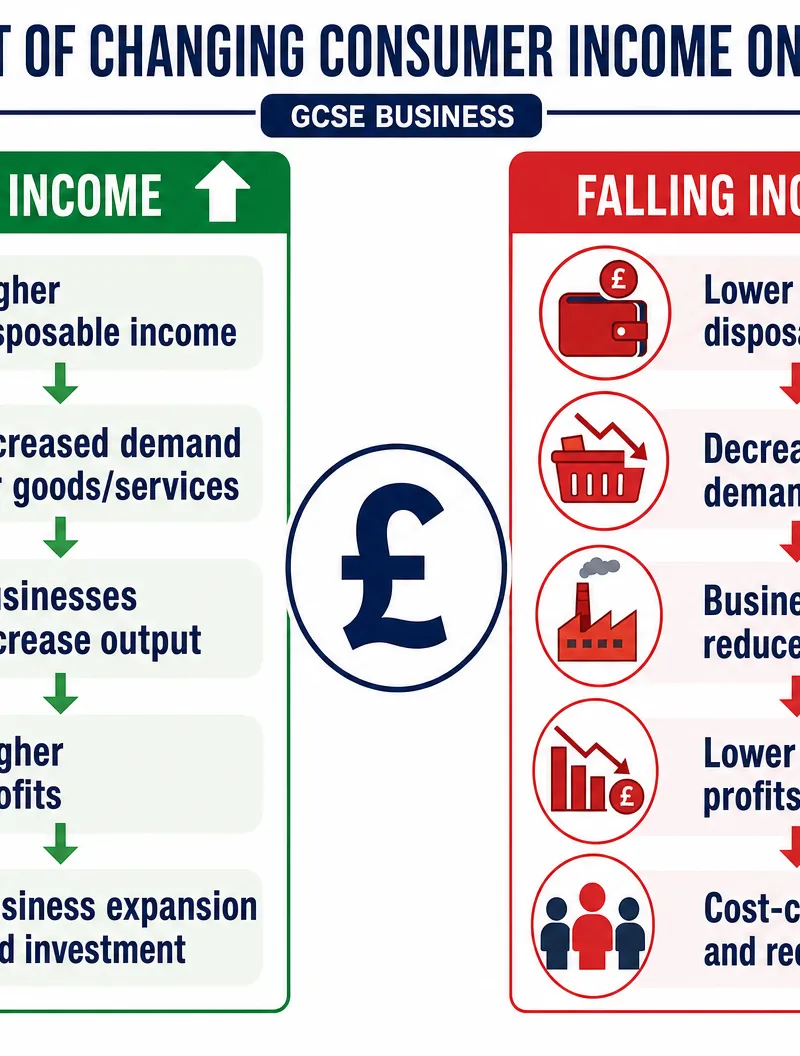
Rising Consumer Income (Economic Boom):
When the economy is growing, wages rise and unemployment falls. Consumers have more disposable income.
- Impact on Demand: Demand for most goods and services increases.
- Business Response: Businesses may increase output, raise prices slightly, expand operations, and launch new products.
- Specific Knowledge: Not all goods benefit. Normal goods (e.g., restaurant meals, new cars) see demand rise. However, inferior goods (e.g., own-brand supermarket beans, budget holidays) may see demand fall as consumers switch to premium alternatives.
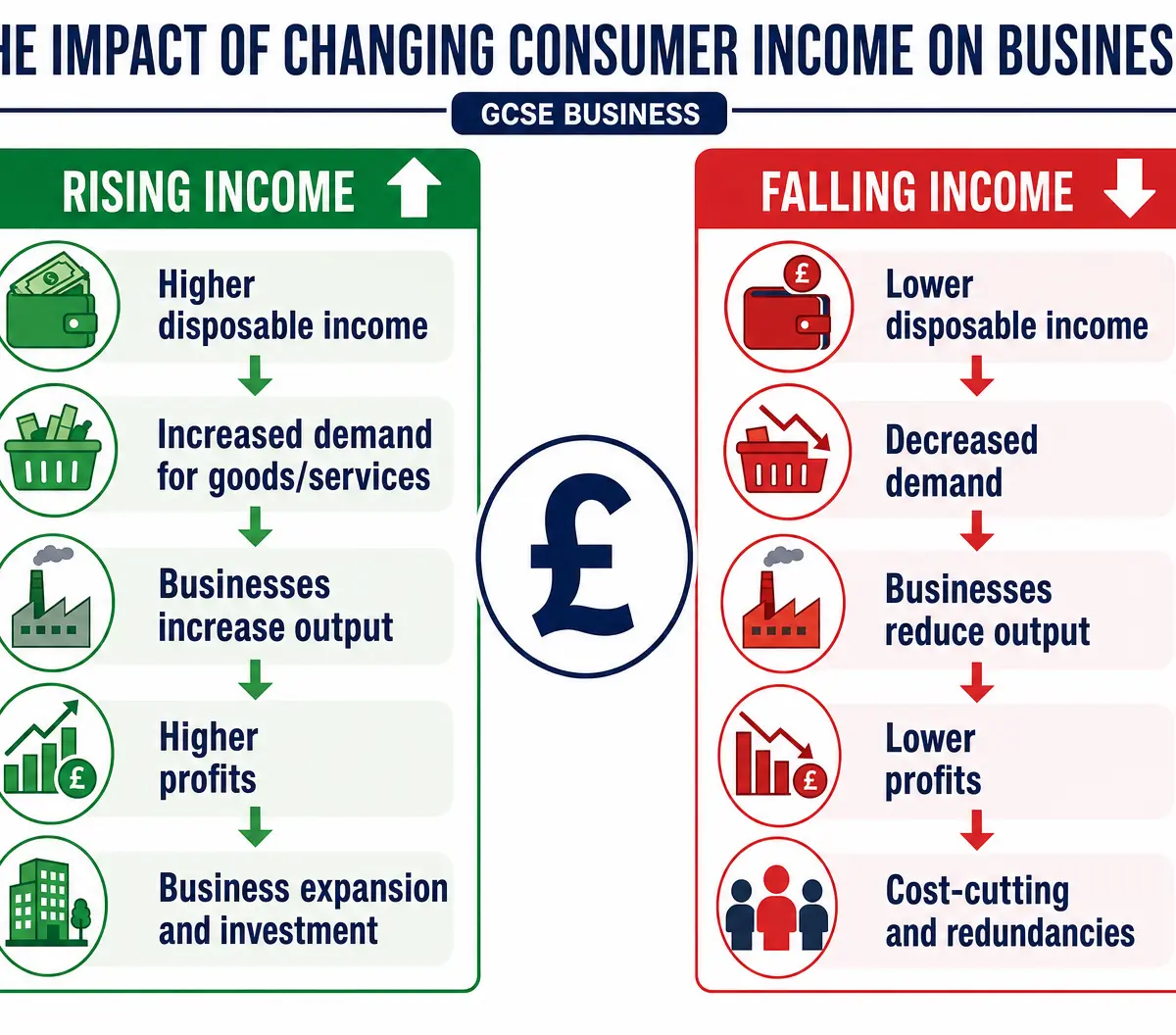
Falling Consumer Income (Recession):
During an economic downturn, wages may stagnate or fall in real terms, and unemployment rises. Consumers have less disposable income.
- Impact on Demand: Consumers cut back on non-essential spending. Demand for luxury goods drops sharply.
- Business Response: Businesses may need to cut costs (e.g., redundancies), lower prices, offer promotions, or delay investment to survive.
Key Concept 2: Unemployment
Definition: The number of people who are willing and able to work but cannot find a job.
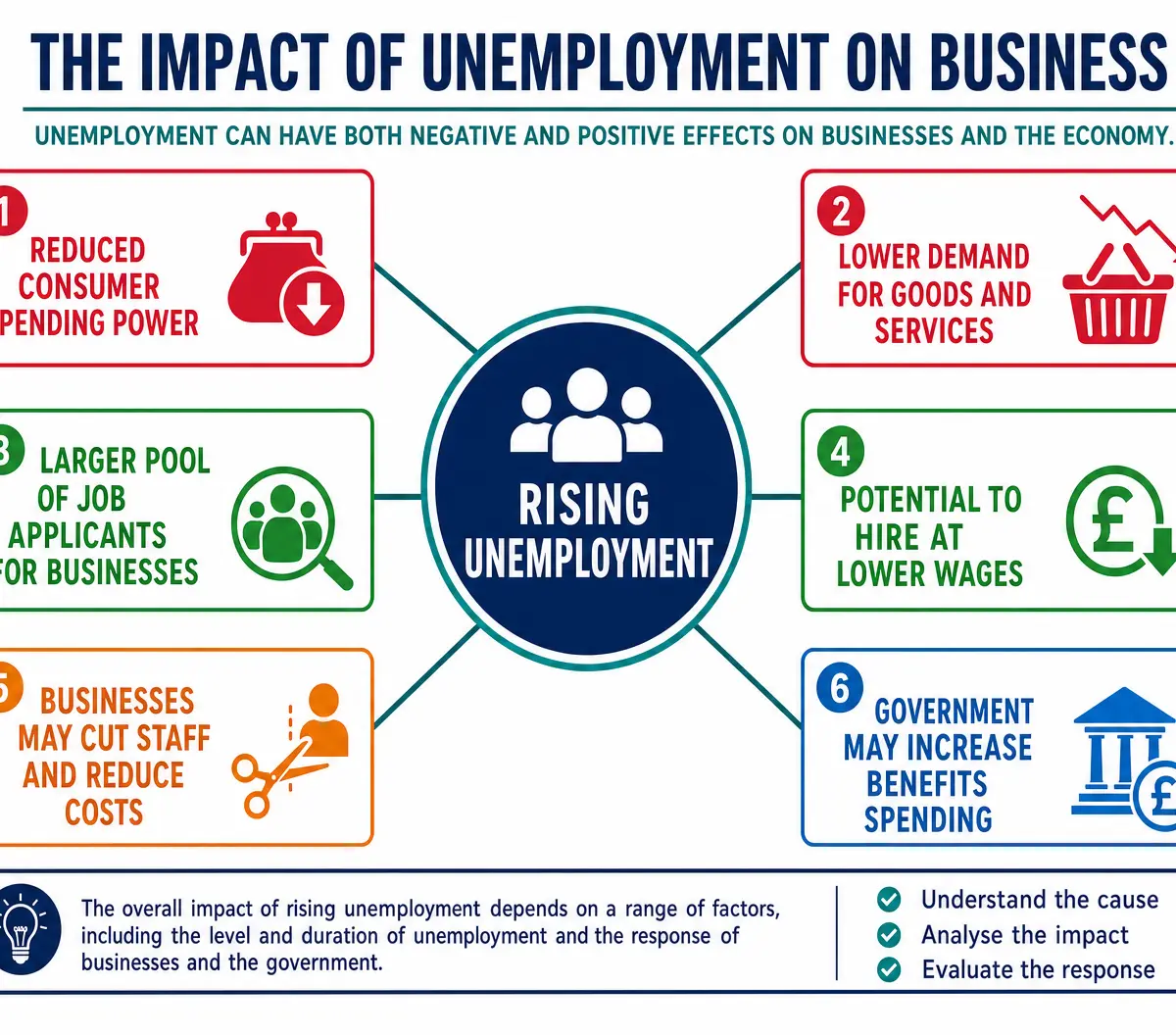
High Unemployment:
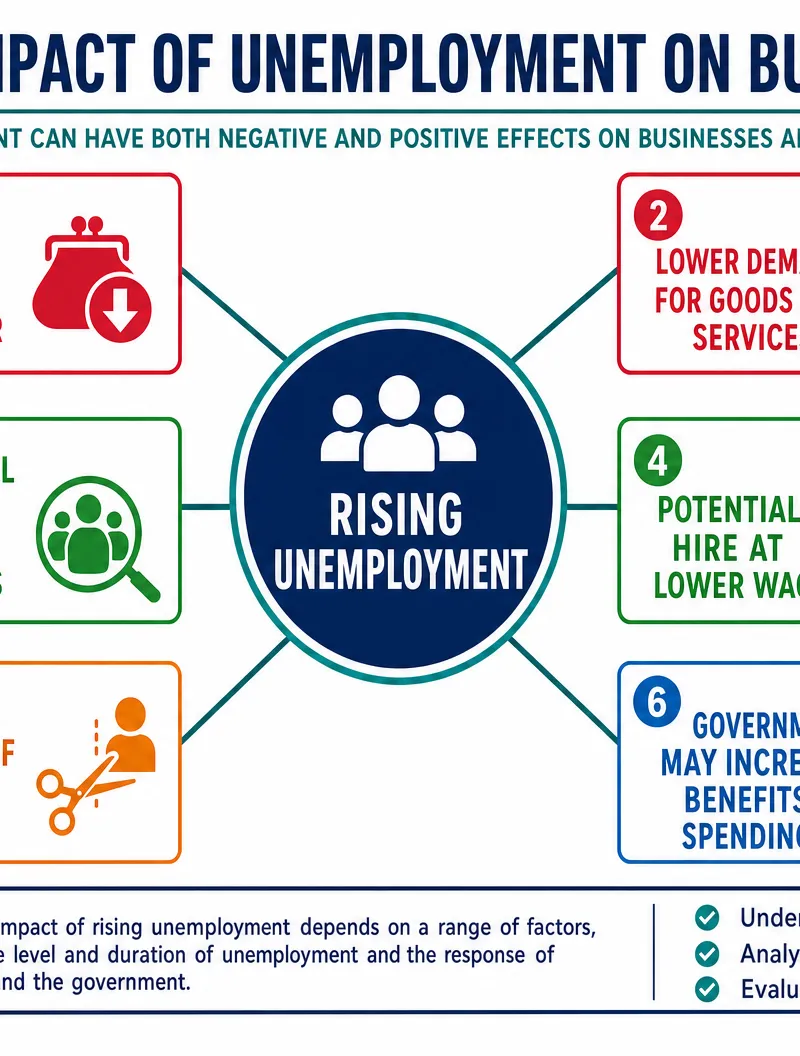
- Negative Impact: Unemployed people have very low incomes, reducing overall consumer spending in the economy. This leads to lower sales revenues and profits for most businesses.
- Positive Impact: A larger pool of available workers makes it easier for businesses to recruit. With more competition for jobs, businesses may be able to offer lower wages, reducing their labour costs.
Low Unemployment:
- Negative Impact: It is harder to find staff. Businesses must compete for workers by offering higher wages and better benefits, which increases costs.
- Positive Impact: High employment means high consumer confidence and spending power, boosting demand for goods and services.
Second-Order Concepts
Causation
Examiners want to see a clear chain of reasoning. For example: Rising unemployment causes a fall in disposable income, which causes a reduction in consumer spending, which causes lower sales for the business, which causes lower profits.
Consequence
Economic changes have both immediate consequences (e.g., a sudden drop in sales) and long-term consequences (e.g., a business deciding to permanently close branches or shift to online-only sales).
Significance
The significance of an economic change depends heavily on the type of business. A 5% drop in consumer income is highly significant for a luxury travel agent, but might actually be beneficial (or have no impact) for a discount retailer like Aldi or Poundland.
Source Skills (Case Studies)
In GCSE Business, your 'sources' are the business case studies. Always read the case study looking for clues about the product type (luxury vs. necessity) and the target market. This context is essential for achieving application marks (AO2).
Visual Resources
2 diagrams and illustrations
Interactive Diagrams
1 interactive diagram to visualise key concepts
Conceptual Flow Outline
The dual impact of rising unemployment on businesses.
Worked Examples
3 worked examples — open one to explore the question and available guidance.
Practice Questions
Try the question, then reveal an answer plan or example response
Explain how a decrease in unemployment might affect a local building company. (3 marks)
Hint: Think about what low unemployment means for recruiting builders and labourers.
State two external factors that can influence business activity. (2 marks)
Hint: Think about the economic climate.
Analyse the impact of a significant rise in consumer income on a business that sells budget, own-brand clothing. (6 marks)
Hint: Remember the concept of 'inferior goods'.
Explain one reason why a business might choose to expand during a period of economic growth. (3 marks)
Hint: Link economic growth to consumer confidence and demand.
Evaluate the impact of an economic recession on a high-end restaurant. (9 marks)
Hint: Discuss both the immediate negative impacts on demand and any potential ways the business could respond or mitigate the damage.
Exam technique
How to turn what you know into marks
How to approach the question
Always identify the specific business in the case study before writing. Underline whether the product is a luxury or a necessity.
How to structure your answer
- Essay questions
- AJIM: Answer the question, Justify with analysis, It depends on (counter-argument), Most important factor (conclusion).
- Source questions
- Use specific data or quotes from the case study to support your points.
- Explain questions
- BLT: Business context, Link to theory, Therefore (consequence).
Timing
Approximately 1 minute per mark, plus planning time for 9 and 12-mark questions.
Common pitfalls
- Failing to link the economic change to a specific business consequence (e.g., saying 'people spend less' but forgetting to add 'so the business loses revenue').
- Assuming rising unemployment is 100% bad for all businesses (forgetting the benefit of cheaper/easier recruitment).
- Confusing 'consumer income' (what people earn) with 'business profit' (what a company makes).
What the command words want
- Analyse
- Show multiple linked consequences or a balanced view (e.g., one positive, one negative). (6 marks)
- Explain
- Make a point, apply it to the context, and provide a chain of reasoning showing the consequence. (3 marks)
- State/Identify
- Short, sharp answer. No explanation needed. (1 mark)
- Evaluate/Recommend
- Balanced argument (pros and cons) followed by a clear, justified judgement/conclusion. (9-12 marks)
Watch or listen (optional)
Test your understanding of The economic climate
Active recall beats re-reading. Take an instant quiz now to test what you’ve learned and lock it into long-term memory.
A week of Premium from your first lesson · Then the free plan continues · No card, no charge