AQA · GCSE · Chemistry
Course version: 8462 · Version from Sept 2018
In some chemical reactions, the products of the reaction can react to…
Full specification wording
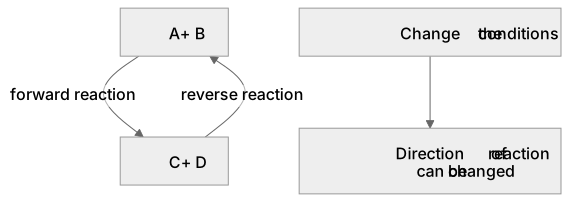
Reversible reactions: In some chemical reactions, the products of the reaction can react to produce the original reactants. Such reactions are called reversible reactions and are represented: A + B C + D The direction of reversible reactions can be changed by changing the conditions.
A reversible reaction is one in which the products can react to reform the original reactants.
Checked against the AQA 8462 specification (opens in a new tab) on .
Study notes
From the checked teaching notes for this specification point.
The idea
A reversible reaction is one in which the products can react to reform the original reactants. It is represented with a reversible arrow, so A + B ⇌ C + D shows both the forward and reverse reactions. The direction can be changed by changing the conditions. For example, heating hydrated copper(II) sulfate drives off water to form anhydrous copper(II) sulfate, and adding water reverses the change. In the Haber process, changing temperature or pressure shifts the direction in which the reaction proceeds. The reversible arrow shows that both reactions can occur, and the conditions determine which direction is favoured.
What earns the marks
- A reversible reaction is one in which the products can react to produce the original reactants.
- Reversible reactions are represented using a reversible arrow, for example A + B ⇌ C + D.
- The direction of a reversible reaction can be changed by changing the conditions.
- Changing temperature, pressure or concentration can favour the forward or reverse reaction.
- Examples include the hydration and dehydration of copper(II) sulfate and the Haber process.
- The reversible arrow indicates that both the forward and reverse reactions can occur.
Common mistakes and how to put them right
Using a single arrow instead of a reversible arrow for a reversible reaction.
Put it right: Use the reversible arrow ⇌.
Thinking the reaction stops when equilibrium is reached.
Put it right: Both forward and reverse reactions continue.
Assuming the direction cannot be changed.
Put it right: Changing conditions such as temperature or pressure can change the direction favoured.
Exam tips
- Write the reversible arrow clearly and correctly in equations for reversible reactions.
- When explaining a change in direction, name the condition changed and state which direction is favoured.
- Use a familiar example, such as hydrated copper(II) sulfate, to illustrate reversibility.
Try the lesson
The start of the Reversible reactions: In some chemical reactions, the products of the reaction can react to produce the original reactants. Such reactions are called reversible reactions and are represented: A + B C + D The direction of reversible reactions can be changed by changing the conditions. lesson, made from checked teaching notes for this specification point.
Have a go first
What does the symbol ⇌ represent when used in a chemical equation?
Listen
A reversible reaction is one in which the products can react to reform the original reactants. It is represented with a reversible arrow, so A + B ⇌ C + D shows both the forward and reverse reactions. The direction can be changed by changing the conditions. For example, heating hydrated copper(II) sulfate drives off water to form anhydrous copper(II) sulfate, and adding water reverses the change. In the Haber process, changing temperature or pressure shifts the direction in which the reaction proceeds. The reversible arrow shows that both reactions can occur, and the conditions determine which direction is favoured. A strong answer earns marks for these points. A reversible reaction is one in which the products can react to produce the original reactants. Reversible reactions are represented using a reversible arrow, for example A + B ⇌ C + D. The direction of a reversible reaction can be changed by changing the conditions. Changing temperature, pressure or concentration can favour the forward or reverse reaction. A common slip: Using a single arrow instead of a reversible arrow for a reversible reaction. Instead, use the reversible arrow ⇌. Exam tip: Write the reversible arrow clearly and correctly in equations for reversible reactions.
See it
Label the diagram
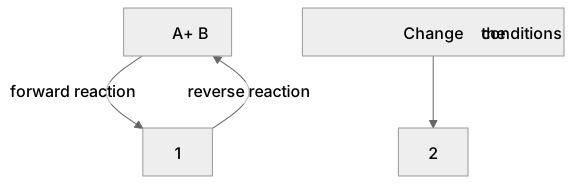
Some boxes have lost their names. Pick the right name for each number.
1Box 1
2Box 2
There is more to this lesson
The full lesson goes on to check your understanding and help you earn the marks. Create a free account to carry on, with your progress saved.
A week of Premium from your first lesson · Then the free plan continues · No card, no charge
Test your understanding of Reversible reactions: In some chemical reactions, the products of the reaction can react to produce the original reactants. Such reactions are called reversible reactions and are represented: A + B C + D The direction of reversible reactions can be changed by changing the conditions.
Active recall beats re-reading. Take an instant quiz now to test what you’ve learned and lock it into long-term memory.
A week of Premium from your first lesson · Then the free plan continues · No card, no charge