AQA · GCSE · Chemistry
Course version: 8462 · Version from Sept 2018
The test for carbon dioxide uses an aqueous solution of calcium hydroxide…
Full specification wording
Test for carbon dioxide: The test for carbon dioxide uses an aqueous solution of calcium hydroxide (lime water).
Carbon dioxide is identified using limewater, which is an aqueous solution of calcium hydroxide.
Checked against the AQA 8462 specification (opens in a new tab) on .
- Point 1 of 2
- 4 key terms
Study notes
From the checked teaching notes for this specification point.
The idea
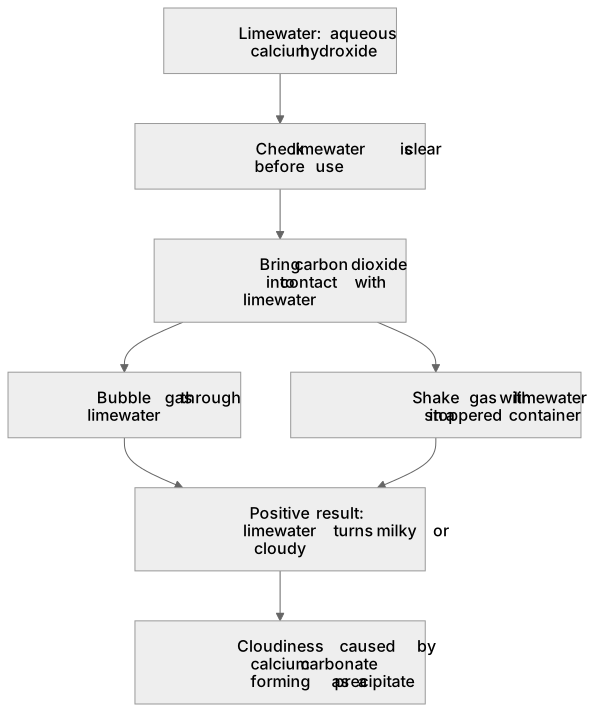
Carbon dioxide is identified using limewater, which is an aqueous solution of calcium hydroxide. The gas is either bubbled through the limewater or shaken with it in a stoppered container. If carbon dioxide is present, the limewater turns milky or cloudy. The active reagent is calcium hydroxide dissolved in water, so the test uses the solution rather than the solid. The milky appearance comes from tiny particles of calcium carbonate formed when carbon dioxide reacts with calcium hydroxide. Limewater must be fresh and clear before use, because stale limewater may already be cloudy and give a false positive.
What earns the marks
- Identify limewater as an aqueous solution of calcium hydroxide.
- State that carbon dioxide is tested by bubbling it through limewater or shaking it with limewater.
- Describe the positive result as the limewater turning milky or cloudy.
- Explain that the cloudiness is caused by calcium carbonate forming as a precipitate.
- Note that limewater should be clear before the test so that any cloudiness is a valid observation.
Common mistakes and how to put them right
Using solid calcium hydroxide instead of limewater.
Put it right: The correct reagent is an aqueous solution of calcium hydroxide.
Saying the limewater turns clear.
Put it right: The correct observation is that clear limewater turns milky or cloudy.
Ignoring the starting appearance of the limewater.
Put it right: The correct approach checks that it is clear before testing so cloudiness can be seen.
Exam tips
- Name the reagent as limewater and identify it as aqueous calcium hydroxide.
- Give the observation as milky or cloudy, not just 'a reaction happens'.
- Mention both possible methods: bubbling the gas through limewater or shaking the gas with limewater.
Try the lesson
The start of the Test for carbon dioxide: The test for carbon dioxide uses an aqueous solution of calcium hydroxide (lime water). lesson, made from checked teaching notes for this specification point.
Have a go first
When testing for the presence of carbon dioxide gas, an aqueous solution called limewater is used. What is the chemical name of the compound dissolved in this solution?
Listen
Carbon dioxide is identified using limewater, which is an aqueous solution of calcium hydroxide. The gas is either bubbled through the limewater or shaken with it in a stoppered container. If carbon dioxide is present, the limewater turns milky or cloudy. The active reagent is calcium hydroxide dissolved in water, so the test uses the solution rather than the solid. The milky appearance comes from tiny particles of calcium carbonate formed when carbon dioxide reacts with calcium hydroxide. Limewater must be fresh and clear before use, because stale limewater may already be cloudy and give a false positive. A strong answer earns marks for these points. Identify limewater as an aqueous solution of calcium hydroxide. State that carbon dioxide is tested by bubbling it through limewater or shaking it with limewater. Describe the positive result as the limewater turning milky or cloudy. Explain that the cloudiness is caused by calcium carbonate forming as a precipitate. Exam tip: Name the reagent as limewater and identify it as aqueous calcium hydroxide.
See it
Key words
Say what each word means before you turn the card.
Limewater
Try answering aloud or in your head before turning the card.
Positive result
Try answering aloud or in your head before turning the card.
Cloudiness
Try answering aloud or in your head before turning the card.
Fresh and clear
Try answering aloud or in your head before turning the card.
See every definition
- Limewater
- An aqueous solution of calcium hydroxide used to test for carbon dioxide.
- Positive result
- The limewater turning milky or cloudy when carbon dioxide is present.
- Cloudiness
- Caused by calcium carbonate forming as a precipitate when carbon dioxide reacts with calcium hydroxide.
- Fresh and clear
- The state limewater must be in before use, because stale limewater may already be cloudy and give a false positive.
Label the diagram
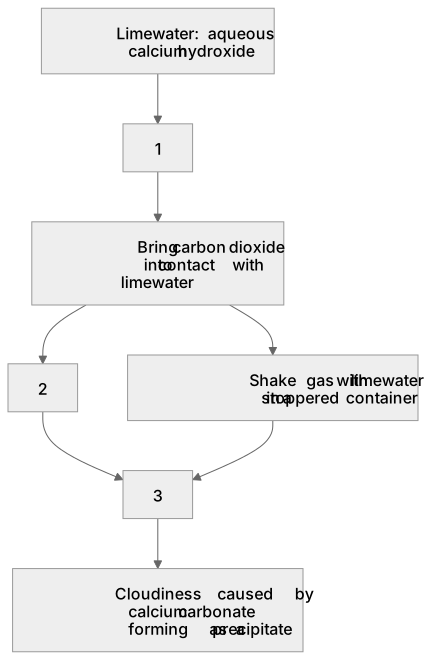
Some boxes have lost their names. Pick the right name for each number.
1Box 1
2Box 2
3Box 3
There is more to this lesson
The full lesson goes on to check your understanding and help you earn the marks. Create a free account to carry on, with your progress saved.
A week of Premium from your first lesson · Then the free plan continues · No card, no charge
Test your understanding of Test for carbon dioxide: The test for carbon dioxide uses an aqueous solution of calcium hydroxide (lime water).
Active recall beats re-reading. Take an instant quiz now to test what you’ve learned and lock it into long-term memory.
A week of Premium from your first lesson · Then the free plan continues · No card, no charge