OCR · A-Level · Chemistry
Course version: H432 · Version from Sept 2017
(a) the formulae of the common acids (HCl, H₂SO₄, HNO₃ and CH₃COOH) and…
Full specification wording
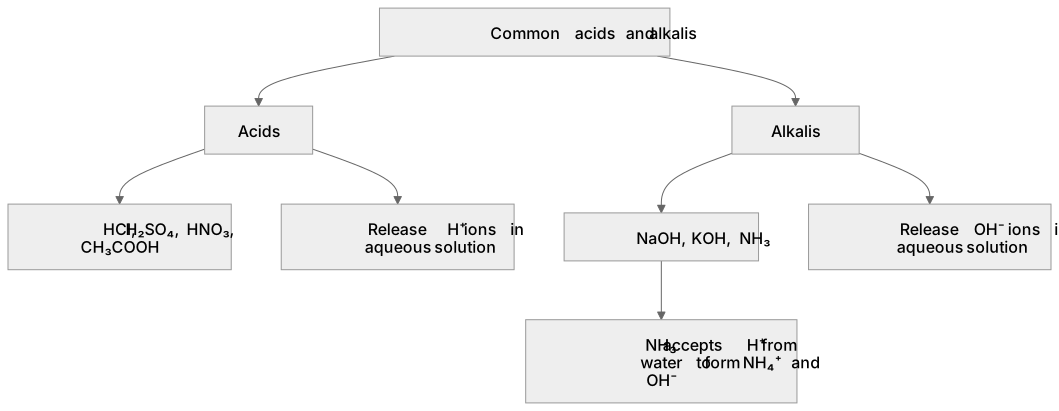
Acids: (a) the formulae of the common acids (HCl, H₂SO₄, HNO₃ and CH₃COOH) and the common alkalis (NaOH, KOH and NH₃) and explanation that acids release H⁺ ions in aqueous solution and alkalis release OH⁻ ions in aqueous solution
Acids and alkalis are identified by their formulae and by the ions they release in water.
- Point 1 of 7
- 4 key terms
Study notes
From the teaching notes for this specification point.
The idea
Acids and alkalis are identified by their formulae and by the ions they release in water. Learn the four common acids: hydrochloric acid HCl, sulfuric acid H₂SO₄, nitric acid HNO₃ and ethanoic acid CH₃COOH. Learn the three common alkalis: sodium hydroxide NaOH, potassium hydroxide KOH and ammonia NH₃. In aqueous solution an acid releases H⁺ ions, so HCl gives H⁺ and Cl⁻, and H₂SO₄ gives 2H⁺ and SO₄²⁻. An alkali releases OH⁻ ions in aqueous solution: NaOH gives Na⁺ and OH⁻, KOH gives K⁺ and OH⁻. Ammonia is the exception to watch: NH₃ accepts H⁺ from water to form NH₄⁺ and OH⁻, so the OH⁻ ions appear indirectly. A multiple-choice question may ask which species is released, which formula is an alkali, or which ion is present in excess.
What earns the marks
- Identifies HCl, H₂SO₄, HNO₃ and CH₃COOH as the common acids named in the specification.
- Identifies NaOH, KOH and NH₃ as the common alkalis named in the specification.
- States that acids release H⁺ ions in aqueous solution.
- States that alkalis release OH⁻ ions in aqueous solution.
- Recognises that NH₃ produces OH⁻ ions in water by accepting H⁺ to form NH₄⁺.
Common mistakes and how to put them right
Writes the formula of ethanoic acid as CH₃CO₂H without recognising it as the same acid.
Put it right: Accept CH₃COOH as the specification form.
Treats NH₃ as releasing OH⁻ directly rather than accepting H⁺ from water to generate OH⁻.
Confuses the ion released by an acid with the ion released by an alkali.
Put it right: Acids release H⁺, alkalis release OH⁻.
Omits the subscript ₂ in H₂SO₄ or the subscript ₃ in NH₃.
Put it right: Check each subscript carefully.
Exam tips
- Read the question stem to see whether it asks for the ion released or the formula of the compound.
- Check each formula against the specification list before selecting an option.
- For ammonia, remember the OH⁻ arises through reaction with water, not by direct release.
Try the lesson
The start of the Acids: (a) the formulae of the common acids (HCl, H₂SO₄, HNO₃ and CH₃COOH) and the common alkalis (NaOH, KOH and NH₃) and explanation that acids release H⁺ ions in aqueous solution and alkalis release OH⁻ ions in aqueous solution lesson, made from teaching notes for this specification point.
Listen
Acids and alkalis are identified by their formulae and by the ions they release in water. Learn the four common acids: hydrochloric acid HCl, sulfuric acid H₂SO₄, nitric acid HNO₃ and ethanoic acid CH₃COOH. Learn the three common alkalis: sodium hydroxide NaOH, potassium hydroxide KOH and ammonia NH₃. In aqueous solution an acid releases H⁺ ions, so HCl gives H⁺ and Cl⁻, and H₂SO₄ gives 2H⁺ and SO₄²⁻. An alkali releases OH⁻ ions in aqueous solution: NaOH gives Na⁺ and OH⁻, KOH gives K⁺ and OH⁻. Ammonia is the exception to watch: NH₃ accepts H⁺ from water to form NH₄⁺ and OH⁻, so the OH⁻ ions appear indirectly. A multiple-choice question may ask which species is released, which formula is an alkali, or which ion is present in excess. A strong answer earns marks for these points. Identifies HCl, H₂SO₄, HNO₃ and CH₃COOH as the common acids named in the specification. Identifies NaOH, KOH and NH₃ as the common alkalis named in the specification. States that acids release H⁺ ions in aqueous solution. States that alkalis release OH⁻ ions in aqueous solution. Exam tip: Read the question stem to see whether it asks for the ion released or the formula of the compound.
See it
Key words
Say what each word means before you turn the card.
Formulae of common acids
Try answering aloud or in your head before turning the card.
Formulae of common alkalis
Try answering aloud or in your head before turning the card.
Release of H⁺ ions by acids in aqueous solution
Try answering aloud or in your head before turning the card.
Release of OH⁻ ions by alkalis in aqueous solution
Try answering aloud or in your head before turning the card.
See every definition
- Formulae of common acids
- The common acids named in the specification are HCl, H₂SO₄, HNO₃ and CH₃COOH.
- Formulae of common alkalis
- The common alkalis named in the specification are NaOH, KOH and NH₃.
- Release of H⁺ ions by acids in aqueous solution
- In aqueous solution an acid releases H⁺ ions, so HCl gives H⁺ and Cl⁻, and H₂SO₄ gives 2H⁺ and SO₄²⁻.
- Release of OH⁻ ions by alkalis in aqueous solution
- An alkali releases OH⁻ ions in aqueous solution, as NaOH gives Na⁺ and OH⁻ and KOH gives K⁺ and OH⁻.
Label the diagram
Some boxes have lost their names. Pick the right name for each number.
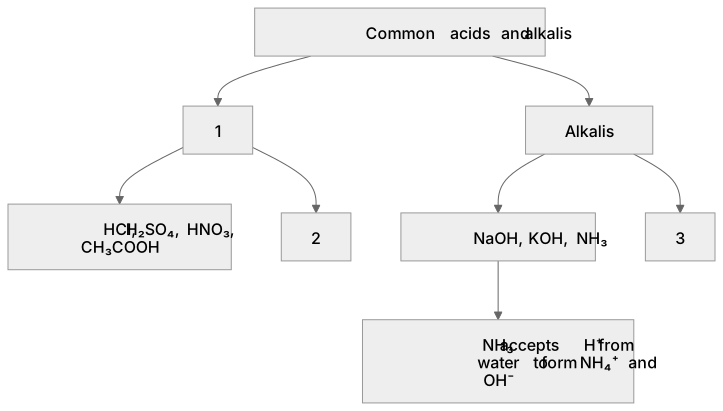
1Box 1
2Box 2
3Box 3
There is more to this lesson
The full lesson goes on to check your understanding and help you earn the marks. Create a free account to carry on, with your progress saved.
A week of Premium from your first lesson · Then the free plan continues · No card, no charge
Test your understanding of Acids: (a) the formulae of the common acids (HCl, H₂SO₄, HNO₃ and CH₃COOH) and the common alkalis (NaOH, KOH and NH₃) and explanation that acids release H⁺ ions in aqueous solution and alkalis release OH⁻ ions in aqueous solution
Active recall beats re-reading. Take an instant quiz now to test what you’ve learned and lock it into long-term memory.
A week of Premium from your first lesson · Then the free plan continues · No card, no charge