OCR · A-Level · Chemistry
Course version: H432 · Version from Sept 2017
(b) qualitative explanation of strong and weak acids in terms of relative…
Full specification wording
Acids: (b) qualitative explanation of strong and weak acids in terms of relative dissociations
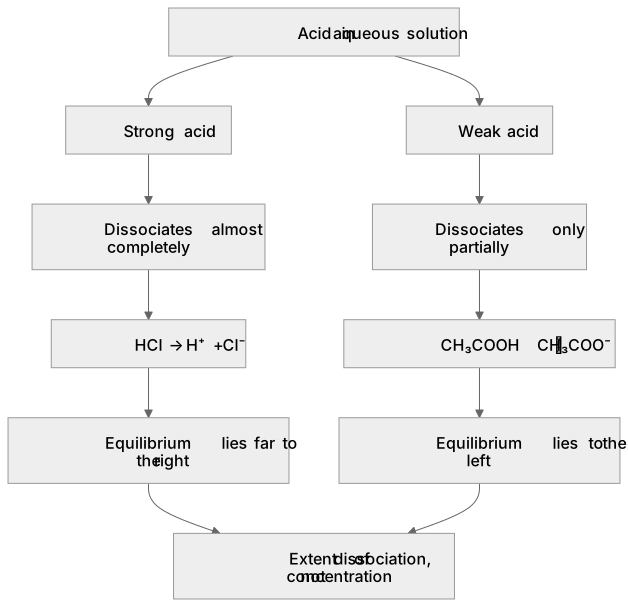
A strong acid dissociates almost completely in aqueous solution, so nearly every acid molecule releases its H⁺ ions.
- Point 2 of 7
- 4 key terms
Study notes
From the teaching notes for this specification point.
The idea
A strong acid dissociates almost completely in aqueous solution, so nearly every acid molecule releases its H⁺ ions. Hydrochloric acid is a strong acid: HCl → H⁺ + Cl⁻, and the equilibrium lies far to the right. A weak acid dissociates only partially, so most molecules remain undissociated and only a small fraction release H⁺ ions. Ethanoic acid is a weak acid: CH₃COOH ⇌ CH₃COO⁻ + H⁺, with the equilibrium lying to the left. The qualitative explanation compares the extent of dissociation, not the concentration of the solution. A dilute strong acid can have a lower H⁺ concentration than a concentrated weak acid, so keep the two ideas separate. A multiple-choice question may ask which acid is strong, which equilibrium position applies, or how the relative numbers of ions compare.
What earns the marks
- States that a strong acid dissociates almost completely in aqueous solution.
- States that a weak acid dissociates only partially in aqueous solution.
- Links the position of equilibrium to the extent of dissociation for a named acid.
- Distinguishes extent of dissociation from concentration of the solution.
- Identifies HCl as strong and CH₃COOH as weak using relative dissociation.
Common mistakes and how to put them right
Confuses a concentrated acid with a strong acid.
Put it right: Concentration describes amount per volume, strength describes extent of dissociation.
Claims a weak acid does not dissociate at all.
Put it right: It dissociates partially, so some ions form.
States that a strong acid has a higher concentration than a weak acid.
Put it right: Strength and concentration are independent.
Describes dissociation as complete for ethanoic acid.
Put it right: It is partial, shown by an equilibrium arrow.
Exam tips
- Use the words 'almost completely' for strong acids and 'partially' for weak acids.
- Refer to the equilibrium position when explaining relative dissociation.
- Separate the idea of strength from the idea of concentration in your reasoning.
Try the lesson
The start of the Acids: (b) qualitative explanation of strong and weak acids in terms of relative dissociations lesson, made from teaching notes for this specification point.
Listen
A strong acid dissociates almost completely in aqueous solution, so nearly every acid molecule releases its H⁺ ions. Hydrochloric acid is a strong acid: HCl → H⁺ + Cl⁻, and the equilibrium lies far to the right. A weak acid dissociates only partially, so most molecules remain undissociated and only a small fraction release H⁺ ions. Ethanoic acid is a weak acid: CH₃COOH ⇌ CH₃COO⁻ + H⁺, with the equilibrium lying to the left. The qualitative explanation compares the extent of dissociation, not the concentration of the solution. A dilute strong acid can have a lower H⁺ concentration than a concentrated weak acid, so keep the two ideas separate. A multiple-choice question may ask which acid is strong, which equilibrium position applies, or how the relative numbers of ions compare. A strong answer earns marks for these points. States that a strong acid dissociates almost completely in aqueous solution. States that a weak acid dissociates only partially in aqueous solution. Links the position of equilibrium to the extent of dissociation for a named acid. Distinguishes extent of dissociation from concentration of the solution. Exam tip: Use the words 'almost completely' for strong acids and 'partially' for weak acids.
See it
Key words
Say what each word means before you turn the card.
Strong acids dissociate almost completely
Try answering aloud or in your head before turning the card.
Weak acids dissociate partially
Try answering aloud or in your head before turning the card.
Relative dissociation and equilibrium position
Try answering aloud or in your head before turning the card.
Distinction between strength and concentration
Try answering aloud or in your head before turning the card.
See every definition
- Strong acids dissociate almost completely
- A strong acid dissociates almost completely in aqueous solution, so nearly every acid molecule releases its H⁺ ions.
- Weak acids dissociate partially
- A weak acid dissociates only partially, so most molecules remain undissociated and only a small fraction release H⁺ ions.
- Relative dissociation and equilibrium position
- The extent of dissociation is linked to the position of equilibrium, which lies far to the right for a strong acid and to the left for a weak acid.
- Distinction between strength and concentration
- Strength describes extent of dissociation, whereas concentration describes amount per volume, so a dilute strong acid can have a lower H⁺ concentration than a concentrated weak acid.
Label the diagram
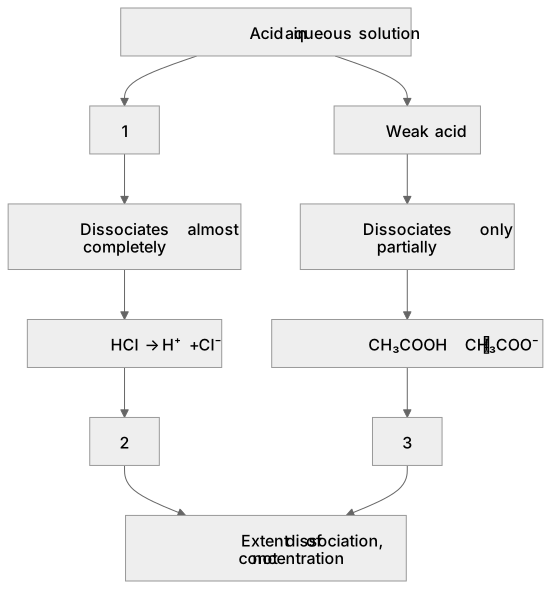
Some boxes have lost their names. Pick the right name for each number.
1Box 1
2Box 2
3Box 3
There is more to this lesson
The full lesson goes on to check your understanding and help you earn the marks. Create a free account to carry on, with your progress saved.
A week of Premium from your first lesson · Then the free plan continues · No card, no charge
Test your understanding of Acids: (b) qualitative explanation of strong and weak acids in terms of relative dissociations
Active recall beats re-reading. Take an instant quiz now to test what you’ve learned and lock it into long-term memory.
A week of Premium from your first lesson · Then the free plan continues · No card, no charge