OCR · A-Level · Chemistry
Course version: H432 · Version from Sept 2017
(g) calculations of pH, Ka or related quantities, for a weak monobasic…
Full specification wording
Acids, bases and buffers: (g) calculations of pH, Ka or related quantities, for a weak monobasic acid using approximations
For a weak monobasic acid HA, the acid-dissociation constant is Ka = [H⁺][A⁻]/[HA].
- Point 14 of 26
- 4 key terms
Study notes
From the teaching notes for this specification point.
The idea
For a weak monobasic acid HA, the acid-dissociation constant is Ka = [H⁺][A⁻]/[HA]. The approximation treats the undissociated concentration as essentially the initial concentration, so [HA] ≈ [HA]₀, and assumes [H⁺] ≈ [A⁻] because the acid is the main source of protons and autoionisation of water is negligible. Combining these gives [H⁺] ≈ √(Ka × [HA]₀), so pH = −log₁₀[H⁺] and pKa = −log₁₀Ka. For example, with Ka = 1.8 × 10⁻⁵ mol dm⁻³ and [HA]₀ = 0.10 mol dm⁻³, [H⁺] ≈ √(1.8 × 10⁻⁶) ≈ 1.34 × 10⁻³ mol dm⁻³ and pH ≈ 2.87. Rearranged forms let you find Ka from pH or find the concentration needed for a target pH. Always keep units consistent and check that the answer is physically sensible for a weak acid.
What earns the marks
- Uses Ka = [H⁺][A⁻]/[HA] as the starting expression for a weak monobasic acid.
- Applies the approximation [HA] ≈ [HA]₀, treating the undissociated concentration as the initial concentration.
- Assumes [H⁺] ≈ [A⁻] because the acid supplies essentially all the protons and water autoionisation is negligible.
- Combines the approximations to give [H⁺] ≈ √(Ka × [HA]₀) and converts to pH using pH = −log₁₀[H⁺].
- Rearranges the relationship to find Ka from a measured pH or to find the concentration giving a stated pH.
- Keeps units consistent, using mol dm⁻³ for concentrations and checking the answer is sensible for a weak acid.
Common mistakes and how to put them right
Squares the concentration instead of taking the square root.
Put it right: Take [H⁺] as the square root of Ka × [HA]₀.
Uses pH = log₁₀[H⁺] without the negative sign.
Put it right: Apply pH = −log₁₀[H⁺].
Treats a weak acid as fully dissociated and sets [H⁺] equal to [HA]₀.
Put it right: Apply the weak-acid approximation instead.
Mixes units or drops mol dm⁻³.
Put it right: Keep every concentration in mol dm⁻³ throughout.
Exam tips
- Write the Ka expression first, then state each approximation explicitly before substituting numbers.
- Show the square-root step and the pH step separately so method marks are visible.
- Sanity-check the pH: a weak acid at around 0.1 mol dm⁻³ should give a pH of roughly 3, not 1.
Try the lesson
The start of the Acids, bases and buffers: (g) calculations of pH, Ka or related quantities, for a weak monobasic acid using approximations lesson, made from teaching notes for this specification point.
Listen
For a weak monobasic acid HA, the acid-dissociation constant is Ka = [H⁺][A⁻]/[HA]. The approximation treats the undissociated concentration as essentially the initial concentration, so [HA] ≈ [HA]₀, and assumes [H⁺] ≈ [A⁻] because the acid is the main source of protons and autoionisation of water is negligible. Combining these gives [H⁺] ≈ √(Ka × [HA]₀), so pH = −log₁₀[H⁺] and pKa = −log₁₀Ka. For example, with Ka = 1.8 × 10⁻⁵ mol dm⁻³ and [HA]₀ = 0.10 mol dm⁻³, [H⁺] ≈ √(1.8 × 10⁻⁶) ≈ 1.34 × 10⁻³ mol dm⁻³ and pH ≈ 2.87. Rearranged forms let you find Ka from pH or find the concentration needed for a target pH. Always keep units consistent and check that the answer is physically sensible for a weak acid. A strong answer earns marks for these points. Uses Ka = [H⁺][A⁻]/[HA] as the starting expression for a weak monobasic acid. Applies the approximation [HA] ≈ [HA]₀, treating the undissociated concentration as the initial concentration. Assumes [H⁺] ≈ [A⁻] because the acid supplies essentially all the protons and water autoionisation is negligible. Combines the approximations to give [H⁺] ≈ √(Ka × [HA]₀) and converts to pH using pH = −log₁₀[H⁺]. Exam tip: Write the Ka expression first, then state each approximation explicitly before substituting numbers.
See it
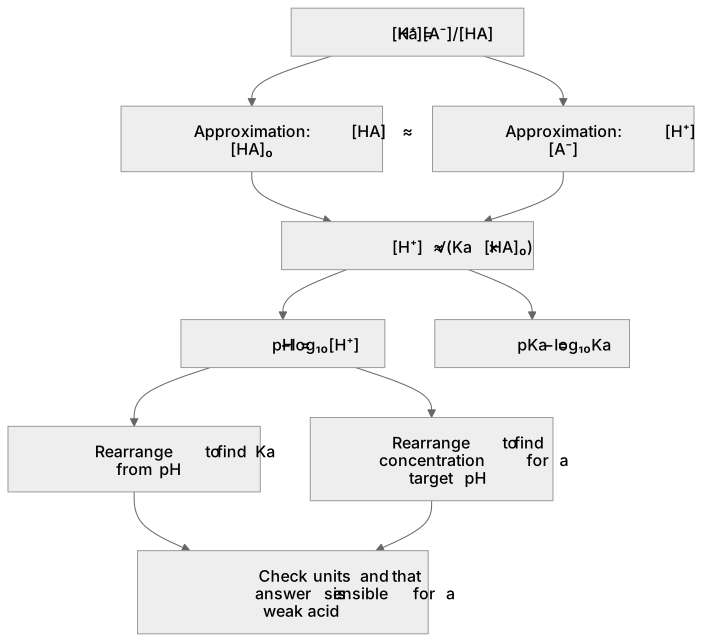
Key words
Say what each word means before you turn the card.
Acid-dissociation constant Ka
Try answering aloud or in your head before turning the card.
Weak-acid approximation for [HA]
Try answering aloud or in your head before turning the card.
Weak-acid approximation for [H⁺]
Try answering aloud or in your head before turning the card.
Relationship between [H⁺], pH and pKa
Try answering aloud or in your head before turning the card.
See every definition
- Acid-dissociation constant Ka
- For a weak monobasic acid HA it is given by the expression Ka = [H⁺][A⁻]/[HA].
- Weak-acid approximation for [HA]
- The undissociated concentration is treated as essentially the initial concentration, so [HA] ≈ [HA]₀.
- Weak-acid approximation for [H⁺]
- It is assumed that [H⁺] ≈ [A⁻] because the acid is the main source of protons and autoionisation of water is negligible.
- Relationship between [H⁺], pH and pKa
- Combining the approximations gives [H⁺] ≈ √(Ka × [HA]₀), so pH = −log₁₀[H⁺] and pKa = −log₁₀Ka.
Label the diagram
Some boxes have lost their names. Pick the right name for each number.
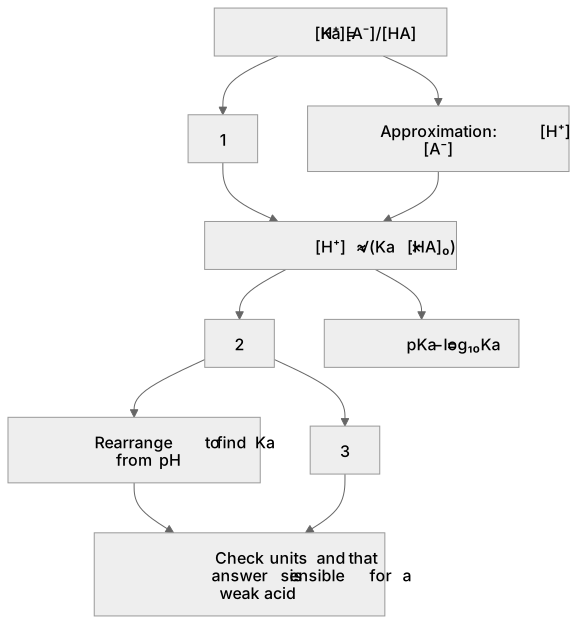
1Box 1
2Box 2
3Box 3
There is more to this lesson
The full lesson goes on to check your understanding and help you earn the marks. Create a free account to carry on, with your progress saved.
A week of Premium from your first lesson · Then the free plan continues · No card, no charge
Test your understanding of Acids, bases and buffers: (g) calculations of pH, Ka or related quantities, for a weak monobasic acid using approximations
Active recall beats re-reading. Take an instant quiz now to test what you’ve learned and lock it into long-term memory.
A week of Premium from your first lesson · Then the free plan continues · No card, no charge