OCR · A-Level · Chemistry
Course version: H432 · Version from Sept 2017
(h) limitations of using approximations to Ka related calculations for…
Full specification wording
Acids, bases and buffers: (h) limitations of using approximations to Ka related calculations for ‘stronger’ weak acids
The approximations [HA] ≈ [HA]₀ and [H⁺] ≈ [A⁻] work well only when the acid is weak enough that a small fraction dissociates.
- Point 15 of 26
- 4 key terms
Study notes
From the teaching notes for this specification point.
The idea
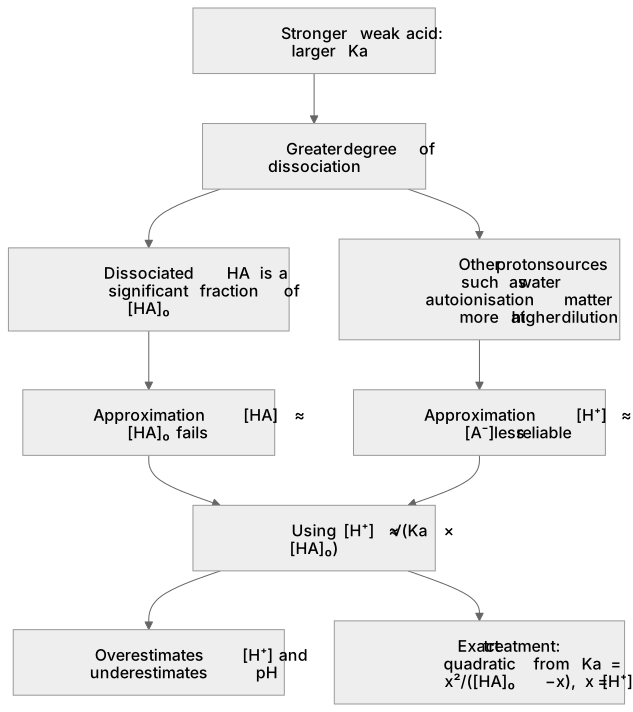
The approximations [HA] ≈ [HA]₀ and [H⁺] ≈ [A⁻] work well only when the acid is weak enough that a small fraction dissociates. For a ‘stronger’ weak acid, with a larger Ka and a greater degree of dissociation, the amount of HA that has dissociated becomes a significant fraction of the initial concentration, so [HA] is noticeably less than [HA]₀. The assumption that [H⁺] equals [A⁻] also weakens because protons from water autoionisation and other sources matter more at higher dilution. Using [H⁺] ≈ √(Ka × [HA]₀) then overestimates [H⁺] and underestimates pH. The exact treatment solves the quadratic from Ka = x²/([HA]₀ − x), where x = [H⁺]. Recognise when the approximation is unsafe and say why.
What earns the marks
- Explains that the approximation [HA] ≈ [HA]₀ fails when a significant fraction of the acid has dissociated.
- Links a larger Ka and greater degree of dissociation to a ‘stronger’ weak acid where the approximation breaks down.
- States that [H⁺] ≈ [A⁻] becomes less reliable when other proton sources such as water autoionisation contribute.
- Identifies that the approximate formula overestimates [H⁺] and so underestimates pH for a stronger weak acid.
- Describes the exact treatment using the quadratic from Ka = x²/([HA]₀ − x) with x = [H⁺].
- Judges when the approximation is acceptable and justifies the choice with the extent of dissociation.
Common mistakes and how to put them right
Claims the approximation is always valid for any weak acid.
Put it right: Recognise that it fails for stronger weak acids with significant dissociation.
Assumes a larger Ka makes the approximate pH more accurate.
Put it right: Explain that greater dissociation makes the approximation less reliable.
Ignores water autoionisation entirely at high dilution.
Put it right: Note that it can contribute significantly to [H⁺].
States the approximation overestimates pH.
Put it right: Correct this to overestimating [H⁺] and therefore underestimating pH.
Exam tips
- Compare the fraction dissociated with the initial concentration to decide whether the approximation is safe.
- When asked about limitations, name the specific assumption that fails and the direction of the resulting error.
- Mention the quadratic exact solution as the alternative to show full understanding.
Try the lesson
The start of the Acids, bases and buffers: (h) limitations of using approximations to Ka related calculations for ‘stronger’ weak acids lesson, made from teaching notes for this specification point.
Listen
The approximations [HA] ≈ [HA]₀ and [H⁺] ≈ [A⁻] work well only when the acid is weak enough that a small fraction dissociates. For a ‘stronger’ weak acid, with a larger Ka and a greater degree of dissociation, the amount of HA that has dissociated becomes a significant fraction of the initial concentration, so [HA] is noticeably less than [HA]₀. The assumption that [H⁺] equals [A⁻] also weakens because protons from water autoionisation and other sources matter more at higher dilution. Using [H⁺] ≈ √(Ka × [HA]₀) then overestimates [H⁺] and underestimates pH. The exact treatment solves the quadratic from Ka = x²/([HA]₀ − x), where x = [H⁺]. Recognise when the approximation is unsafe and say why. A strong answer earns marks for these points. Explains that the approximation [HA] ≈ [HA]₀ fails when a significant fraction of the acid has dissociated. Links a larger Ka and greater degree of dissociation to a ‘stronger’ weak acid where the approximation breaks down. States that [H⁺] ≈ [A⁻] becomes less reliable when other proton sources such as water autoionisation contribute. Identifies that the approximate formula overestimates [H⁺] and so underestimates pH for a stronger weak acid. Exam tip: Compare the fraction dissociated with the initial concentration to decide whether the approximation is safe.
See it
Key words
Say what each word means before you turn the card.
Validity of weak-acid approximations
Try answering aloud or in your head before turning the card.
Degree of dissociation and acid strength
Try answering aloud or in your head before turning the card.
Direction of error from approximations
Try answering aloud or in your head before turning the card.
Exact versus approximate Ka calculations
Try answering aloud or in your head before turning the card.
See every definition
- Validity of weak-acid approximations
- The approximations work well only when the acid is weak enough that a small fraction dissociates, and become unsafe when a significant fraction of the acid has dissociated.
- Degree of dissociation and acid strength
- A larger Ka and a greater degree of dissociation make a ‘stronger’ weak acid, where the amount dissociated becomes a significant fraction of the initial concentration.
- Direction of error from approximations
- Using [H⁺] ≈ √(Ka × [HA]₀) overestimates [H⁺] and therefore underestimates pH for a stronger weak acid.
- Exact versus approximate Ka calculations
- The exact treatment solves the quadratic from Ka = x²/([HA]₀ − x), where x = [H⁺], instead of using the approximation.
Label the diagram
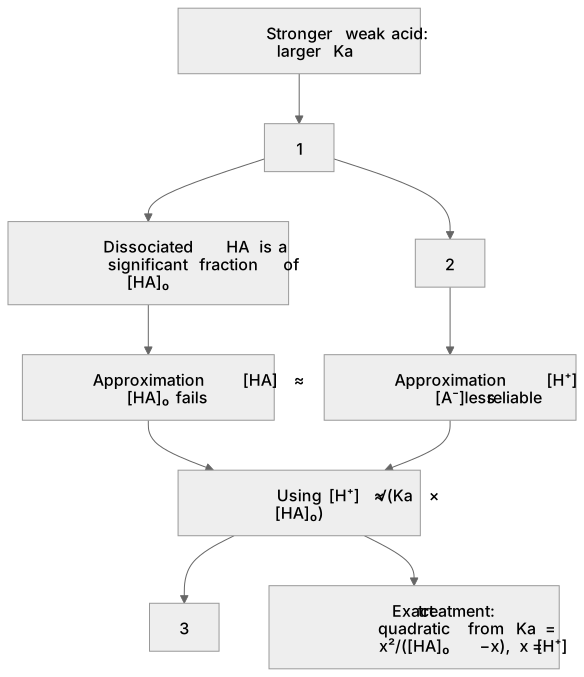
Some boxes have lost their names. Pick the right name for each number.
1Box 1
2Box 2
3Box 3
There is more to this lesson
The full lesson goes on to check your understanding and help you earn the marks. Create a free account to carry on, with your progress saved.
A week of Premium from your first lesson · Then the free plan continues · No card, no charge
Test your understanding of Acids, bases and buffers: (h) limitations of using approximations to Ka related calculations for ‘stronger’ weak acids
Active recall beats re-reading. Take an instant quiz now to test what you’ve learned and lock it into long-term memory.
A week of Premium from your first lesson · Then the free plan continues · No card, no charge