OCR · A-Level · Chemistry
Course version: H432 · Version from Sept 2017
(i) a weak acid and a salt of the weak acid, e.g. CH₃COOH/CH₃COONa
Full specification wording
Acids, bases and buffers: (i) a weak acid and a salt of the weak acid, e.g. CH₃COOH/CH₃COONa
This route forms a buffer by dissolving a weak acid together with a salt of that same weak acid.
- Point 19 of 26
- 4 key terms
Study notes
From the teaching notes for this specification point.
The idea
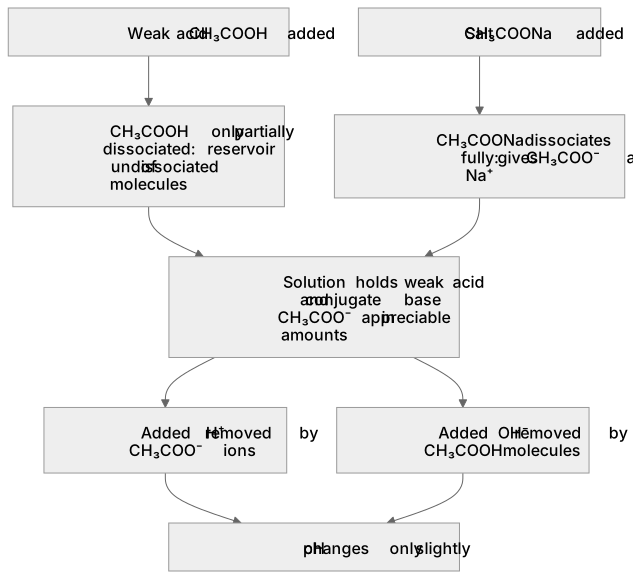
This route forms a buffer by dissolving a weak acid together with a salt of that same weak acid. Ethanoic acid, CH₃COOH, is only partially dissociated, so the mixture contains a substantial reservoir of undissociated CH₃COOH molecules. Sodium ethanoate, CH₃COONa, is a soluble ionic salt that dissociates fully to give CH₃COO⁻ ions and Na⁺ ions. The result is a solution holding both the weak acid and its conjugate base, CH₃COO⁻, in appreciable amounts. Added H⁺ ions are removed by the CH₃COO⁻ ions, and added OH⁻ ions are removed by the CH₃COOH molecules, so the pH changes only slightly. The salt must contain the conjugate base of the same weak acid; a salt of a different acid does not give this buffer pair.
What earns the marks
- Identifies CH₃COOH as a weak acid that is only partially dissociated and so supplies undissociated molecules.
- States that CH₃COONa dissociates fully to give CH₃COO⁻ ions, the conjugate base of the weak acid.
- Recognises that the mixture contains both the weak acid and its conjugate base in appreciable amounts.
- Explains that added H⁺ ions are removed by CH₃COO⁻ ions and added OH⁻ ions are removed by CH₃COOH molecules.
- Selects a salt containing the conjugate base of the same weak acid rather than a salt of a different acid.
Common mistakes and how to put them right
Chooses a salt of a different acid from the weak acid.
Put it right: Match the anion of the salt to the conjugate base of the weak acid.
Assumes the salt is the source of the weak acid.
Put it right: Recognise that the salt supplies the conjugate base while the weak acid is added separately.
Treats CH₃COOH as fully dissociated.
Put it right: Describe it as only partially dissociated so undissociated molecules remain.
Claims the buffer neutralises all added acid or alkali.
Put it right: Explain that the components remove added ions and resist pH change.
Exam tips
- Write the weak acid and its conjugate base side by side to confirm the pair matches.
- Check that the salt chosen provides the same anion as the conjugate base of the weak acid.
- Trace added H⁺ to the conjugate base and added OH⁻ to the weak acid when justifying buffer action.
- Reject options where a strong acid is paired with a salt, since the weak acid is essential.
Try the lesson
The start of the Acids, bases and buffers: (i) a weak acid and a salt of the weak acid, e.g. CH₃COOH/CH₃COONa lesson, made from teaching notes for this specification point.
Listen
This route forms a buffer by dissolving a weak acid together with a salt of that same weak acid. Ethanoic acid, CH₃COOH, is only partially dissociated, so the mixture contains a substantial reservoir of undissociated CH₃COOH molecules. Sodium ethanoate, CH₃COONa, is a soluble ionic salt that dissociates fully to give CH₃COO⁻ ions and Na⁺ ions. The result is a solution holding both the weak acid and its conjugate base, CH₃COO⁻, in appreciable amounts. Added H⁺ ions are removed by the CH₃COO⁻ ions, and added OH⁻ ions are removed by the CH₃COOH molecules, so the pH changes only slightly. The salt must contain the conjugate base of the same weak acid; a salt of a different acid does not give this buffer pair. A strong answer earns marks for these points. Identifies CH₃COOH as a weak acid that is only partially dissociated and so supplies undissociated molecules. States that CH₃COONa dissociates fully to give CH₃COO⁻ ions, the conjugate base of the weak acid. Recognises that the mixture contains both the weak acid and its conjugate base in appreciable amounts. Explains that added H⁺ ions are removed by CH₃COO⁻ ions and added OH⁻ ions are removed by CH₃COOH molecules. Exam tip: Write the weak acid and its conjugate base side by side to confirm the pair matches.
See it
Key words
Say what each word means before you turn the card.
Partial dissociation of weak acids
Try answering aloud or in your head before turning the card.
Full dissociation of soluble salts
Try answering aloud or in your head before turning the card.
Conjugate acid–base pairing
Try answering aloud or in your head before turning the card.
Buffer action against added acid and alkali
Try answering aloud or in your head before turning the card.
See every definition
- Partial dissociation of weak acids
- A weak acid such as CH₃COOH is only partially dissociated, so the mixture contains a substantial reservoir of undissociated CH₃COOH molecules.
- Full dissociation of soluble salts
- A soluble ionic salt such as CH₃COONa dissociates fully to give CH₃COO⁻ ions and Na⁺ ions.
- Conjugate acid–base pairing
- The salt must contain the conjugate base of the same weak acid, giving a solution holding both the weak acid and its conjugate base in appreciable amounts.
- Buffer action against added acid and alkali
- Added H⁺ ions are removed by the CH₃COO⁻ ions, and added OH⁻ ions are removed by the CH₃COOH molecules, so the pH changes only slightly.
Label the diagram
Some boxes have lost their names. Pick the right name for each number.
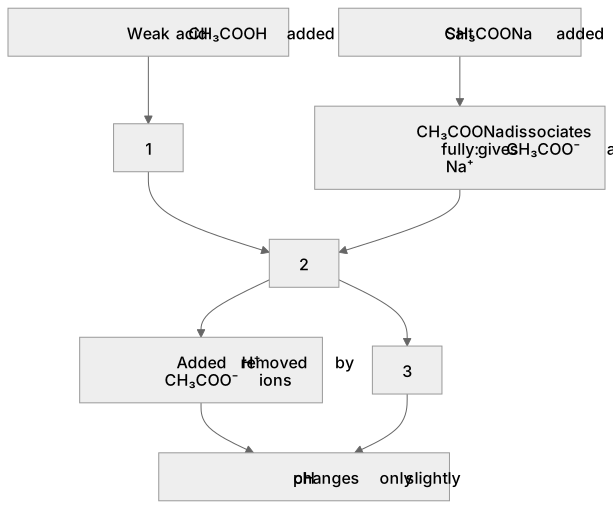
1Box 1
2Box 2
3Box 3
There is more to this lesson
The full lesson goes on to check your understanding and help you earn the marks. Create a free account to carry on, with your progress saved.
A week of Premium from your first lesson · Then the free plan continues · No card, no charge
Test your understanding of Acids, bases and buffers: (i) a weak acid and a salt of the weak acid, e.g. CH₃COOH/CH₃COONa
Active recall beats re-reading. Take an instant quiz now to test what you’ve learned and lock it into long-term memory.
A week of Premium from your first lesson · Then the free plan continues · No card, no charge