OCR · A-Level · Chemistry
Course version: H432 · Version from Sept 2017
(ii) excess of a weak acid and a strong alkali, e.g. excess CH₃COOH/NaOH
Full specification wording
Acids, bases and buffers: (ii) excess of a weak acid and a strong alkali, e.g. excess CH₃COOH/NaOH
This item concerns a mixture in which a weak acid such as CH₃COOH is present in excess and a strong alkali such as NaOH is the limiting reagent.
- Point 20 of 26
- 4 key terms
Study notes
From the teaching notes for this specification point.
The idea
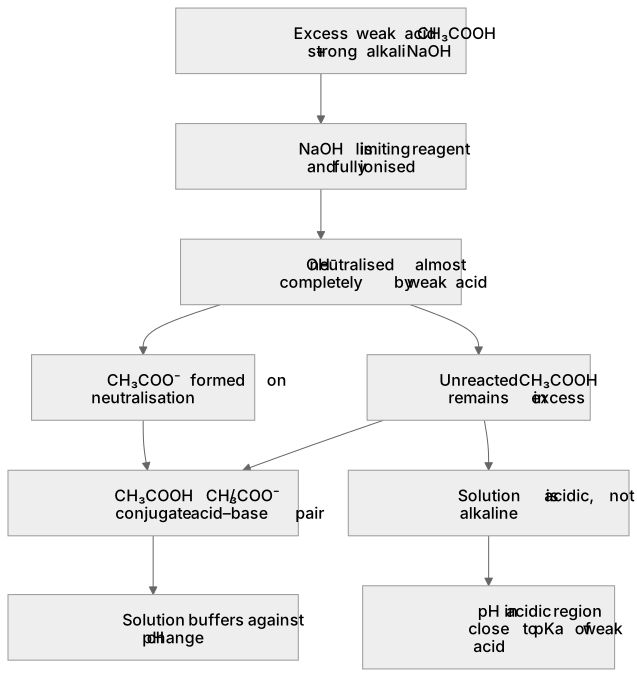
This item concerns a mixture in which a weak acid such as CH₃COOH is present in excess and a strong alkali such as NaOH is the limiting reagent. The strong alkali is fully ionised, so its OH⁻ ions are neutralised almost completely by the weak acid, which is only partially dissociated. Because unreacted weak acid remains in large amount, the resulting solution is a buffer: the undissociated CH₃COOH and its conjugate base CH₃COO⁻ form a conjugate acid–base pair that resists pH change. The pH lies in the acidic region, close to the pKa of the weak acid, not in the alkaline region, because the excess weak acid dominates. Learners should reason from amounts in moles, not from the labels 'acid' and 'alkali', and should recognise that the strong alkali is used up while the weak acid survives.
What earns the marks
- Identifies that the strong alkali is the limiting reagent and is neutralised almost completely by the excess weak acid.
- States that unreacted CH₃COOH remains in excess so the solution is acidic rather than alkaline.
- Explains that CH₃COOH and CH₃COO⁻ form a conjugate acid–base pair that buffers the solution.
- Selects the acidic pH region close to the pKa of the weak acid as the outcome of the mixture.
Common mistakes and how to put them right
Assumes that adding a strong alkali always gives an alkaline solution.
Put it right: Compare the moles and recognise that excess weak acid keeps the pH acidic.
Treats the weak acid as fully ionised like a strong acid.
Put it right: Keep the partial dissociation and the surviving undissociated CH₃COOH in the reasoning.
Ignores the conjugate base formed on neutralisation.
Put it right: Include CH₃COO⁻ as the partner of the conjugate acid–base pair.
Exam tips
- Work in moles first: subtract the moles of NaOH from the moles of CH₃COOH to find the excess weak acid.
- Link the surviving CH₃COOH/CH₃COO⁻ pair explicitly to buffer action before choosing a pH region.
- Reject any option that places the mixture in the alkaline region when weak acid is in excess.
Try the lesson
The start of the Acids, bases and buffers: (ii) excess of a weak acid and a strong alkali, e.g. excess CH₃COOH/NaOH lesson, made from teaching notes for this specification point.
Listen
This item concerns a mixture in which a weak acid such as CH₃COOH is present in excess and a strong alkali such as NaOH is the limiting reagent. The strong alkali is fully ionised, so its OH⁻ ions are neutralised almost completely by the weak acid, which is only partially dissociated. Because unreacted weak acid remains in large amount, the resulting solution is a buffer: the undissociated CH₃COOH and its conjugate base CH₃COO⁻ form a conjugate acid–base pair that resists pH change. The pH lies in the acidic region, close to the pKa of the weak acid, not in the alkaline region, because the excess weak acid dominates. Learners should reason from amounts in moles, not from the labels 'acid' and 'alkali', and should recognise that the strong alkali is used up while the weak acid survives. A strong answer earns marks for these points. Identifies that the strong alkali is the limiting reagent and is neutralised almost completely by the excess weak acid. States that unreacted CH₃COOH remains in excess so the solution is acidic rather than alkaline. Explains that CH₃COOH and CH₃COO⁻ form a conjugate acid–base pair that buffers the solution. Selects the acidic pH region close to the pKa of the weak acid as the outcome of the mixture. Exam tip: Work in moles first: subtract the moles of NaOH from the moles of CH₃COOH to find the excess weak acid.
See it
Key words
Say what each word means before you turn the card.
Limiting reagent
Try answering aloud or in your head before turning the card.
Weak acid partial dissociation
Try answering aloud or in your head before turning the card.
Conjugate acid–base pair buffering
Try answering aloud or in your head before turning the card.
Strong alkali full ionisation
Try answering aloud or in your head before turning the card.
See every definition
- Limiting reagent
- The strong alkali, which is fully ionised and is neutralised almost completely by the excess weak acid.
- Weak acid partial dissociation
- The weak acid is only partially dissociated, so undissociated CH₃COOH survives and remains in excess.
- Conjugate acid–base pair buffering
- The undissociated CH₃COOH and its conjugate base CH₃COO⁻ form a conjugate acid–base pair that resists pH change.
- Strong alkali full ionisation
- The strong alkali is fully ionised, so its OH⁻ ions are neutralised almost completely by the weak acid.
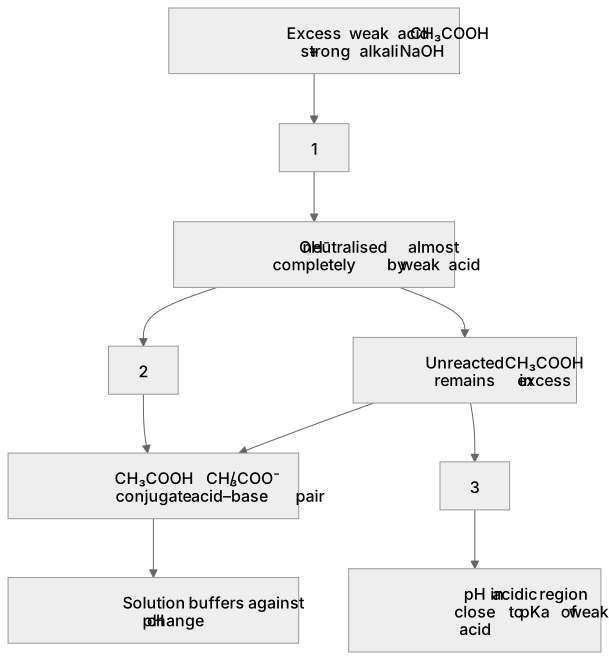
Label the diagram
Some boxes have lost their names. Pick the right name for each number.
1Box 1
2Box 2
3Box 3
There is more to this lesson
The full lesson goes on to check your understanding and help you earn the marks. Create a free account to carry on, with your progress saved.
A week of Premium from your first lesson · Then the free plan continues · No card, no charge
Test your understanding of Acids, bases and buffers: (ii) excess of a weak acid and a strong alkali, e.g. excess CH₃COOH/NaOH
Active recall beats re-reading. Take an instant quiz now to test what you’ve learned and lock it into long-term memory.
A week of Premium from your first lesson · Then the free plan continues · No card, no charge