OCR · A-Level · Chemistry
Course version: H432 · Version from Sept 2017
Acids, bases and buffers: (ii) the relationship between Ka and pKa
pKa is a logarithmic scale that makes the wide range of Ka values easier to handle.
- Point 7 of 26
- 4 key terms
Study notes
From the teaching notes for this specification point.
The idea
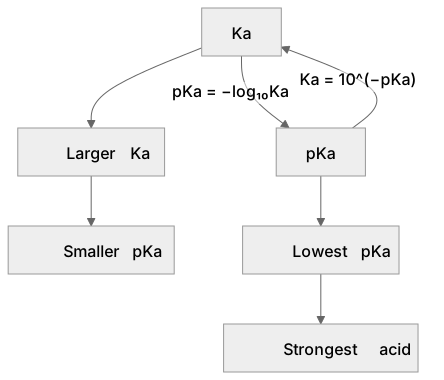
pKa is a logarithmic scale that makes the wide range of Ka values easier to handle. The relationship is pKa = −log₁₀Ka, and rearranging gives Ka = 10^(−pKa). Because of the negative sign, a larger Ka gives a smaller pKa, so a stronger acid has the lower pKa.
For example: If Ka = 1.8 × 10⁻⁵ mol dm⁻³ then pKa = −log₁₀(1.8 × 10⁻⁵) ≈ 4.74.
What earns the marks
- States the relationship pKa = −log₁₀Ka and its rearrangement Ka = 10^(−pKa).
- Explains that a larger Ka produces a smaller pKa, so the stronger acid has the lower pKa.
- Converts a given Ka into pKa by taking the negative logarithm to base ten, retaining the negative sign.
- Ranks a set of acids by pKa, identifying the lowest pKa as the strongest acid.
Common mistakes and how to put them right
Omits the negative sign when converting Ka to pKa.
Put it right: Apply pKa = −log₁₀Ka so the sign is included.
Assumes a larger pKa means a stronger acid.
Put it right: Reverse this and link the lowest pKa to the strongest acid.
Uses the natural logarithm instead of log to base ten.
Put it right: Apply log₁₀ in the pKa relationship.
Exam tips
- Write pKa = −log₁₀Ka before substituting numbers to avoid sign errors.
- Use Ka = 10^(−pKa) when working from pKa back to Ka.
- Rank acids by pKa with the lowest value as strongest, mirroring the inverse of Ka.
Try the lesson
The start of the Acids, bases and buffers: (ii) the relationship between Ka and pKa lesson, made from teaching notes for this specification point.
Listen
pKa is a logarithmic scale that makes the wide range of Ka values easier to handle. The relationship is pKa = −log₁₀Ka, and rearranging gives Ka = 10^(−pKa). Because of the negative sign, a larger Ka gives a smaller pKa, so a stronger acid has the lower pKa. For example, if Ka = 1.8 × 10⁻⁵ mol dm⁻³ then pKa = −log₁₀(1.8 × 10⁻⁵) ≈ 4.74. A strong answer earns marks for these points. States the relationship pKa = −log₁₀Ka and its rearrangement Ka = 10^(−pKa). Explains that a larger Ka produces a smaller pKa, so the stronger acid has the lower pKa. Converts a given Ka into pKa by taking the negative logarithm to base ten, retaining the negative sign. Ranks a set of acids by pKa, identifying the lowest pKa as the strongest acid. Exam tip: Write pKa = −log₁₀Ka before substituting numbers to avoid sign errors.
See it
Key words
Say what each word means before you turn the card.
Logarithmic pKa scale
Try answering aloud or in your head before turning the card.
Inverse relationship between Ka and pKa
Try answering aloud or in your head before turning the card.
Converting between Ka and pKa
Try answering aloud or in your head before turning the card.
Ranking acid strength by pKa
Try answering aloud or in your head before turning the card.
See every definition
- Logarithmic pKa scale
- A logarithmic scale that makes the wide range of Ka values easier to handle.
- Inverse relationship between Ka and pKa
- Because of the negative sign, a larger Ka gives a smaller pKa, so a stronger acid has the lower pKa.
- Converting between Ka and pKa
- The relationship is pKa = −log₁₀Ka, and rearranging gives Ka = 10^(−pKa).
- Ranking acid strength by pKa
- Use the inverse relationship to rank acid strength: lowest pKa means strongest acid.
Label the diagram
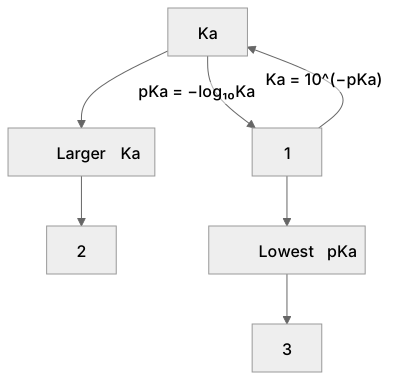
Some boxes have lost their names. Pick the right name for each number.
1Box 1
2Box 2
3Box 3
There is more to this lesson
The full lesson goes on to check your understanding and help you earn the marks. Create a free account to carry on, with your progress saved.
A week of Premium from your first lesson · Then the free plan continues · No card, no charge
Test your understanding of Acids, bases and buffers: (ii) the relationship between Ka and pKa
Active recall beats re-reading. Take an instant quiz now to test what you’ve learned and lock it into long-term memory.
A week of Premium from your first lesson · Then the free plan continues · No card, no charge