OCR · A-Level · Chemistry
Course version: H432 · Version from Sept 2017
Acids, bases and buffers: Neutralisation
Neutralisation is the reaction of an acid with a base to form a salt and water; in ionic terms H⁺ from the acid reacts with OH⁻ from the base to form H₂O. For a strong acid and strong base the…
- Point 22 of 26
- 4 key terms
Study notes
From the teaching notes for this specification point.
The idea
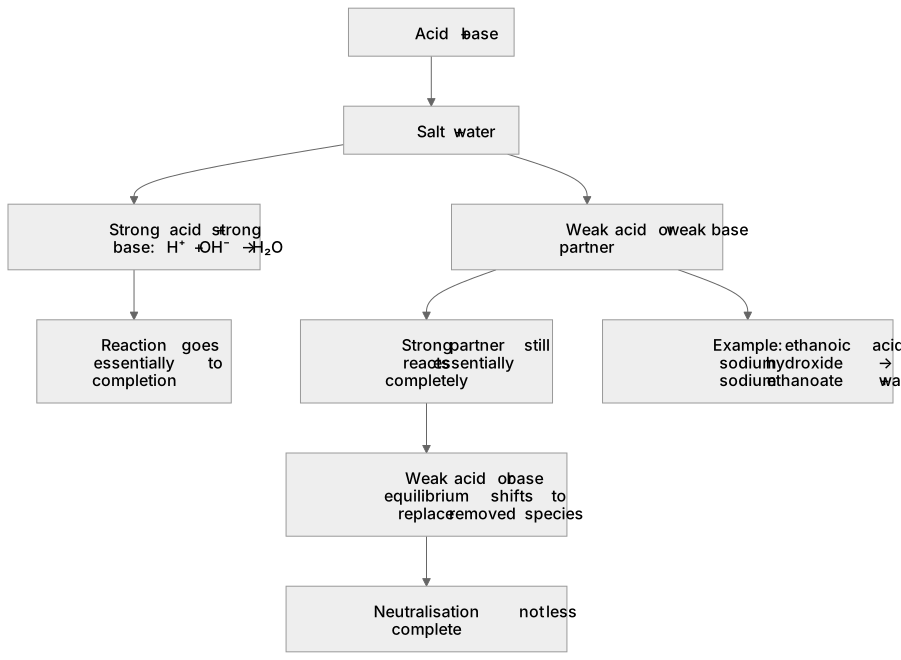
Neutralisation is the reaction of an acid with a base to form a salt and water; in ionic terms H⁺ from the acid reacts with OH⁻ from the base to form H₂O. For a strong acid and strong base the reaction goes essentially to completion. When one partner is weak, the strong partner still reacts essentially completely: the weak acid or weak base equilibrium shifts to replace the species being removed, so neutralisation is not less complete. For example, ethanoic acid with sodium hydroxide forms sodium ethanoate and water, and the ethanoic acid equilibrium shifts as H⁺ is removed. The enthalpy change of neutralisation for strong acid with strong base is about −57.1 kJ mol⁻¹ because the reaction is essentially H⁺ + OH⁻ → H₂O.
What earns the marks
- States that neutralisation forms a salt and water from the reaction of an acid with a base.
- Describes the ionic reaction as H⁺ + OH⁻ → H₂O for strong acid with strong base.
- Explains that neutralisation with a weak acid or weak base still proceeds essentially to completion because the weak acid or base equilibrium shifts.
- Identifies the salt formed from the named acid and base, for example sodium ethanoate from ethanoic acid and sodium hydroxide.
- Links the enthalpy change of neutralisation of a strong acid with a strong base to the formation of water from H⁺ and OH⁻.
Common mistakes and how to put them right
Claims that neutralisation involving a weak acid or weak base is less complete than with strong partners.
Put it right: The strong partner reacts essentially completely as the weak equilibrium shifts.
Writes the ionic equation with undissociated weak acid shown as fully ionised.
Put it right: Show weak acids mainly undissociated in the equilibrium.
Omits water from the products.
Put it right: Include water alongside the salt.
Confuses the enthalpy of neutralisation with the enthalpy of solution.
Put it right: Neutralisation refers to acid reacting with base.
Exam tips
- Write the full equation and then the ionic equation to show which ions actually react.
- For weak acids or bases, state explicitly that the equilibrium shifts to replace removed ions.
- Check the salt name against the acid and base used, including the correct anion ending.
Try the lesson
The start of the Acids, bases and buffers: Neutralisation lesson, made from teaching notes for this specification point.
Listen
Neutralisation is the reaction of an acid with a base to form a salt and water; in ionic terms H⁺ from the acid reacts with OH⁻ from the base to form H₂O. For a strong acid and strong base the reaction goes essentially to completion. When one partner is weak, the strong partner still reacts essentially completely: the weak acid or weak base equilibrium shifts to replace the species being removed, so neutralisation is not less complete. For example, ethanoic acid with sodium hydroxide forms sodium ethanoate and water, and the ethanoic acid equilibrium shifts as H⁺ is removed. The enthalpy change of neutralisation for strong acid with strong base is about −57.1 kJ mol⁻¹ because the reaction is essentially H⁺ + OH⁻ → H₂O. A strong answer earns marks for these points. States that neutralisation forms a salt and water from the reaction of an acid with a base. Describes the ionic reaction as H⁺ + OH⁻ → H₂O for strong acid with strong base. Explains that neutralisation with a weak acid or weak base still proceeds essentially to completion because the weak acid or base equilibrium shifts. Identifies the salt formed from the named acid and base, for example sodium ethanoate from ethanoic acid and sodium hydroxide. Exam tip: Write the full equation and then the ionic equation to show which ions actually react.
See it
Key words
Say what each word means before you turn the card.
Acid-base neutralisation
Try answering aloud or in your head before turning the card.
Ionic equation H⁺ + OH⁻ → H₂O
Try answering aloud or in your head before turning the card.
Weak acid and weak base equilibria
Try answering aloud or in your head before turning the card.
Enthalpy change of neutralisation
Try answering aloud or in your head before turning the card.
See every definition
- Acid-base neutralisation
- The reaction of an acid with a base to form a salt and water.
- Ionic equation H⁺ + OH⁻ → H₂O
- The ionic reaction for a strong acid with a strong base, in which H⁺ from the acid reacts with OH⁻ from the base to form H₂O.
- Weak acid and weak base equilibria
- When one partner is weak, the strong partner still reacts essentially completely because the weak acid or weak base equilibrium shifts to replace the species being removed.
- Enthalpy change of neutralisation
- For strong acid with strong base it is about −57.1 kJ mol⁻¹ because the reaction is essentially H⁺ + OH⁻ → H₂O.
Label the diagram
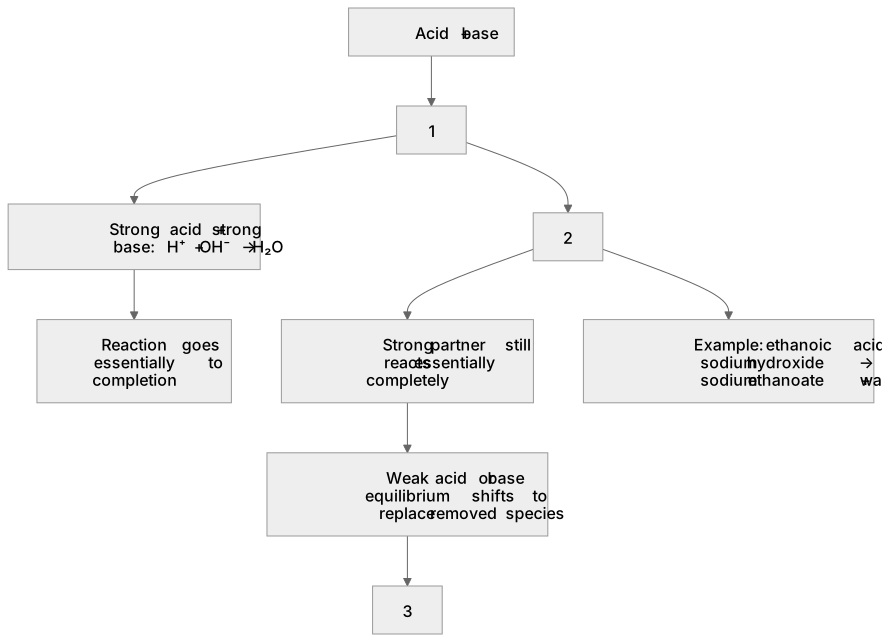
Some boxes have lost their names. Pick the right name for each number.
1Box 1
2Box 2
3Box 3
There is more to this lesson
The full lesson goes on to check your understanding and help you earn the marks. Create a free account to carry on, with your progress saved.
A week of Premium from your first lesson · Then the free plan continues · No card, no charge
Test your understanding of Acids, bases and buffers: Neutralisation
Active recall beats re-reading. Take an instant quiz now to test what you’ve learned and lock it into long-term memory.
A week of Premium from your first lesson · Then the free plan continues · No card, no charge