OCR · A-Level · Chemistry
Course version: H432 · Version from Sept 2017
(l) calculation of the pH of a buffer solution, from the Ka value of a…
Full specification wording
Acids, bases and buffers: (l) calculation of the pH of a buffer solution, from the Ka value of a weak acid and the equilibrium concentrations of the conjugate acid–base pair; calculations of related quantities
A buffer resists pH change because a weak acid HA and its conjugate base A⁻ are both present in significant amount.
- Point 21 of 26
- 4 key terms
Study notes
From the teaching notes for this specification point.
The idea
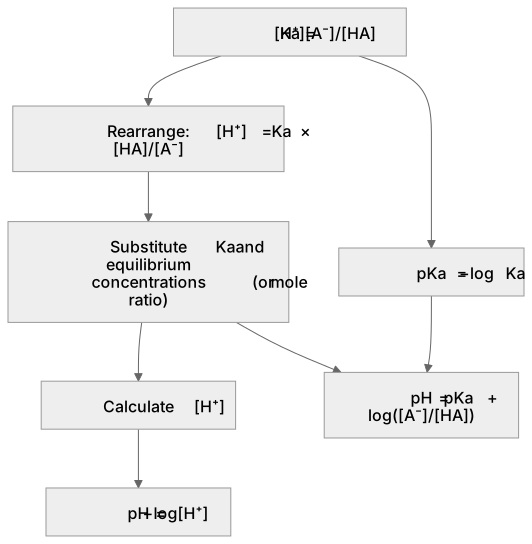
A buffer resists pH change because a weak acid HA and its conjugate base A⁻ are both present in significant amount. The acid dissociation constant Ka = [H⁺][A⁻]/[HA] rearranges to [H⁺] = Ka × [HA]/[A⁻]. Taking negative logarithms gives pH = pKa + log([A⁻]/[HA]), where pKa = −log Ka. In a typical buffer made from a weak acid partly neutralised by strong base, [HA] and [A⁻] come from the amounts present after reaction, divided by the total volume. Because both concentrations share the same volume, the ratio [A⁻]/[HA] equals the ratio of amounts in moles, so volume often cancels. Related quantities include [H⁺], pKa, Ka, the ratio of acid to base, and the pH after adding small amounts of acid or base. Worked example: a buffer with [HA] = 0.10 mol dm⁻³ and [A⁻] = 0.20 mol dm⁻³ and Ka = 1.8 × 10⁻⁵ mol dm⁻³ gives [H⁺] = 1.8 × 10⁻⁵ × 0.10/0.20 = 9.0 × 10⁻⁶ mol dm⁻³, so pH = 5.05.
What earns the marks
- Rearranges Ka = [H⁺][A⁻]/[HA] to give [H⁺] = Ka × [HA]/[A⁻] before substituting values.
- Uses the equilibrium concentrations of the conjugate acid and conjugate base, or their mole ratio, correctly in the expression.
- Calculates pH as the negative logarithm to base ten of the hydrogen ion concentration.
- Determines pKa from Ka using pKa = −log Ka and applies pH = pKa + log([A⁻]/[HA]) as an equivalent route.
- Handles related quantities such as [H⁺], Ka, pKa or the acid-to-base ratio consistently with the buffer expression.
- Keeps units consistent, recognising that Ka has units of mol dm⁻³ and that the concentration ratio is dimensionless.
Common mistakes and how to put them right
Inverts the ratio and uses [A⁻]/[HA] where [HA]/[A⁻] is required.
Put it right: Check the rearrangement of Ka before substituting.
Forgets to take the negative logarithm and reports [H⁺] as the pH.
Put it right: Convert with pH = −log[H⁺].
Uses initial amounts rather than equilibrium amounts after partial neutralisation.
Put it right: Calculate the amounts of HA and A⁻ remaining.
Mixes up Ka and pKa in the expression.
Put it right: Convert with pKa = −log Ka first.
Exam tips
- Write the Ka expression and rearrange it explicitly before inserting numbers, so the method is visible.
- Check whether the question gives concentrations or moles; if moles, divide by total volume or use the mole ratio directly.
- Sanity-check the answer: a buffer with more conjugate base than acid should give pH above pKa.
- Quote pH to an appropriate number of decimal places, usually two, consistent with the data given.
Try the lesson
The start of the Acids, bases and buffers: (l) calculation of the pH of a buffer solution, from the Ka value of a weak acid and the equilibrium concentrations of the conjugate acid–base pair; calculations of related quantities lesson, made from teaching notes for this specification point.
Listen
A buffer resists pH change because a weak acid HA and its conjugate base A⁻ are both present in significant amount. The acid dissociation constant Ka = [H⁺][A⁻]/[HA] rearranges to [H⁺] = Ka × [HA]/[A⁻]. Taking negative logarithms gives pH = pKa + log([A⁻]/[HA]), where pKa = −log Ka. In a typical buffer made from a weak acid partly neutralised by strong base, [HA] and [A⁻] come from the amounts present after reaction, divided by the total volume. Because both concentrations share the same volume, the ratio [A⁻]/[HA] equals the ratio of amounts in moles, so volume often cancels. Related quantities include [H⁺], pKa, Ka, the ratio of acid to base, and the pH after adding small amounts of acid or base. Worked example: a buffer with [HA] = 0.10 mol dm⁻³ and [A⁻] = 0.20 mol dm⁻³ and Ka = 1.8 × 10⁻⁵ mol dm⁻³ gives [H⁺] = 1.8 × 10⁻⁵ × 0.10/0.20 = 9.0 × 10⁻⁶ mol dm⁻³, so pH = 5.05. A strong answer earns marks for these points. Rearranges Ka = [H⁺][A⁻]/[HA] to give [H⁺] = Ka × [HA]/[A⁻] before substituting values. Uses the equilibrium concentrations of the conjugate acid and conjugate base, or their mole ratio, correctly in the expression. Calculates pH as the negative logarithm to base ten of the hydrogen ion concentration. Determines pKa from Ka using pKa = −log Ka and applies pH = pKa + log([A⁻]/[HA]) as an equivalent route. Exam tip: Write the Ka expression and rearrange it explicitly before inserting numbers, so the method is visible.
See it
Key words
Say what each word means before you turn the card.
Acid dissociation constant and its rearrangement
Try answering aloud or in your head before turning the card.
Buffer solutions and the conjugate acid–base pair
Try answering aloud or in your head before turning the card.
pH, pKa and logarithmic relationships
Try answering aloud or in your head before turning the card.
Equilibrium concentrations after partial neutralisation
Try answering aloud or in your head before turning the card.
See every definition
- Acid dissociation constant and its rearrangement
- Ka = [H⁺][A⁻]/[HA] rearranges to [H⁺] = Ka × [HA]/[A⁻], and has units of mol dm⁻³.
- Buffer solutions and the conjugate acid–base pair
- A buffer resists pH change because a weak acid HA and its conjugate base A⁻ are both present in significant amount.
- pH, pKa and logarithmic relationships
- pH is the negative logarithm to base ten of the hydrogen ion concentration, pKa = −log Ka, and pH = pKa + log([A⁻]/[HA]).
- Equilibrium concentrations after partial neutralisation
- In a buffer made from a weak acid partly neutralised by strong base, [HA] and [A⁻] come from the amounts present after reaction, divided by the total volume.
Label the diagram
Some boxes have lost their names. Pick the right name for each number.
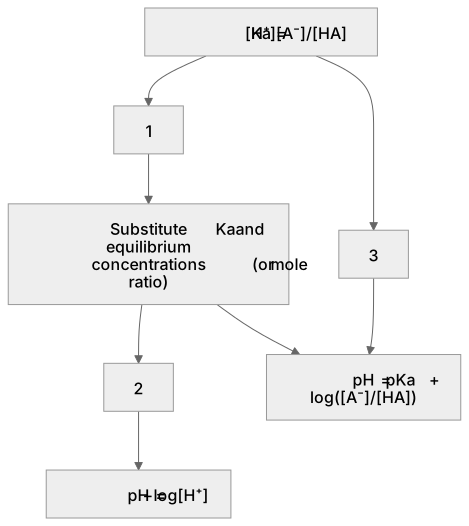
1Box 1
2Box 2
3Box 3
There is more to this lesson
The full lesson goes on to check your understanding and help you earn the marks. Create a free account to carry on, with your progress saved.
A week of Premium from your first lesson · Then the free plan continues · No card, no charge
Test your understanding of Acids, bases and buffers: (l) calculation of the pH of a buffer solution, from the Ka value of a weak acid and the equilibrium concentrations of the conjugate acid–base pair; calculations of related quantities
Active recall beats re-reading. Take an instant quiz now to test what you’ve learned and lock it into long-term memory.
A week of Premium from your first lesson · Then the free plan continues · No card, no charge