OCR · A-Level · Chemistry
Course version: H432 · Version from Sept 2017
(e) structured and non-structured titration calculations, based on…
Full specification wording
Acids: (e) structured and non-structured titration calculations, based on experimental results of familiar and non-familiar acids and bases.
Titration calculations start from the mean titre in cm³, converted to dm³ by dividing by 1000, and the known concentration of the standard solution, giving amount in moles by n = c × V. The…
- Point 7 of 7
- 4 key terms
Study notes
From the teaching notes for this specification point.
The idea
Titration calculations start from the mean titre in cm³, converted to dm³ by dividing by 1000, and the known concentration of the standard solution, giving amount in moles by n = c × V. The balanced equation gives the mole ratio between the two reactants, so the amount of the unknown is found. Dividing by its volume in dm³ gives its concentration; multiplying by its molar mass gives mass concentration if needed. Structured questions lead you through these steps, while non-structured questions require you to choose the route yourself. The method works for familiar acids and bases such as hydrochloric acid and sodium hydroxide and for unfamiliar ones, because only the balanced equation and the data change.
What earns the marks
- Converts the mean titre from cm³ to dm³ by dividing by 1000 before use.
- Calculates the amount of the known solution using n = c × V.
- Applies the mole ratio from the balanced equation to find the amount of the unknown.
- Divides the amount of the unknown by its volume in dm³ to obtain its concentration.
- Multiplies concentration by molar mass to find mass concentration where required.
- Selects the correct sequence of steps without prompts in a non-structured calculation.
Common mistakes and how to put them right
Uses the titre in cm³ directly in n = c × V.
Put it right: Convert to dm³ first by dividing by 1000.
Inverts the mole ratio from the balanced equation.
Put it right: Read the coefficients in the equation to set the ratio correctly.
Uses the total volume of the conical flask mixture instead of the titre volume delivered from the burette.
Rounds intermediate amounts too early.
Put it right: Carry extra figures and round only the final answer.
Exam tips
- Write the balanced equation first so the mole ratio is clear before calculating.
- Show each stage of working so method marks can be awarded even if the final value is wrong.
- Check the units of every quantity before substituting into n = c × V.
- For unfamiliar acids or bases, rely on the balanced equation rather than assumed formulae.
Try the lesson
The start of the Acids: (e) structured and non-structured titration calculations, based on experimental results of familiar and non-familiar acids and bases. lesson, made from teaching notes for this specification point.
Listen
Titration calculations start from the mean titre in cm³, converted to dm³ by dividing by 1000, and the known concentration of the standard solution, giving amount in moles by n = c × V. The balanced equation gives the mole ratio between the two reactants, so the amount of the unknown is found. Dividing by its volume in dm³ gives its concentration; multiplying by its molar mass gives mass concentration if needed. Structured questions lead you through these steps, while non-structured questions require you to choose the route yourself. The method works for familiar acids and bases such as hydrochloric acid and sodium hydroxide and for unfamiliar ones, because only the balanced equation and the data change. A strong answer earns marks for these points. Converts the mean titre from cm³ to dm³ by dividing by 1000 before use. Calculates the amount of the known solution using n = c × V. Applies the mole ratio from the balanced equation to find the amount of the unknown. Divides the amount of the unknown by its volume in dm³ to obtain its concentration. Exam tip: Write the balanced equation first so the mole ratio is clear before calculating.
See it
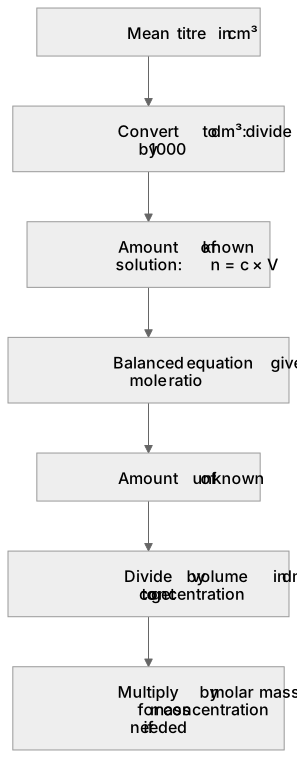
Put it in order
Put these steps in the order they happen.
- 1. Multiply by molar mass for mass concentration if needed
- 2. Divide by volume in dm³ to get concentration
- 3. Amount of known solution: n = c × V
- 4. Amount of unknown
- 5. Mean titre in cm³
- 6. Convert to dm³: divide by 1000
- 7. Balanced equation gives mole ratio
Key words
Say what each word means before you turn the card.
Mole calculations from titration data
Try answering aloud or in your head before turning the card.
Converting cm³ to dm³
Try answering aloud or in your head before turning the card.
Mole ratios from balanced equations
Try answering aloud or in your head before turning the card.
Concentration and mass concentration
Try answering aloud or in your head before turning the card.
See every definition
- Mole calculations from titration data
- Starting from the mean titre in cm³ and the known concentration of the standard solution, the amount in moles is found by n = c × V.
- Converting cm³ to dm³
- The mean titre in cm³ is converted to dm³ by dividing by 1000 before use.
- Mole ratios from balanced equations
- The balanced equation gives the mole ratio between the two reactants, so the amount of the unknown is found.
- Concentration and mass concentration
- Dividing the amount of the unknown by its volume in dm³ gives its concentration; multiplying by its molar mass gives mass concentration if needed.
Label the diagram
Some boxes have lost their names. Pick the right name for each number.
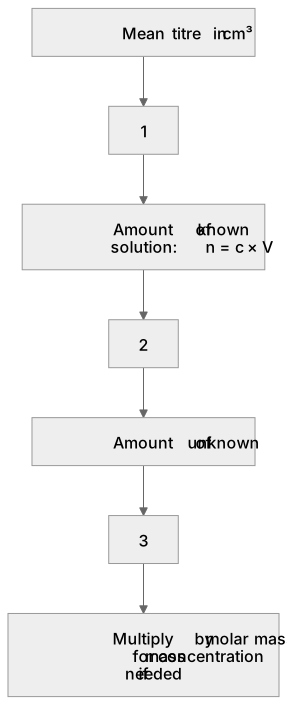
1Box 1
2Box 2
3Box 3
There is more to this lesson
The full lesson goes on to check your understanding and help you earn the marks. Create a free account to carry on, with your progress saved.
A week of Premium from your first lesson · Then the free plan continues · No card, no charge
Test your understanding of Acids: (e) structured and non-structured titration calculations, based on experimental results of familiar and non-familiar acids and bases.
Active recall beats re-reading. Take an instant quiz now to test what you’ve learned and lock it into long-term memory.
A week of Premium from your first lesson · Then the free plan continues · No card, no charge