OCR · A-Level · Chemistry
Course version: H432 · Version from Sept 2017
(d) the techniques and procedures used when preparing a standard solution…
Full specification wording
Acids: (d) the techniques and procedures used when preparing a standard solution of required concentration and carrying out acid–base titrations
This point requires practical technique, not just description.
- Point 6 of 7
- 4 key terms
Study notes
From the teaching notes for this specification point.
The idea
This point requires practical technique, not just description. For a standard solution, weigh the solid accurately, dissolve it in a small volume of distilled water in a beaker, transfer the solution and rinsings through a funnel into a volumetric flask, then add distilled water to the graduation mark and invert to mix. For a titration, rinse and fill the burette with the titrant, pipette a measured volume of the analyte into a conical flask, and add the indicator before you begin. Run titrant in, swirling continuously, and add it dropwise as the end point approaches. Record the volume at the first permanent colour change and repeat for concordant results.
What earns the marks
- Describes weighing the solid accurately and dissolving it in a small volume of distilled water before transfer.
- Transfers the solution and beaker rinsings into a volumetric flask and makes up to the graduation mark before mixing.
- Adds the indicator to the measured analyte in the conical flask before starting the titration.
- Runs titrant from the burette with swirling and adds it dropwise as the end point approaches.
- Records the burette reading at the first permanent colour change and repeats to obtain concordant titres.
Common mistakes and how to put them right
Adds the indicator dropwise near the end point.
Put it right: Add the indicator to the analyte before the titration begins.
Makes the volumetric flask up to the mark before transferring all rinsings.
Put it right: Include the beaker rinsings in the flask before making up to the mark.
Stops at the first flash of colour.
Put it right: Record the volume at the first permanent colour change and repeat for concordance.
Exam tips
- Learn the standard-solution sequence as an ordered list so no transfer or rinsing step is missed.
- State clearly that the indicator goes into the flask before titration and that titrant is added dropwise near the end point.
- Explain why each step matters, such as rinsings ensuring all solute reaches the flask, to show understanding rather than recall alone.
Try the lesson
The start of the Acids: (d) the techniques and procedures used when preparing a standard solution of required concentration and carrying out acid–base titrations lesson, made from teaching notes for this specification point.
Listen
This point requires practical technique, not just description. For a standard solution, weigh the solid accurately, dissolve it in a small volume of distilled water in a beaker, transfer the solution and rinsings through a funnel into a volumetric flask, then add distilled water to the graduation mark and invert to mix. For a titration, rinse and fill the burette with the titrant, pipette a measured volume of the analyte into a conical flask, and add the indicator before you begin. Run titrant in, swirling continuously, and add it dropwise as the end point approaches. Record the volume at the first permanent colour change and repeat for concordant results. A strong answer earns marks for these points. Describes weighing the solid accurately and dissolving it in a small volume of distilled water before transfer. Transfers the solution and beaker rinsings into a volumetric flask and makes up to the graduation mark before mixing. Adds the indicator to the measured analyte in the conical flask before starting the titration. Runs titrant from the burette with swirling and adds it dropwise as the end point approaches. Exam tip: Learn the standard-solution sequence as an ordered list so no transfer or rinsing step is missed.
See it
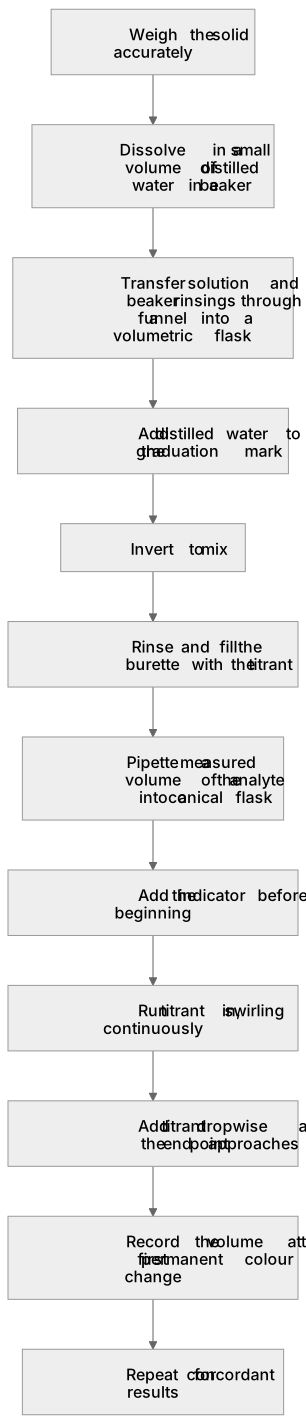
Key words
Say what each word means before you turn the card.
Accurate weighing and dissolving
Try answering aloud or in your head before turning the card.
Quantitative transfer to a volumetric flask
Try answering aloud or in your head before turning the card.
Indicator added before titration
Try answering aloud or in your head before turning the card.
Dropwise addition near the end point
Try answering aloud or in your head before turning the card.
See every definition
- Accurate weighing and dissolving
- Weigh the solid accurately and dissolve it in a small volume of distilled water in a beaker.
- Quantitative transfer to a volumetric flask
- Transfer the solution and beaker rinsings through a funnel into a volumetric flask, then add distilled water to the graduation mark and invert to mix.
- Indicator added before titration
- Add the indicator to the measured analyte in the conical flask before starting the titration.
- Dropwise addition near the end point
- Run titrant in, swirling continuously, and add it dropwise as the end point approaches.
Label the diagram
Some boxes have lost their names. Pick the right name for each number.
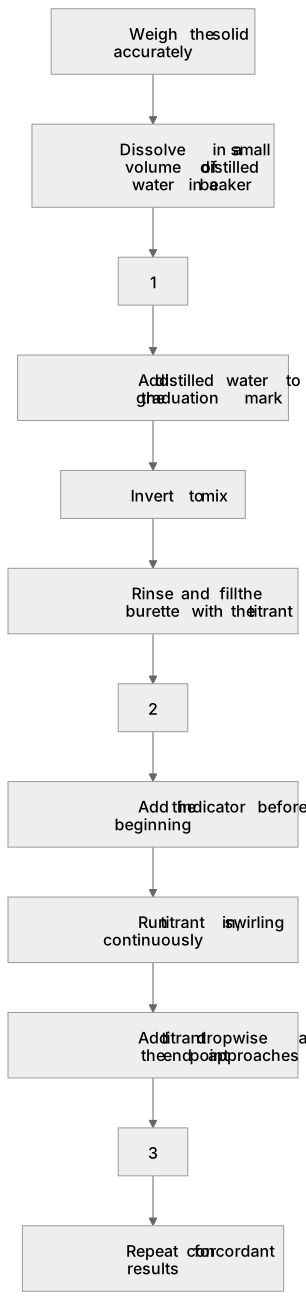
1Box 1
2Box 2
3Box 3
There is more to this lesson
The full lesson goes on to check your understanding and help you earn the marks. Create a free account to carry on, with your progress saved.
A week of Premium from your first lesson · Then the free plan continues · No card, no charge
Test your understanding of Acids: (d) the techniques and procedures used when preparing a standard solution of required concentration and carrying out acid–base titrations
Active recall beats re-reading. Take an instant quiz now to test what you’ve learned and lock it into long-term memory.
A week of Premium from your first lesson · Then the free plan continues · No card, no charge