OCR · A-Level · Chemistry
Course version: H432 · Version from Sept 2017
(d) elimination of H₂O from alcohols in the presence of an acid catalyst…
Full specification wording
Alcohols: (d) elimination of H₂O from alcohols in the presence of an acid catalyst (e.g. H₃PO₄ or H₂SO₄) and heat to form alkenes
This is acid-catalysed dehydration of an alcohol.
- Point 9 of 10
- 4 key terms
Study notes
From the teaching notes for this specification point.
The idea
This is acid-catalysed dehydration of an alcohol. Heat the alcohol with a concentrated acid catalyst such as H₃PO₄ or H₂SO₄; the acid protonates the –OH group, a water molecule leaves and a carbocation forms, then a neighbouring C–H bond breaks to give a C=C and regenerate the catalyst. Ethanol, for example, gives ethene plus water. The organic product is an alkene, so the key structural change is loss of H and OH from adjacent carbon atoms to create the double bond. Recognise that the acid is a catalyst, that heat is needed, and that the product contains a C=C bond rather than a new functional group such as a halogen.
What earns the marks
- Identifies the reaction as elimination of water (dehydration) from an alcohol to give an alkene.
- States that an acid catalyst such as H₃PO₄ or H₂SO₄ is required together with heat.
- Recognises that the acid is regenerated and so acts as a catalyst rather than being consumed.
- Describes the structural change as removal of H and OH from adjacent carbon atoms to form a C=C bond.
- Selects the alkene as the organic product, for example ethene from ethanol.
Common mistakes and how to put them right
Names the product as an alkane.
Put it right by stating that a C=C double bond forms, giving an alkene.
Treats the acid as a reactant that is used up.
Put it right by describing it as a catalyst that is regenerated.
Omits the need for heat.
Put it right by including heating with the acid catalyst in the method.
Expects a halogen to be incorporated.
Put it right by noting that dehydration adds no new atom to the carbon skeleton.
Exam tips
- Check whether the question asks for the type of reaction, the reagent and condition, or the product, and answer that specific point.
- Link the word elimination to the loss of a small molecule (water) and the formation of a double bond.
- When a structure is shown, count that H and OH leave adjacent carbons so the double bond can form.
Try the lesson
The start of the Alcohols: (d) elimination of H₂O from alcohols in the presence of an acid catalyst (e.g. H₃PO₄ or H₂SO₄) and heat to form alkenes lesson, made from teaching notes for this specification point.
Listen
This is acid-catalysed dehydration of an alcohol. Heat the alcohol with a concentrated acid catalyst such as H₃PO₄ or H₂SO₄; the acid protonates the –OH group, a water molecule leaves and a carbocation forms, then a neighbouring C–H bond breaks to give a C=C and regenerate the catalyst. Ethanol, for example, gives ethene plus water. The organic product is an alkene, so the key structural change is loss of H and OH from adjacent carbon atoms to create the double bond. Recognise that the acid is a catalyst, that heat is needed, and that the product contains a C=C bond rather than a new functional group such as a halogen. A strong answer earns marks for these points. Identifies the reaction as elimination of water (dehydration) from an alcohol to give an alkene. States that an acid catalyst such as H₃PO₄ or H₂SO₄ is required together with heat. Recognises that the acid is regenerated and so acts as a catalyst rather than being consumed. Describes the structural change as removal of H and OH from adjacent carbon atoms to form a C=C bond. A common slip: Names the product as an alkane. Instead, stating that a C=C double bond forms, giving an alkene. Exam tip: Check whether the question asks for the type of reaction, the reagent and condition, or the product, and answer that specific point.
See it
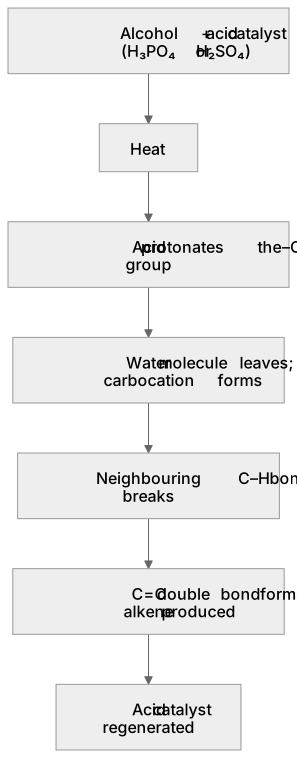
Put it in order
Put these steps in the order they happen.
- 1. Acid catalyst regenerated
- 2. C=C double bond forms; alkene produced
- 3. Acid protonates the –OH group
- 4. Neighbouring C–H bond breaks
- 5. Alcohol + acid catalyst (H₃PO₄ or H₂SO₄)
- 6. Heat
- 7. Water molecule leaves; carbocation forms
Key words
Say what each word means before you turn the card.
Elimination reactions
Try answering aloud or in your head before turning the card.
Acid catalysis
Try answering aloud or in your head before turning the card.
Alcohols to alkenes
Try answering aloud or in your head before turning the card.
Reaction conditions
Try answering aloud or in your head before turning the card.
See every definition
- Elimination reactions
- Reactions in which water is lost from an alcohol and a C=C double bond forms, with H and OH removed from adjacent carbon atoms.
- Acid catalysis
- The acid is regenerated rather than being consumed, so it acts as a catalyst in the reaction.
- Alcohols to alkenes
- Heating an alcohol with an acid catalyst gives an alkene as the organic product, for example ethene from ethanol.
- Reaction conditions
- An acid catalyst such as H₃PO₄ or H₂SO₄ is required together with heat.
Label the diagram
Some boxes have lost their names. Pick the right name for each number.
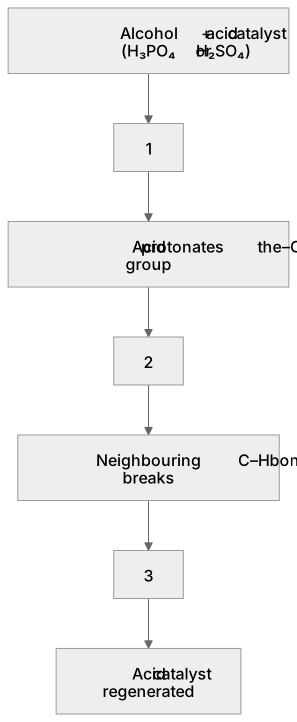
1Box 1
2Box 2
3Box 3
There is more to this lesson
The full lesson goes on to check your understanding and help you earn the marks. Create a free account to carry on, with your progress saved.
A week of Premium from your first lesson · Then the free plan continues · No card, no charge
Test your understanding of Alcohols: (d) elimination of H₂O from alcohols in the presence of an acid catalyst (e.g. H₃PO₄ or H₂SO₄) and heat to form alkenes
Active recall beats re-reading. Take an instant quiz now to test what you’ve learned and lock it into long-term memory.
A week of Premium from your first lesson · Then the free plan continues · No card, no charge