OCR · A-Level · Chemistry
Course version: H432 · Version from Sept 2017
(e) substitution with halide ions in the presence of acid (e.g.…
Full specification wording
Alcohols: (e) substitution with halide ions in the presence of acid (e.g. NaBr/H₂SO₄) to form haloalkanes.
This is conversion of an alcohol into a haloalkane by substitution.
- Point 10 of 10
- 2 key terms
Study notes
From the teaching notes for this specification point.
The idea
This is conversion of an alcohol into a haloalkane by substitution. A mixture such as NaBr with H₂SO₄ generates hydrogen bromide in situ; the acid protonates the alcohol's –OH group so it becomes a good leaving group, a halide ion then attacks the carbon and displaces water, giving a haloalkane. The net change is replacement of –OH by –X (for example –Br), so the carbon skeleton is retained and one functional group is swapped for another. Distinguish this from elimination: substitution keeps the single bonds and adds a halogen, whereas elimination forms a C=C. Recognise that acid is present to generate the hydrogen halide and to protonate the alcohol.
What earns the marks
- Identifies the reaction as substitution in which the –OH group of the alcohol is replaced by a halide.
- States that a halide source such as NaBr with H₂SO₄ generates the hydrogen halide needed.
- Recognises that acid is present to protonate the alcohol and make water a good leaving group.
- Describes the product as a haloalkane with the carbon skeleton unchanged.
- Distinguishes substitution from elimination by noting that no C=C bond is formed.
Common mistakes and how to put them right
Describes the reaction as elimination.
Put it right by stating that –OH is replaced by a halogen and no double bond forms.
Assumes the halogen is added without loss of anything.
Put it right by noting that the –OH group is displaced.
Ignores the role of acid.
Put it right by explaining that acid generates HBr and protonates the alcohol.
Changes the carbon skeleton.
Put it right by keeping the same carbon chain and only swapping the functional group.
Exam tips
- Identify which atom or group leaves and which is introduced, then state the substitution clearly.
- Use the reagent given (for example NaBr/H₂SO₄) to deduce that HBr is generated and a bromoalkane forms.
- Compare with dehydration so you do not confuse substitution (haloalkane) with elimination (alkene).
Try the lesson
The start of the Alcohols: (e) substitution with halide ions in the presence of acid (e.g. NaBr/H₂SO₄) to form haloalkanes. lesson, made from teaching notes for this specification point.
Listen
This is conversion of an alcohol into a haloalkane by substitution. A mixture such as NaBr with H₂SO₄ generates hydrogen bromide in situ; the acid protonates the alcohol's –OH group so it becomes a good leaving group, a halide ion then attacks the carbon and displaces water, giving a haloalkane. The net change is replacement of –OH by –X (for example –Br), so the carbon skeleton is retained and one functional group is swapped for another. Distinguish this from elimination: substitution keeps the single bonds and adds a halogen, whereas elimination forms a C=C. Recognise that acid is present to generate the hydrogen halide and to protonate the alcohol. A strong answer earns marks for these points. Identifies the reaction as substitution in which the –OH group of the alcohol is replaced by a halide. States that a halide source such as NaBr with H₂SO₄ generates the hydrogen halide needed. Recognises that acid is present to protonate the alcohol and make water a good leaving group. Describes the product as a haloalkane with the carbon skeleton unchanged. A common slip: Describes the reaction as elimination. Instead, stating that –OH is replaced by a halogen and no double bond forms. Exam tip: Identify which atom or group leaves and which is introduced, then state the substitution clearly.
See it
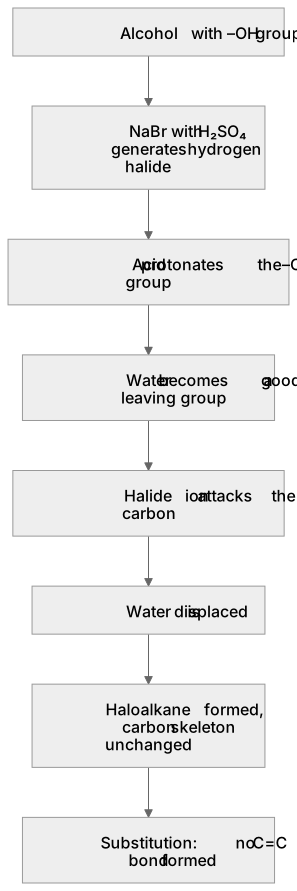
Put it in order
Put these steps in the order they happen.
- 1. Halide ion attacks the carbon
- 2. Substitution: no C=C bond formed
- 3. Water is displaced
- 4. Alcohol with –OH group
- 5. NaBr with H₂SO₄ generates hydrogen halide
- 6. Haloalkane formed, carbon skeleton unchanged
- 7. Acid protonates the –OH group
- 8. Water becomes a good leaving group
Key words
Say what each word means before you turn the card.
Haloalkanes
Try answering aloud or in your head before turning the card.
Role of acid
Try answering aloud or in your head before turning the card.
See every definition
- Haloalkanes
- The product formed when the –OH group of an alcohol is replaced by a halide, with the carbon skeleton unchanged.
- Role of acid
- Acid is present to generate the hydrogen halide and to protonate the alcohol so it becomes a good leaving group.
Label the diagram
Some boxes have lost their names. Pick the right name for each number.
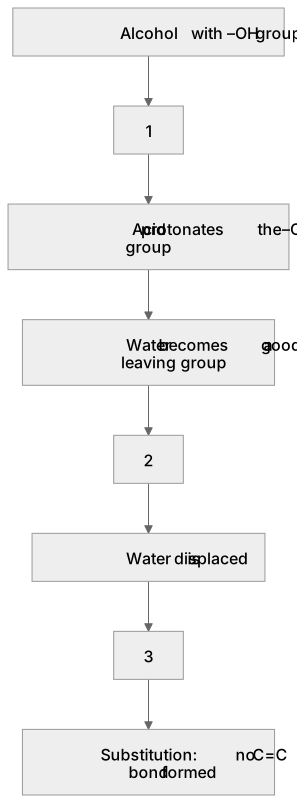
1Box 1
2Box 2
3Box 3
There is more to this lesson
The full lesson goes on to check your understanding and help you earn the marks. Create a free account to carry on, with your progress saved.
A week of Premium from your first lesson · Then the free plan continues · No card, no charge
Test your understanding of Alcohols: (e) substitution with halide ions in the presence of acid (e.g. NaBr/H₂SO₄) to form haloalkanes.
Active recall beats re-reading. Take an instant quiz now to test what you’ve learned and lock it into long-term memory.
A week of Premium from your first lesson · Then the free plan continues · No card, no charge