OCR · A-Level · Chemistry
Course version: H432 · Version from Sept 2017
(c) two-stage synthetic routes for preparing organic compounds.
Full specification wording
Alcohols, haloalkanes and analysis - 4.2.3 Organic synthesis: (c) two-stage synthetic routes for preparing organic compounds.
A two-stage route converts a stated starting material into a stated target by naming two reactions in order, each with its reagent and condition.
- Point 9 of 9
- 4 key terms
Study notes
From the teaching notes for this specification point.
The idea
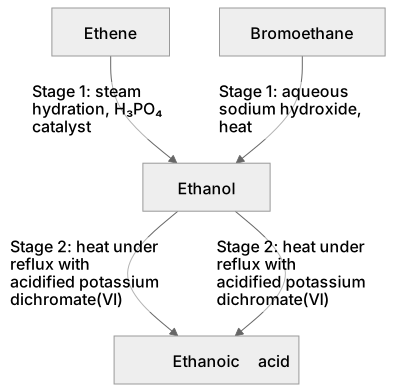
A two-stage route converts a stated starting material into a stated target by naming two reactions in order, each with its reagent and condition. Stage 1 changes the functional group; stage 2 changes it again. For example, ethene to ethanoic acid runs through ethanol: steam hydration with H₃PO₄ catalyst gives ethanol, then heating under reflux with acidified potassium dichromate(VI) oxidises the primary alcohol to the carboxylic acid. Alternatively, bromoethane to ethanoic acid goes via ethanol using aqueous NaOH hydrolysis, then oxidation. Check carbon skeleton, functional group and carbon number at each stage, and reject routes that skip a step or use a reagent that cannot deliver the change.
What earns the marks
- Names two reactions in the correct order, each with a reagent and a condition that can deliver the required functional-group change.
- Checks that the carbon skeleton and carbon number are preserved or deliberately changed at each stage of the route.
- Selects acidified potassium dichromate(VI) under reflux to oxidise a primary alcohol to a carboxylic acid.
- Uses aqueous sodium hydroxide and heat to hydrolyse a haloalkane to an alcohol before a later oxidation step.
- Rejects a one-step proposal when the target functional group cannot be reached directly from the starting material.
Common mistakes and how to put them right
Omits the reagent or condition for one stage.
Put it right: State both the reagent and the condition for every stage.
Uses distillation instead of reflux when a carboxylic acid is required.
Put it right: Choose reflux for full oxidation of a primary alcohol.
Proposes oxidation of a haloalkane directly.
Put it right: Hydrolyse the haloalkane to an alcohol first, then oxidise.
Exam tips
- Write the route as numbered stages, each with starting compound, reagent, condition and product.
- Check the oxidation state of the carbon centre at each stage to confirm the change is feasible.
- Underline the functional group in the start and target before choosing reactions.
Try the lesson
The start of the Alcohols, haloalkanes and analysis - 4.2.3 Organic synthesis: (c) two-stage synthetic routes for preparing organic compounds. lesson, made from teaching notes for this specification point.
Listen
A two-stage route converts a stated starting material into a stated target by naming two reactions in order, each with its reagent and condition. Stage 1 changes the functional group; stage 2 changes it again. For example, ethene to ethanoic acid runs through ethanol: steam hydration with H₃PO₄ catalyst gives ethanol, then heating under reflux with acidified potassium dichromate(VI) oxidises the primary alcohol to the carboxylic acid. Alternatively, bromoethane to ethanoic acid goes via ethanol using aqueous NaOH hydrolysis, then oxidation. Check carbon skeleton, functional group and carbon number at each stage, and reject routes that skip a step or use a reagent that cannot deliver the change. A strong answer earns marks for these points. Names two reactions in the correct order, each with a reagent and a condition that can deliver the required functional-group change. Checks that the carbon skeleton and carbon number are preserved or deliberately changed at each stage of the route. Selects acidified potassium dichromate(VI) under reflux to oxidise a primary alcohol to a carboxylic acid. Uses aqueous sodium hydroxide and heat to hydrolyse a haloalkane to an alcohol before a later oxidation step. Exam tip: Write the route as numbered stages, each with starting compound, reagent, condition and product.
See it
Key words
Say what each word means before you turn the card.
Functional-group interconversion
Try answering aloud or in your head before turning the card.
Reagent and condition selection
Try answering aloud or in your head before turning the card.
Ordering of reaction steps
Try answering aloud or in your head before turning the card.
Carbon-skeleton conservation
Try answering aloud or in your head before turning the card.
See every definition
- Functional-group interconversion
- Each stage of a two-stage route changes the functional group, and stage 2 changes it again.
- Reagent and condition selection
- Every stage is named with a reagent and a condition that can deliver the required functional-group change.
- Ordering of reaction steps
- The two reactions are named in order, and routes that skip a step are rejected.
- Carbon-skeleton conservation
- The carbon skeleton and carbon number are checked at each stage to confirm they are preserved or deliberately changed.
Label the diagram
Some boxes have lost their names. Pick the right name for each number.
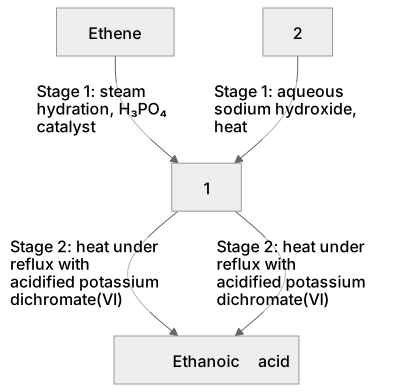
1Box 1
2Box 2
There is more to this lesson
The full lesson goes on to check your understanding and help you earn the marks. Create a free account to carry on, with your progress saved.
A week of Premium from your first lesson · Then the free plan continues · No card, no charge
Test your understanding of Alcohols, haloalkanes and analysis - 4.2.3 Organic synthesis: (c) two-stage synthetic routes for preparing organic compounds.
Active recall beats re-reading. Take an instant quiz now to test what you’ve learned and lock it into long-term memory.
A week of Premium from your first lesson · Then the free plan continues · No card, no charge