OCR · A-Level · Chemistry
Course version: H432 · Version from Sept 2017
(ii) prediction of properties and reactions
Full specification wording
Alcohols, haloalkanes and analysis - 4.2.3 Organic synthesis: (ii) prediction of properties and reactions
Predicting properties and reactions means using the functional groups you have identified to say how a molecule will behave.
- Point 8 of 9
- 4 key terms
Study notes
From the teaching notes for this specification point.
The idea
Predicting properties and reactions means using the functional groups you have identified to say how a molecule will behave. Link each group to its characteristic chemistry: alcohols undergo oxidation to aldehydes, ketones or carboxylic acids depending on their class and the conditions, and react with sodium to give hydrogen; haloalkanes undergo nucleophilic substitution and elimination; alkenes undergo electrophilic addition and decolourise bromine water; aldehydes are oxidised by Tollens' or Fehling's reagents while ketones are not; carboxylic acids react with carbonates to release carbon dioxide; esters hydrolyse. Physical properties follow structure too: hydrogen bonding raises boiling point in alcohols and carboxylic acids, and larger chains raise boiling point through stronger induced dipole–dipole forces.
What earns the marks
- Links each identified functional group to a characteristic reaction and states the reagent or condition needed.
- Predicts the oxidation product of a primary alcohol as an aldehyde or carboxylic acid according to the conditions given.
- States that a ketone resists oxidation by Tollens' reagent while an aldehyde reduces it.
- Predicts nucleophilic substitution when a haloalkane reacts with aqueous hydroxide and elimination when ethanolic hydroxide is heated.
- Explains a difference in boiling point between two molecules by reference to hydrogen bonding or chain length.
- Selects the option whose predicted product contains the functional group consistent with the stated reaction type.
Common mistakes and how to put them right
Predicts that a tertiary alcohol is oxidised to a ketone.
Put it right: Recognise that tertiary alcohols resist oxidation under these conditions.
Assumes all alcohols react with Tollens' reagent.
Put it right: Only aldehydes give a positive result.
Predicts addition across a C=O bond when the reagent attacks a C=C bond.
Put it right: Match the reagent to the correct functional group.
Ignores the solvent or condition when predicting haloalkane reactions.
Put it right: Aqueous hydroxide favours substitution and ethanolic hydroxide with heat favours elimination.
Exam tips
- Write the functional group beside the reagent before choosing an option.
- Check the oxidation state of the carbon bearing the –OH to decide whether oxidation is possible.
- Use the product's functional group to test whether the proposed reaction makes chemical sense.
- Recall that hydrogen bonding requires an O–H or N–H bond, so check for one before claiming it.
Try the lesson
The start of the Alcohols, haloalkanes and analysis - 4.2.3 Organic synthesis: (ii) prediction of properties and reactions lesson, made from teaching notes for this specification point.
Listen
Predicting properties and reactions means using the functional groups you have identified to say how a molecule will behave. Link each group to its characteristic chemistry: alcohols undergo oxidation to aldehydes, ketones or carboxylic acids depending on their class and the conditions, and react with sodium to give hydrogen; haloalkanes undergo nucleophilic substitution and elimination; alkenes undergo electrophilic addition and decolourise bromine water; aldehydes are oxidised by Tollens' or Fehling's reagents while ketones are not; carboxylic acids react with carbonates to release carbon dioxide; esters hydrolyse. Physical properties follow structure too: hydrogen bonding raises boiling point in alcohols and carboxylic acids, and larger chains raise boiling point through stronger induced dipole–dipole forces. A strong answer earns marks for these points. Links each identified functional group to a characteristic reaction and states the reagent or condition needed. Predicts the oxidation product of a primary alcohol as an aldehyde or carboxylic acid according to the conditions given. States that a ketone resists oxidation by Tollens' reagent while an aldehyde reduces it. Predicts nucleophilic substitution when a haloalkane reacts with aqueous hydroxide and elimination when ethanolic hydroxide is heated. Exam tip: Write the functional group beside the reagent before choosing an option.
See it
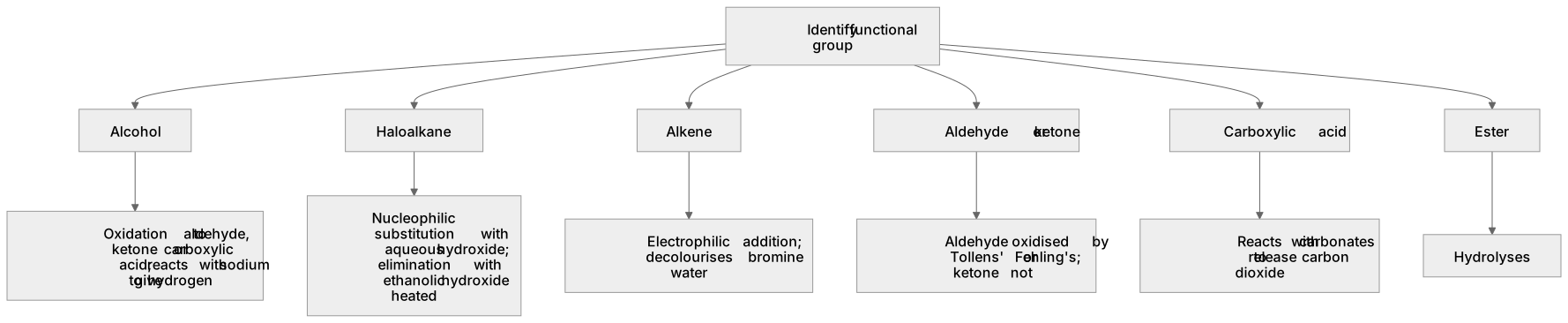
Key words
Say what each word means before you turn the card.
Functional group to reaction mapping
Try answering aloud or in your head before turning the card.
Oxidation of alcohols and aldehydes
Try answering aloud or in your head before turning the card.
Nucleophilic substitution versus elimination
Try answering aloud or in your head before turning the card.
Intermolecular forces and physical properties
Try answering aloud or in your head before turning the card.
See every definition
- Functional group to reaction mapping
- Using the functional groups you have identified to say how a molecule will behave, linking each group to its characteristic chemistry.
- Oxidation of alcohols and aldehydes
- Alcohols undergo oxidation to aldehydes, ketones or carboxylic acids depending on their class and the conditions, while aldehydes are oxidised by Tollens' or Fehling's reagents.
- Nucleophilic substitution versus elimination
- Haloalkanes undergo nucleophilic substitution and elimination, with aqueous hydroxide favouring substitution and ethanolic hydroxide with heat favouring elimination.
- Intermolecular forces and physical properties
- Hydrogen bonding raises boiling point in alcohols and carboxylic acids, and larger chains raise boiling point through stronger induced dipole–dipole forces.
Label the diagram
Some boxes have lost their names. Pick the right name for each number.
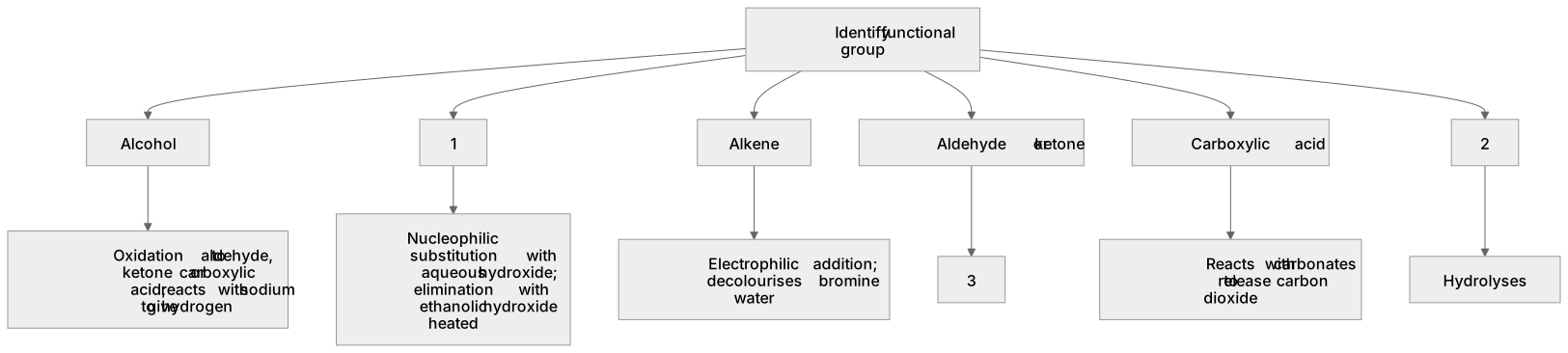
1Box 1
2Box 2
3Box 3
There is more to this lesson
The full lesson goes on to check your understanding and help you earn the marks. Create a free account to carry on, with your progress saved.
A week of Premium from your first lesson · Then the free plan continues · No card, no charge
Test your understanding of Alcohols, haloalkanes and analysis - 4.2.3 Organic synthesis: (ii) prediction of properties and reactions
Active recall beats re-reading. Take an instant quiz now to test what you’ve learned and lock it into long-term memory.
A week of Premium from your first lesson · Then the free plan continues · No card, no charge