OCR · A-Level · Chemistry
Course version: H432 · Version from Sept 2017
(ii) preparation and purification of an organic liquid including:
Full specification wording
Alcohols, haloalkanes and analysis - 4.2.3 Organic synthesis: (ii) preparation and purification of an organic liquid including:
This sub-statement introduces the practical sequence for making an organic liquid in the laboratory and then purifying it.
- Point 2 of 9
- 4 key terms
Study notes
From the teaching notes for this specification point.
The idea
This sub-statement introduces the practical sequence for making an organic liquid in the laboratory and then purifying it. Preparation typically means heating a reaction mixture under reflux so volatile reactants and products are returned and the reaction can proceed without loss, then cooling and transferring the mixture. Purification then removes impurities and water: a separating funnel isolates the organic layer, a drying agent such as anhydrous sodium sulfate or calcium chloride removes residual water, and distillation collects a fraction boiling over a narrow range. The MCQ tests whether you can order these steps and match each technique to its purpose, for example why reflux is used rather than simple heating, or why the drying agent is added before the final distillation.
What earns the marks
- Identifies reflux as the technique that returns volatile vapours to the reaction flask during heating.
- Places separation of the organic layer in a separating funnel before drying and distillation.
- Selects an anhydrous drying agent to remove residual water from the organic layer.
- Recognises that distillation purifies by collecting a fraction over a narrow boiling range.
- Distinguishes the purpose of each step so preparation is not confused with purification.
Common mistakes and how to put them right
Treats distillation as the first step of preparation.
Put it right: Place reflux heating first and distillation later in purification.
Assumes any drying agent is suitable regardless of whether it reacts with the product.
Put it right: Choose an anhydrous agent that does not react with the organic liquid.
Confuses the separating funnel with a distillation apparatus.
Put it right: Use the funnel only to separate immiscible layers.
Believes reflux increases yield by removing product.
Put it right: State that reflux returns volatile vapours to prevent loss of reactants and solvent.
Exam tips
- Read the whole stem to see whether the question asks about preparation or purification before choosing an option.
- Link each named technique to a single purpose: reflux for heating without loss, funnel for layer separation, drying agent for water removal, distillation for final purification.
- Eliminate options that reverse the order of steps or give a technique the wrong purpose.
- Check that any named drying agent is described as anhydrous and does not react with the product.
Try the lesson
The start of the Alcohols, haloalkanes and analysis - 4.2.3 Organic synthesis: (ii) preparation and purification of an organic liquid including: lesson, made from teaching notes for this specification point.
Listen
This sub-statement introduces the practical sequence for making an organic liquid in the laboratory and then purifying it. Preparation typically means heating a reaction mixture under reflux so volatile reactants and products are returned and the reaction can proceed without loss, then cooling and transferring the mixture. Purification then removes impurities and water: a separating funnel isolates the organic layer, a drying agent such as anhydrous sodium sulfate or calcium chloride removes residual water, and distillation collects a fraction boiling over a narrow range. The MCQ tests whether you can order these steps and match each technique to its purpose, for example why reflux is used rather than simple heating, or why the drying agent is added before the final distillation. A strong answer earns marks for these points. Identifies reflux as the technique that returns volatile vapours to the reaction flask during heating. Places separation of the organic layer in a separating funnel before drying and distillation. Selects an anhydrous drying agent to remove residual water from the organic layer. Recognises that distillation purifies by collecting a fraction over a narrow boiling range. Exam tip: Read the whole stem to see whether the question asks about preparation or purification before choosing an option.
See it
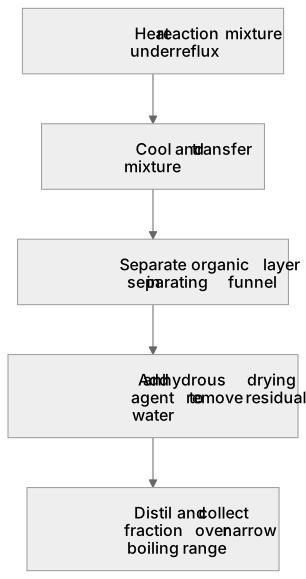
Put it in order
Put these steps in the order they happen.
- 1. Cool and transfer mixture
- 2. Separate organic layer in separating funnel
- 3. Heat reaction mixture under reflux
- 4. Distil and collect fraction over narrow boiling range
- 5. Add anhydrous drying agent to remove residual water
Key words
Say what each word means before you turn the card.
Reflux
Try answering aloud or in your head before turning the card.
Separating funnel
Try answering aloud or in your head before turning the card.
Drying agent
Try answering aloud or in your head before turning the card.
Distillation
Try answering aloud or in your head before turning the card.
See every definition
- Reflux
- Heating a reaction mixture so that volatile vapours are returned to the reaction flask, preventing loss of reactants and solvent.
- Separating funnel
- Apparatus used to separate immiscible layers and isolate the organic layer before drying and distillation.
- Drying agent
- An anhydrous substance, such as anhydrous sodium sulfate or calcium chloride, that removes residual water from the organic layer and does not react with the product.
- Distillation
- Technique that purifies by collecting a fraction boiling over a narrow range.
Label the diagram
Some boxes have lost their names. Pick the right name for each number.
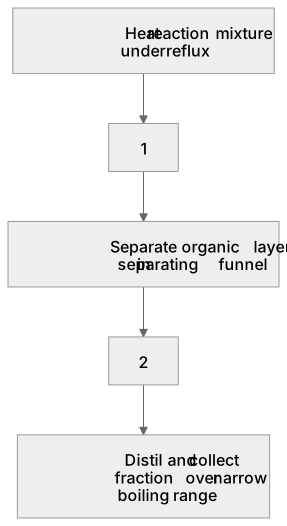
1Box 1
2Box 2
There is more to this lesson
The full lesson goes on to check your understanding and help you earn the marks. Create a free account to carry on, with your progress saved.
A week of Premium from your first lesson · Then the free plan continues · No card, no charge
Test your understanding of Alcohols, haloalkanes and analysis - 4.2.3 Organic synthesis: (ii) preparation and purification of an organic liquid including:
Active recall beats re-reading. Take an instant quiz now to test what you’ve learned and lock it into long-term memory.
A week of Premium from your first lesson · Then the free plan continues · No card, no charge