OCR · A-Level · Chemistry
Course version: H432 · Version from Sept 2017
• redistillation
Full specification wording
Alcohols, haloalkanes and analysis - 4.2.3 Organic synthesis: • redistillation
Redistillation means distilling a liquid product a second time to raise its purity.
- Point 5 of 9
- 4 key terms
Study notes
From the teaching notes for this specification point.
The idea
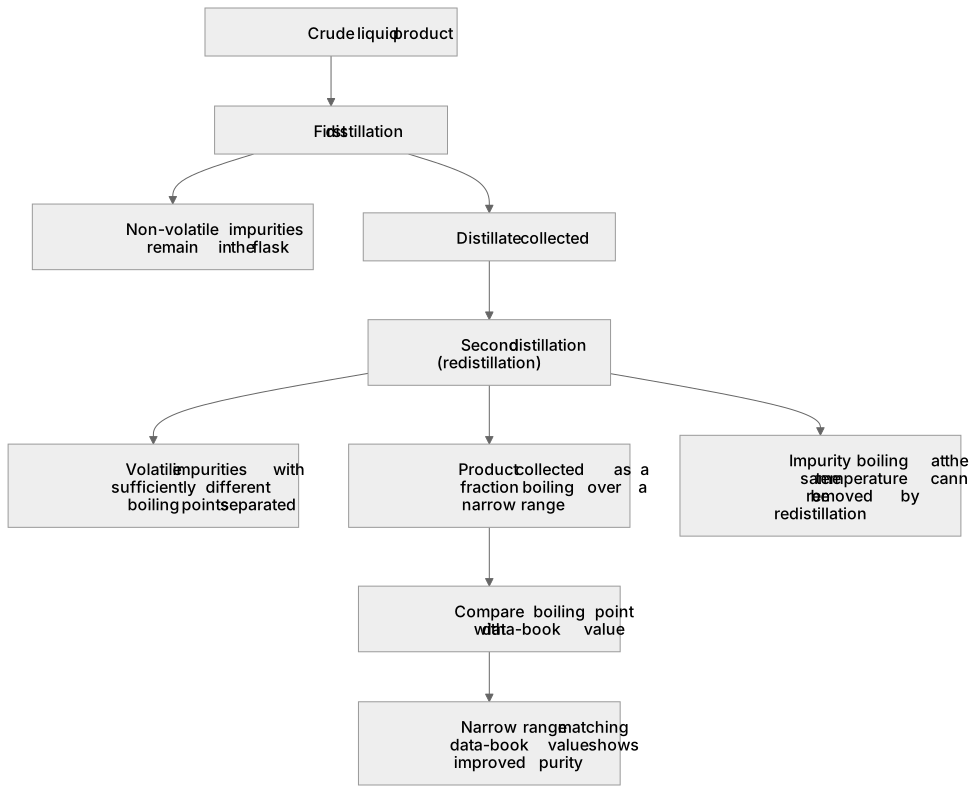
Redistillation means distilling a liquid product a second time to raise its purity. In synthesis, the crude product from a separating funnel often carries a volatile impurity with a boiling point close to the target, plus traces of water or solvent. A first distillation removes non-volatile impurities, which stay in the flask while the more volatile product distils over. A second distillation then separates the product from volatile impurities whose boiling points differ enough from the product's. Each distillation collects a fraction boiling over a narrow range, so redistillation sharpens that range and improves purity. Assess purity by comparing the boiling point with a data-book value and by checking the range is narrow. Redistillation cannot remove an impurity that boils at the same temperature as the product; that needs another method such as solvent extraction or a drying agent.
What earns the marks
- States that redistillation distils a liquid product a second time to increase its purity.
- Explains that non-volatile impurities remain in the distillation flask and so are removed from the distillate.
- Explains that volatile impurities with sufficiently different boiling points are separated from the product during redistillation.
- Identifies a narrow boiling-point range matching a data-book value as evidence of improved purity.
- Recognises that an impurity with a boiling point identical to the product cannot be removed by redistillation.
Common mistakes and how to put them right
Claims that distillation cannot remove non-volatile impurities.
Put it right by stating that non-volatile impurities are left behind in the flask while the product distils over.
Treats redistillation as able to separate any impurity.
Put it right by noting that an impurity boiling at the same temperature as the product distils with it.
Describes redistillation as a chemical reaction that purifies the product.
Put it right by describing it as a physical separation by boiling point.
Exam tips
- Link each purification step to the physical property it exploits, here differences in boiling point.
- Quote a boiling-point range and compare it with a data-book value when asked how purity is checked.
- Distinguish clearly between removing non-volatile and volatile impurities in your answer.
Try the lesson
The start of the Alcohols, haloalkanes and analysis - 4.2.3 Organic synthesis: • redistillation lesson, made from teaching notes for this specification point.
Listen
Redistillation means distilling a liquid product a second time to raise its purity. In synthesis, the crude product from a separating funnel often carries a volatile impurity with a boiling point close to the target, plus traces of water or solvent. A first distillation removes non-volatile impurities, which stay in the flask while the more volatile product distils over. A second distillation then separates the product from volatile impurities whose boiling points differ enough from the product's. Each distillation collects a fraction boiling over a narrow range, so redistillation sharpens that range and improves purity. Assess purity by comparing the boiling point with a data-book value and by checking the range is narrow. Redistillation cannot remove an impurity that boils at the same temperature as the product; that needs another method such as solvent extraction or a drying agent. A strong answer earns marks for these points. States that redistillation distils a liquid product a second time to increase its purity. Explains that non-volatile impurities remain in the distillation flask and so are removed from the distillate. Explains that volatile impurities with sufficiently different boiling points are separated from the product during redistillation. Identifies a narrow boiling-point range matching a data-book value as evidence of improved purity. A common slip: Claims that distillation cannot remove non-volatile impurities. Instead, stating that non-volatile impurities are left behind in the flask while the product distils over. Exam tip: Link each purification step to the physical property it exploits, here differences in boiling point.
See it
Key words
Say what each word means before you turn the card.
Redistillation
Try answering aloud or in your head before turning the card.
Non-volatile impurities
Try answering aloud or in your head before turning the card.
Volatile impurities
Try answering aloud or in your head before turning the card.
Assessing purity by boiling point
Try answering aloud or in your head before turning the card.
See every definition
- Redistillation
- Distilling a liquid product a second time to raise its purity.
- Non-volatile impurities
- Impurities that stay in the flask while the more volatile product distils over.
- Volatile impurities
- Impurities separated from the product during redistillation when their boiling points differ enough from the product's.
- Assessing purity by boiling point
- Comparing the boiling point with a data-book value and checking the range is narrow.
Label the diagram
Some boxes have lost their names. Pick the right name for each number.
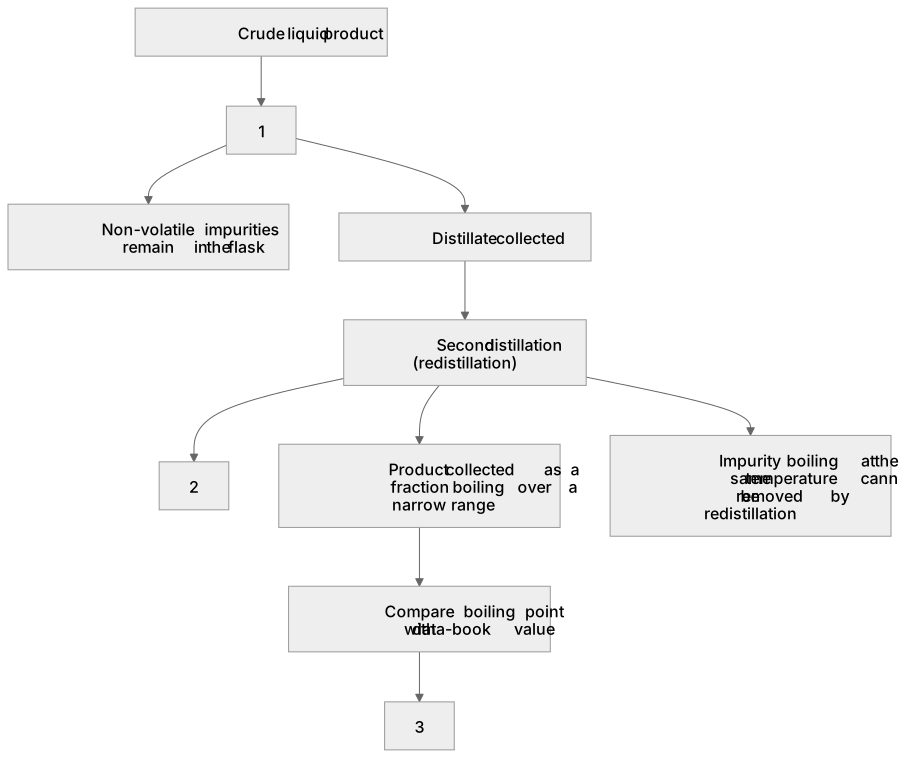
1Box 1
2Box 2
3Box 3
There is more to this lesson
The full lesson goes on to check your understanding and help you earn the marks. Create a free account to carry on, with your progress saved.
A week of Premium from your first lesson · Then the free plan continues · No card, no charge
Test your understanding of Alcohols, haloalkanes and analysis - 4.2.3 Organic synthesis: • redistillation
Active recall beats re-reading. Take an instant quiz now to test what you’ve learned and lock it into long-term memory.
A week of Premium from your first lesson · Then the free plan continues · No card, no charge