OCR · A-Level · Chemistry
Course version: H432 · Version from Sept 2017
(b) for an organic molecule containing several functional groups:
Full specification wording
Alcohols, haloalkanes and analysis - 4.2.3 Organic synthesis: (b) for an organic molecule containing several functional groups:
When a molecule carries several functional groups, each group can react independently, so a route must account for all of them.
- Point 6 of 9
- 3 key terms
Study notes
From the teaching notes for this specification point.
The idea
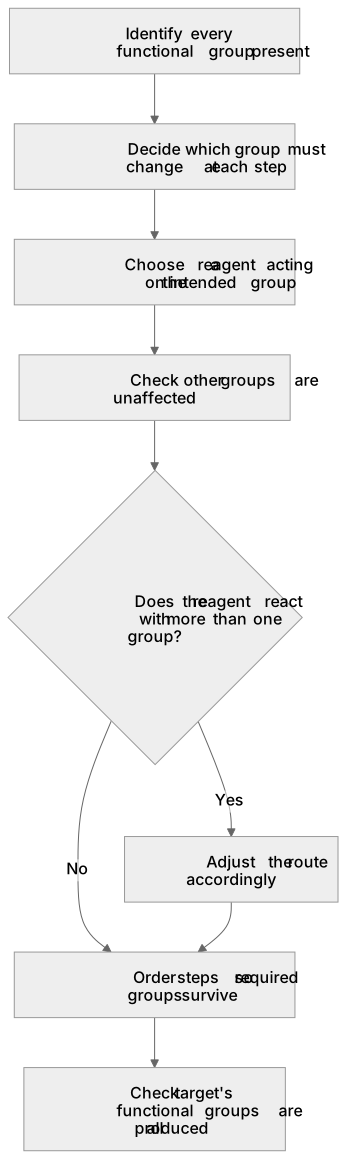
When a molecule carries several functional groups, each group can react independently, so a route must account for all of them. Identify every functional group present, decide which one must change at each step, and choose reagents that act on the intended group without unwanted side reactions on the others. For example, an oxidising agent may convert an alcohol to a carbonyl while leaving a halogen substituent intact, but a reagent that also attacks the halogen would spoil the route. Working backwards from the target and checking each group at every stage keeps the plan consistent.
What earns the marks
- Identifies every functional group present in the molecule rather than only one.
- States which functional group is being converted at each step of the route.
- Selects a reagent that reacts with the intended group and explains why other groups are unaffected.
- Recognises that some reagents may react with more than one functional group and adjusts the route accordingly.
- Checks that the target molecule's functional groups are all produced by the chosen sequence.
Common mistakes and how to put them right
Considers only one functional group and ignores the others.
Put it right: List every group before planning.
Assumes a reagent affects only the intended group without checking.
Put it right: State why the other groups are unaffected.
Chooses a step that destroys a group needed later in the route.
Put it right: Plan the order so protected groups survive.
Stops the route before all target functional groups are formed.
Put it right: Confirm each group is present at the end.
Exam tips
- List all functional groups in the starting material and target before choosing any reagent.
- For each step, state which group changes and why the others are left unchanged.
- Order the steps so a group needed later is not removed early.
- Re-read the target structure to confirm every functional group has been produced.
Try the lesson
The start of the Alcohols, haloalkanes and analysis - 4.2.3 Organic synthesis: (b) for an organic molecule containing several functional groups: lesson, made from teaching notes for this specification point.
Listen
When a molecule carries several functional groups, each group can react independently, so a route must account for all of them. Identify every functional group present, decide which one must change at each step, and choose reagents that act on the intended group without unwanted side reactions on the others. For example, an oxidising agent may convert an alcohol to a carbonyl while leaving a halogen substituent intact, but a reagent that also attacks the halogen would spoil the route. Working backwards from the target and checking each group at every stage keeps the plan consistent. A strong answer earns marks for these points. Identifies every functional group present in the molecule rather than only one. States which functional group is being converted at each step of the route. Selects a reagent that reacts with the intended group and explains why other groups are unaffected. Recognises that some reagents may react with more than one functional group and adjusts the route accordingly. Exam tip: List all functional groups in the starting material and target before choosing any reagent.
See it
Key words
Say what each word means before you turn the card.
Selective reagents
Try answering aloud or in your head before turning the card.
Order of reaction steps
Try answering aloud or in your head before turning the card.
Retrosynthetic planning
Try answering aloud or in your head before turning the card.
See every definition
- Selective reagents
- Reagents chosen to act on the intended group without unwanted side reactions on the other groups in the molecule.
- Order of reaction steps
- Planning the sequence so that a group needed later in the route is not removed early and survives to the target molecule.
- Retrosynthetic planning
- Working backwards from the target and checking each group at every stage to keep the plan consistent.
There is more to this lesson
The full lesson goes on to check your understanding and help you earn the marks. Create a free account to carry on, with your progress saved.
A week of Premium from your first lesson · Then the free plan continues · No card, no charge
Test your understanding of Alcohols, haloalkanes and analysis - 4.2.3 Organic synthesis: (b) for an organic molecule containing several functional groups:
Active recall beats re-reading. Take an instant quiz now to test what you’ve learned and lock it into long-term memory.
A week of Premium from your first lesson · Then the free plan continues · No card, no charge