OCR · A-Level · Chemistry
Course version: H432 · Version from Sept 2017
(d) the low reactivity of alkanes with many reagents in terms of the high…
Full specification wording
Alkanes: (d) the low reactivity of alkanes with many reagents in terms of the high bond enthalpy and very low polarity of the σ-bonds present (see also 2.2.2 j)
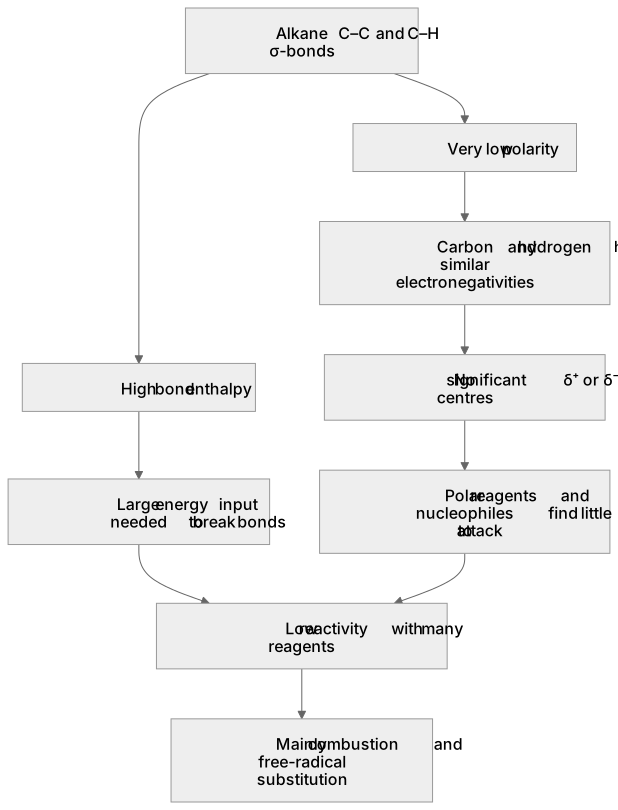
Alkanes are relatively unreactive because their C–C and C–H bonds are strong σ-bonds with high bond enthalpies, so a lot of energy is needed to break them.
- Point 4 of 7
- 4 key terms
Study notes
From the teaching notes for this specification point.
The idea
Alkanes are relatively unreactive because their C–C and C–H bonds are strong σ-bonds with high bond enthalpies, so a lot of energy is needed to break them. The bonds are also essentially non-polar: carbon and hydrogen have similar electronegativities, so the σ-bond electrons are shared fairly evenly and there is no significant δ⁺ or δ⁻ centre. Many reagents, such as polar reagents and nucleophiles, attack regions of partial charge, so they find little to react with on an alkane. This explains why alkanes mainly undergo combustion and free-radical substitution, where radicals or high-energy conditions are involved, rather than addition or substitution by polar reagents. Link this to the bonding work in 2.2.2 j on σ-bonds and bond polarity.
What earns the marks
- States that alkane C–C and C–H bonds have high bond enthalpies, so breaking them requires a large energy input.
- Explains that the σ-bonds in alkanes are essentially non-polar because carbon and hydrogen have similar electronegativities.
- Links low polarity to the absence of δ⁺ and δ⁻ centres that polar reagents or nucleophiles could attack.
- Concludes that alkanes therefore react with few reagents and mainly by combustion or free-radical substitution.
- Refers to the σ-bonding covered in 2.2.2 j when explaining bond polarity and strength.
Common mistakes and how to put them right
Claims alkanes are unreactive because they contain no bonds that can break.
Put it right: State instead that the bonds are strong and need high energy to break.
Says the C–H bond is strongly polar.
Put it right: Recognise that the small electronegativity difference makes the σ-bond essentially non-polar.
Attributes low reactivity to a lack of hydrogen atoms.
Put it right: Explain it through high bond enthalpy and low polarity of the σ-bonds.
Ignores the reference to 2.2.2 j.
Put it right: Connect the answer to σ-bond formation and polarity as taught there.
Exam tips
- Name both factors, high bond enthalpy and very low polarity, and explain each in a separate sentence.
- Use the phrase 'similar electronegativities' to justify why the σ-bonds are non-polar.
- Finish by linking the two factors to the limited range of reactions alkanes undergo.
Try the lesson
The start of the Alkanes: (d) the low reactivity of alkanes with many reagents in terms of the high bond enthalpy and very low polarity of the σ-bonds present (see also 2.2.2 j) lesson, made from teaching notes for this specification point.
Listen
Alkanes are relatively unreactive because their C–C and C–H bonds are strong σ-bonds with high bond enthalpies, so a lot of energy is needed to break them. The bonds are also essentially non-polar: carbon and hydrogen have similar electronegativities, so the σ-bond electrons are shared fairly evenly and there is no significant δ⁺ or δ⁻ centre. Many reagents, such as polar reagents and nucleophiles, attack regions of partial charge, so they find little to react with on an alkane. This explains why alkanes mainly undergo combustion and free-radical substitution, where radicals or high-energy conditions are involved, rather than addition or substitution by polar reagents. Link this to the bonding work in 2.2.2 j on σ-bonds and bond polarity. A strong answer earns marks for these points. States that alkane C–C and C–H bonds have high bond enthalpies, so breaking them requires a large energy input. Explains that the σ-bonds in alkanes are essentially non-polar because carbon and hydrogen have similar electronegativities. Links low polarity to the absence of δ⁺ and δ⁻ centres that polar reagents or nucleophiles could attack. Concludes that alkanes therefore react with few reagents and mainly by combustion or free-radical substitution. Exam tip: Name both factors, high bond enthalpy and very low polarity, and explain each in a separate sentence.
See it
Key words
Say what each word means before you turn the card.
High bond enthalpy of C–C and C–H bonds
Try answering aloud or in your head before turning the card.
Low polarity of σ-bonds
Try answering aloud or in your head before turning the card.
Similar electronegativity of carbon and hydrogen
Try answering aloud or in your head before turning the card.
Consequences for alkane reactivity
Try answering aloud or in your head before turning the card.
See every definition
- High bond enthalpy of C–C and C–H bonds
- The C–C and C–H bonds are strong σ-bonds with high bond enthalpies, so a lot of energy is needed to break them.
- Low polarity of σ-bonds
- The σ-bond electrons are shared fairly evenly, so there is no significant δ⁺ or δ⁻ centre for polar reagents or nucleophiles to attack.
- Similar electronegativity of carbon and hydrogen
- Carbon and hydrogen have similar electronegativities, which makes the σ-bonds in alkanes essentially non-polar.
- Consequences for alkane reactivity
- Alkanes react with few reagents and mainly by combustion or free-radical substitution rather than addition or substitution by polar reagents.
Label the diagram
Some boxes have lost their names. Pick the right name for each number.
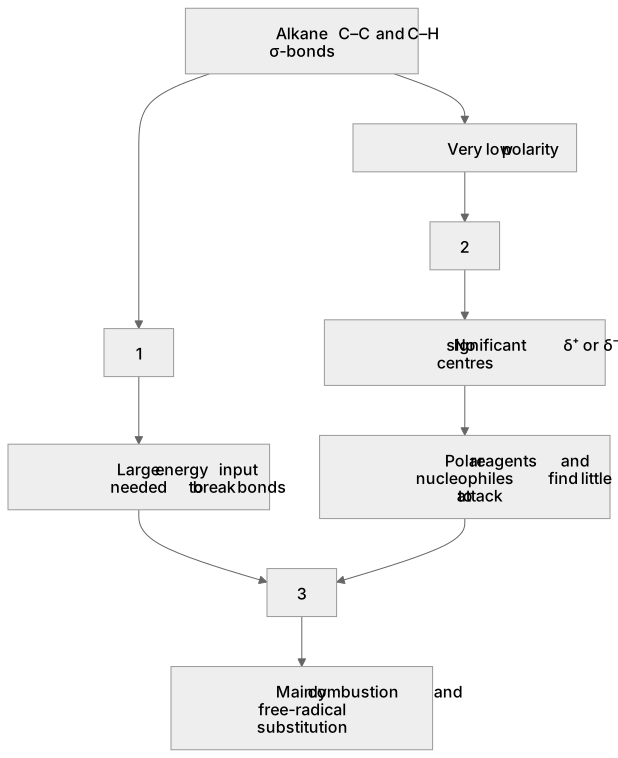
1Box 1
2Box 2
3Box 3
There is more to this lesson
The full lesson goes on to check your understanding and help you earn the marks. Create a free account to carry on, with your progress saved.
A week of Premium from your first lesson · Then the free plan continues · No card, no charge
Test your understanding of Alkanes: (d) the low reactivity of alkanes with many reagents in terms of the high bond enthalpy and very low polarity of the σ-bonds present (see also 2.2.2 j)
Active recall beats re-reading. Take an instant quiz now to test what you’ve learned and lock it into long-term memory.
A week of Premium from your first lesson · Then the free plan continues · No card, no charge