OCR · A-Level · Chemistry
Course version: H432 · Version from Sept 2017
(e) complete combustion of alkanes, as used in fuels, and the incomplete…
Full specification wording
Alkanes: (e) complete combustion of alkanes, as used in fuels, and the incomplete combustion of alkane fuels in a limited supply of oxygen with the resulting potential dangers from CO
Alkanes burn exothermically and are used as fuels.
- Point 5 of 7
- 3 key terms
Study notes
From the teaching notes for this specification point.
The idea
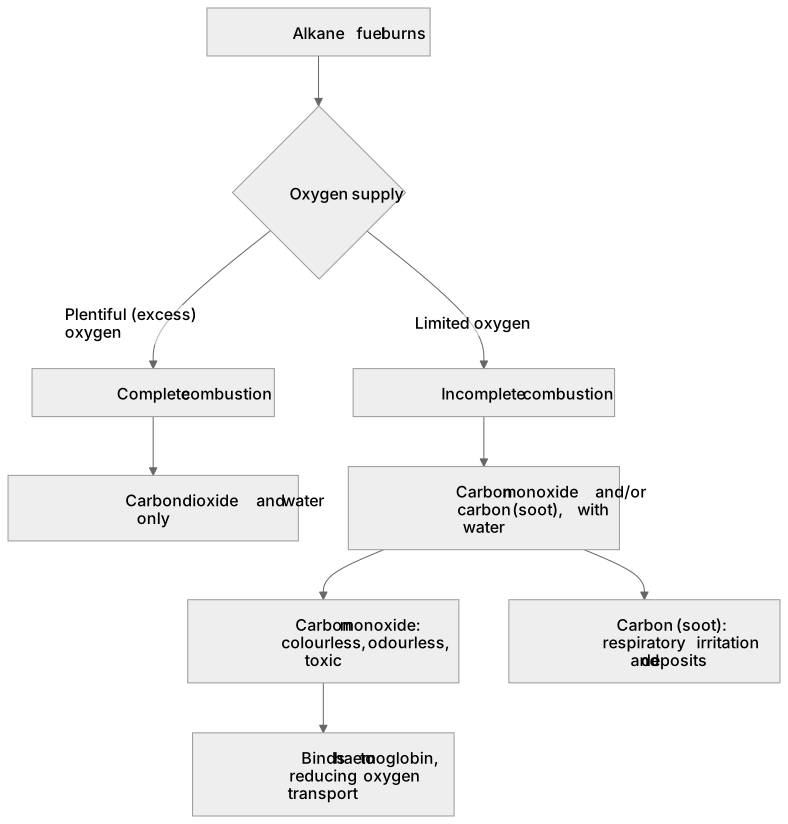
Alkanes burn exothermically and are used as fuels. In a plentiful supply of oxygen, complete combustion occurs: the alkane reacts with O₂ to give carbon dioxide and water only, for example CH₄ + 2O₂ → CO₂ + 2H₂O. In a limited supply of oxygen, incomplete combustion occurs, producing carbon monoxide and/or carbon (soot) alongside water, for example 2CH₄ + 3O₂ → 2CO + 4H₂O. Carbon monoxide is colourless, odourless and toxic because it binds to haemoglobin in the blood, reducing oxygen transport, so faulty or poorly ventilated appliances are dangerous. Carbon (soot) also causes respiratory irritation and deposits. A question may ask you to balance an equation, identify the products, or explain why CO is hazardous.
What earns the marks
- States that complete combustion of an alkane in excess oxygen produces carbon dioxide and water only.
- Writes a correctly balanced equation for the complete combustion of a named alkane, such as CH₄ + 2O₂ → CO₂ + 2H₂O.
- States that incomplete combustion occurs in a limited supply of oxygen and produces carbon monoxide and/or carbon, together with water.
- Explains that carbon monoxide is dangerous because it is toxic and binds to haemoglobin, reducing the blood's capacity to carry oxygen.
- Identifies carbon monoxide as colourless and odourless, so it gives no warning of its presence.
Common mistakes and how to put them right
Writes water and carbon dioxide as the products of incomplete combustion.
Put it right by linking limited oxygen to carbon monoxide and/or carbon.
Omits the need for a plentiful oxygen supply when describing complete combustion.
Put it right: State that excess oxygen is required.
Treats carbon monoxide as harmless or merely a greenhouse gas.
Put it right: Explain instead that it is toxic because it binds to haemoglobin.
Exam tips
- Check that every combustion equation is balanced for both atoms and charge-free species before selecting an answer.
- Read the stem carefully for the words 'limited' or 'excess' oxygen, because they change the products.
- Link the danger of CO explicitly to its effect on haemoglobin rather than just calling it 'bad'.
Try the lesson
The start of the Alkanes: (e) complete combustion of alkanes, as used in fuels, and the incomplete combustion of alkane fuels in a limited supply of oxygen with the resulting potential dangers from CO lesson, made from teaching notes for this specification point.
Listen
Alkanes burn exothermically and are used as fuels. In a plentiful supply of oxygen, complete combustion occurs: the alkane reacts with O₂ to give carbon dioxide and water only, for example CH₄ + 2O₂ → CO₂ + 2H₂O. In a limited supply of oxygen, incomplete combustion occurs, producing carbon monoxide and/or carbon (soot) alongside water, for example 2CH₄ + 3O₂ → 2CO + 4H₂O. Carbon monoxide is colourless, odourless and toxic because it binds to haemoglobin in the blood, reducing oxygen transport, so faulty or poorly ventilated appliances are dangerous. Carbon (soot) also causes respiratory irritation and deposits. A question may ask you to balance an equation, identify the products, or explain why CO is hazardous. A strong answer earns marks for these points. States that complete combustion of an alkane in excess oxygen produces carbon dioxide and water only. Writes a correctly balanced equation for the complete combustion of a named alkane, such as CH₄ + 2O₂ → CO₂ + 2H₂O. States that incomplete combustion occurs in a limited supply of oxygen and produces carbon monoxide and/or carbon, together with water. Explains that carbon monoxide is dangerous because it is toxic and binds to haemoglobin, reducing the blood's capacity to carry oxygen. A common slip: Writes water and carbon dioxide as the products of incomplete combustion. Instead, linking limited oxygen to carbon monoxide and/or carbon. Exam tip: Check that every combustion equation is balanced for both atoms and charge-free species before selecting an answer.
See it
Key words
Say what each word means before you turn the card.
Complete combustion products
Try answering aloud or in your head before turning the card.
Incomplete combustion products
Try answering aloud or in your head before turning the card.
Toxicity of carbon monoxide
Try answering aloud or in your head before turning the card.
See every definition
- Complete combustion products
- In a plentiful supply of oxygen, the alkane reacts with O₂ to give carbon dioxide and water only.
- Incomplete combustion products
- In a limited supply of oxygen, incomplete combustion occurs, producing carbon monoxide and/or carbon (soot) alongside water.
- Toxicity of carbon monoxide
- Carbon monoxide is colourless, odourless and toxic because it binds to haemoglobin in the blood, reducing oxygen transport.
There is more to this lesson
The full lesson goes on to check your understanding and help you earn the marks. Create a free account to carry on, with your progress saved.
A week of Premium from your first lesson · Then the free plan continues · No card, no charge
Test your understanding of Alkanes: (e) complete combustion of alkanes, as used in fuels, and the incomplete combustion of alkane fuels in a limited supply of oxygen with the resulting potential dangers from CO
Active recall beats re-reading. Take an instant quiz now to test what you’ve learned and lock it into long-term memory.
A week of Premium from your first lesson · Then the free plan continues · No card, no charge