OCR · A-Level · Chemistry
Course version: H432 · Version from Sept 2017
(i) hydrogen in the presence of a suitable catalyst, e.g. Ni, to form…
Full specification wording
Alkenes: (i) hydrogen in the presence of a suitable catalyst, e.g. Ni, to form alkanes
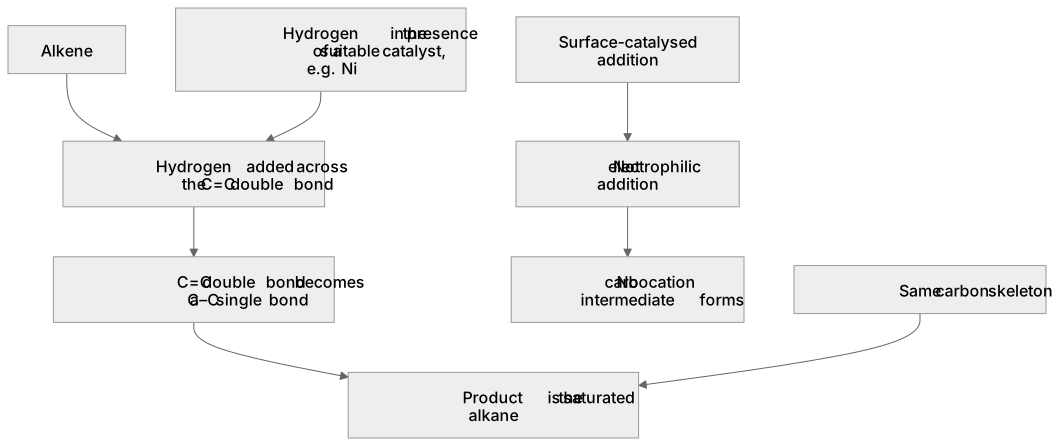
An alkene reacts with hydrogen gas over a suitable catalyst, for example nickel, to form the corresponding alkane.
- Point 11 of 27
- 4 key terms
Study notes
From the teaching notes for this specification point.
The idea
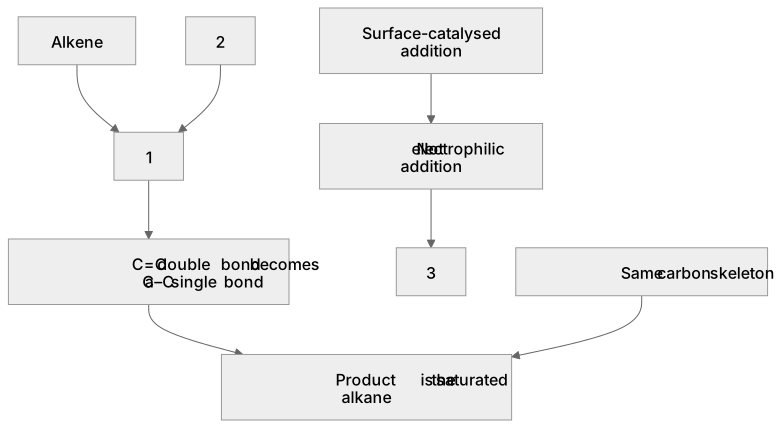
An alkene reacts with hydrogen gas over a suitable catalyst, for example nickel, to form the corresponding alkane. The C=C double bond becomes a C–C single bond as each carbon gains a hydrogen atom, so the product has the same carbon skeleton but is saturated. This is a surface-catalysed addition: hydrogen and the alkene are adsorbed onto the nickel surface, where the reaction occurs, so it is not an electrophilic addition and no carbocation intermediate forms. For example, ethene with hydrogen over nickel gives ethane. In multiple-choice questions, check the reagent, the catalyst, the product class and the type of addition before choosing an option.
What earns the marks
- States that hydrogen is added across the C=C double bond to form the corresponding alkane.
- Identifies nickel as a suitable catalyst for the reaction between an alkene and hydrogen.
- Describes the product as saturated, with the C=C double bond converted to a C–C single bond.
- Classifies the reaction as a surface-catalysed addition rather than an electrophilic addition with a carbocation intermediate.
- Applies the reaction to a named example, such as ethene with hydrogen over nickel forming ethane.
Common mistakes and how to put them right
Describes hydrogenation over nickel as electrophilic addition with a carbocation.
Put it right: Classify it as a surface-catalysed addition instead.
Omits the catalyst and writes only hydrogen.
Put it right: Include nickel or another suitable catalyst as the condition.
Claims the product still contains a C=C double bond.
Put it right: State that the product is the saturated alkane.
Gives a product with a different carbon skeleton.
Put it right: Keep the same carbon chain and only add hydrogen across the double bond.
Exam tips
- Read every option for the reagent, catalyst and product class before selecting an answer.
- Recall a named example such as ethene to ethane to check whether an option is chemically sensible.
- Eliminate options that describe a carbocation intermediate, because this reaction is surface-catalysed.
Try the lesson
The start of the Alkenes: (i) hydrogen in the presence of a suitable catalyst, e.g. Ni, to form alkanes lesson, made from teaching notes for this specification point.
Listen
An alkene reacts with hydrogen gas over a suitable catalyst, for example nickel, to form the corresponding alkane. The C=C double bond becomes a C–C single bond as each carbon gains a hydrogen atom, so the product has the same carbon skeleton but is saturated. This is a surface-catalysed addition: hydrogen and the alkene are adsorbed onto the nickel surface, where the reaction occurs, so it is not an electrophilic addition and no carbocation intermediate forms. For example, ethene with hydrogen over nickel gives ethane. In multiple-choice questions, check the reagent, the catalyst, the product class and the type of addition before choosing an option. A strong answer earns marks for these points. States that hydrogen is added across the C=C double bond to form the corresponding alkane. Identifies nickel as a suitable catalyst for the reaction between an alkene and hydrogen. Describes the product as saturated, with the C=C double bond converted to a C–C single bond. Classifies the reaction as a surface-catalysed addition rather than an electrophilic addition with a carbocation intermediate. Exam tip: Read every option for the reagent, catalyst and product class before selecting an answer.
See it
Key words
Say what each word means before you turn the card.
Addition of hydrogen across the C=C double bond
Try answering aloud or in your head before turning the card.
Nickel as a suitable catalyst
Try answering aloud or in your head before turning the card.
Formation of saturated alkanes
Try answering aloud or in your head before turning the card.
Surface-catalysed addition
Try answering aloud or in your head before turning the card.
See every definition
- Addition of hydrogen across the C=C double bond
- Hydrogen is added across the C=C double bond, which becomes a C–C single bond as each carbon gains a hydrogen atom.
- Nickel as a suitable catalyst
- Nickel is a suitable catalyst for the reaction between an alkene and hydrogen.
- Formation of saturated alkanes
- The product is the saturated alkane, with the same carbon skeleton and the C=C double bond converted to a C–C single bond.
- Surface-catalysed addition
- Hydrogen and the alkene are adsorbed onto the nickel surface, where the reaction occurs, so it is not an electrophilic addition and no carbocation intermediate forms.
Label the diagram
Some boxes have lost their names. Pick the right name for each number.
1Box 1
2Box 2
3Box 3
There is more to this lesson
The full lesson goes on to check your understanding and help you earn the marks. Create a free account to carry on, with your progress saved.
A week of Premium from your first lesson · Then the free plan continues · No card, no charge
Test your understanding of Alkenes: (i) hydrogen in the presence of a suitable catalyst, e.g. Ni, to form alkanes
Active recall beats re-reading. Take an instant quiz now to test what you’ve learned and lock it into long-term memory.
A week of Premium from your first lesson · Then the free plan continues · No card, no charge