OCR · A-Level · Chemistry
Course version: H432 · Version from Sept 2017
(ii) halogens to form dihaloalkanes, including the use of bromine to…
Full specification wording
Alkenes: (ii) halogens to form dihaloalkanes, including the use of bromine to detect the presence of a double C=C bond as a test for unsaturation in a carbon chain
This row covers the addition of a halogen across the C=C bond to form a dihaloalkane, and the use of bromine as a test for unsaturation.
- Point 12 of 27
- 4 key terms
Study notes
From the teaching notes for this specification point.
The idea
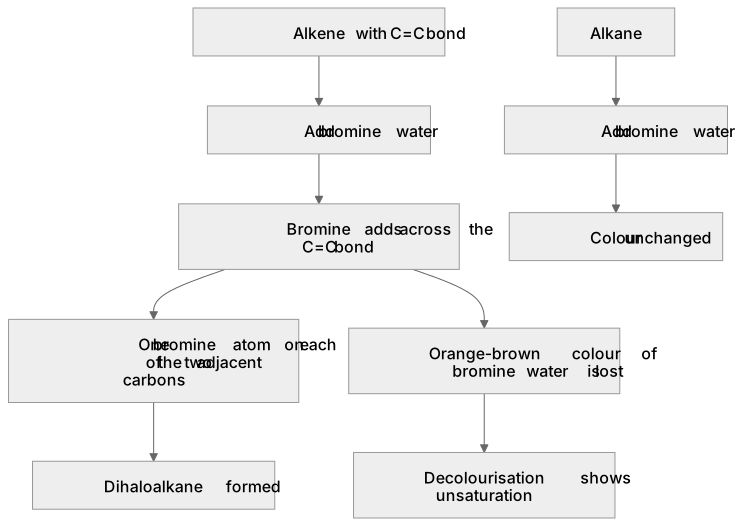
This row covers the addition of a halogen across the C=C bond to form a dihaloalkane, and the use of bromine as a test for unsaturation. When bromine, Br₂, adds to an alkene, one bromine atom bonds to each carbon of the former double bond, giving a compound with two halogen atoms on adjacent carbons, a dihaloalkane. For example, ethene with bromine gives 1,2-dibromoethane, C₂H₄ + Br₂ → C₂H₄Br₂. In the test, bromine water is added to the sample: an alkene decolourises the orange-brown bromine water because the bromine reacts with the C=C bond, whereas an alkane leaves the colour unchanged. Decolourisation therefore indicates unsaturation.
What earns the marks
- States that a halogen such as bromine adds across the C=C bond to form a dihaloalkane.
- Describes the product as having one halogen atom on each of the two adjacent carbon atoms.
- States that bromine water is decolourised by an alkene, showing unsaturation.
- Contrasts the result with an alkane, which leaves the bromine water colour unchanged.
Common mistakes and how to put them right
Claims that bromine water stays coloured with an alkene.
Put it right: State that the orange-brown colour is lost as bromine reacts.
Says the test proves the presence of a single bond.
Put it right: Explain that decolourisation indicates a C=C double bond, that is, unsaturation.
Places both halogen atoms on the same carbon.
Put it right: Show that one halogen atom bonds to each carbon of the former double bond.
Exam tips
- Link the observation (loss of colour) directly to the structural feature (C=C bond) in your answer.
- Use the alkane comparison to show the test is specific to unsaturation.
- Name the product correctly, for example 1,2-dibromoethane, to show you understand the addition.
Try the lesson
The start of the Alkenes: (ii) halogens to form dihaloalkanes, including the use of bromine to detect the presence of a double C=C bond as a test for unsaturation in a carbon chain lesson, made from teaching notes for this specification point.
Listen
This row covers the addition of a halogen across the C=C bond to form a dihaloalkane, and the use of bromine as a test for unsaturation. When bromine, Br₂, adds to an alkene, one bromine atom bonds to each carbon of the former double bond, giving a compound with two halogen atoms on adjacent carbons, a dihaloalkane. For example, ethene with bromine gives 1,2-dibromoethane, C₂H₄ + Br₂ → C₂H₄Br₂. In the test, bromine water is added to the sample: an alkene decolourises the orange-brown bromine water because the bromine reacts with the C=C bond, whereas an alkane leaves the colour unchanged. Decolourisation therefore indicates unsaturation. A strong answer earns marks for these points. States that a halogen such as bromine adds across the C=C bond to form a dihaloalkane. Describes the product as having one halogen atom on each of the two adjacent carbon atoms. States that bromine water is decolourised by an alkene, showing unsaturation. Contrasts the result with an alkane, which leaves the bromine water colour unchanged. Exam tip: Link the observation (loss of colour) directly to the structural feature (C=C bond) in your answer.
See it
Key words
Say what each word means before you turn the card.
Electrophilic addition of halogens
Try answering aloud or in your head before turning the card.
Formation of dihaloalkanes
Try answering aloud or in your head before turning the card.
Bromine water test for unsaturation
Try answering aloud or in your head before turning the card.
Distinguishing alkenes from alkanes
Try answering aloud or in your head before turning the card.
See every definition
- Electrophilic addition of halogens
- A halogen such as bromine adds across the C=C bond to form a dihaloalkane.
- Formation of dihaloalkanes
- The product has one halogen atom on each of the two adjacent carbon atoms, as when ethene with bromine gives 1,2-dibromoethane.
- Bromine water test for unsaturation
- Bromine water is added to the sample and an alkene decolourises the orange-brown bromine water because the bromine reacts with the C=C bond.
- Distinguishing alkenes from alkanes
- An alkane leaves the bromine water colour unchanged, whereas decolourisation indicates unsaturation.
There is more to this lesson
The full lesson goes on to check your understanding and help you earn the marks. Create a free account to carry on, with your progress saved.
A week of Premium from your first lesson · Then the free plan continues · No card, no charge
Test your understanding of Alkenes: (ii) halogens to form dihaloalkanes, including the use of bromine to detect the presence of a double C=C bond as a test for unsaturation in a carbon chain
Active recall beats re-reading. Take an instant quiz now to test what you’ve learned and lock it into long-term memory.
A week of Premium from your first lesson · Then the free plan continues · No card, no charge