OCR · A-Level · Chemistry
Course version: H432 · Version from Sept 2017
Alkenes: (iii) hydrogen halides to form haloalkanes
Alkenes undergo electrophilic addition with hydrogen halides (HX, where X is Cl, Br or I) to give haloalkanes.
- Point 13 of 27
- 4 key terms
Study notes
From the teaching notes for this specification point.
The idea
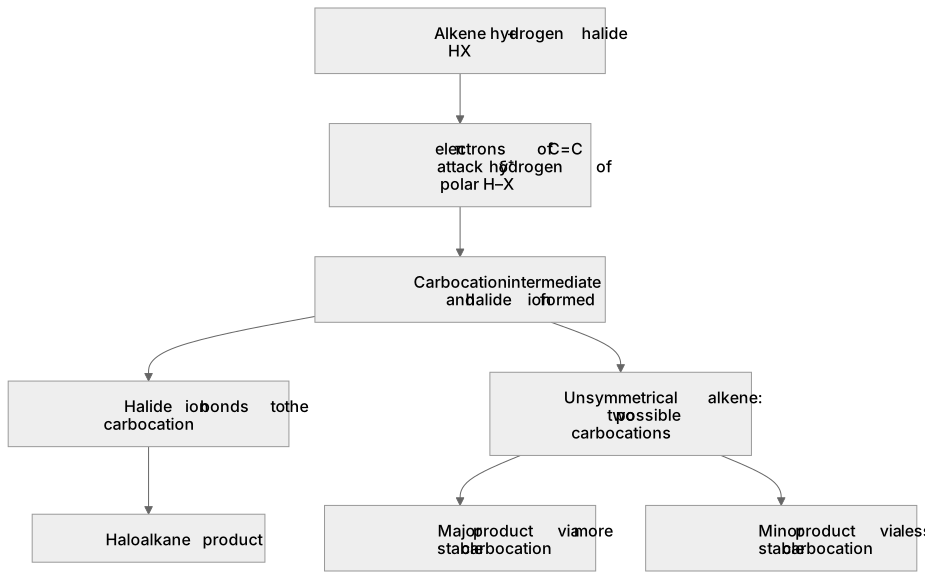
Alkenes undergo electrophilic addition with hydrogen halides (HX, where X is Cl, Br or I) to give haloalkanes. The π electrons of the C=C bond attack the δ⁺ hydrogen of the polar H–X molecule, forming a carbocation and a halide ion; the halide ion then bonds to the carbocation. With an unsymmetrical alkene such as propene, two products are possible, and the major product forms via the more stable carbocation (the Markovnikov outcome). For example, propene with HBr gives mainly 2-bromopropane, with 1-bromopropane as the minor product. The reaction is carried out by passing the gaseous hydrogen halide into the alkene, often in an inert solvent, at room temperature. Learners should be able to name the product haloalkane and explain why one product predominates.
What earns the marks
- Identifies the reaction of an alkene with a hydrogen halide as an electrophilic addition that forms a haloalkane.
- Describes the π electrons of the C=C bond attacking the δ⁺ hydrogen of the polar H–X molecule to form a carbocation intermediate.
- Explains that the halide ion then bonds to the carbocation to complete the haloalkane product.
- Applies carbocation stability to predict the major product for an unsymmetrical alkene such as propene with HBr giving mainly 2-bromopropane.
- Names the haloalkane products correctly using IUPAC nomenclature for a given alkene and hydrogen halide.
Common mistakes and how to put them right
Treats the reaction as a substitution rather than an addition.
Put it right by stating that both atoms of HX add across the double bond.
Assumes the major product always places the halogen on the terminal carbon.
Put it right by applying carbocation stability so the halogen sits on the more substituted carbon.
Writes the mechanism without showing the carbocation intermediate.
Put it right by including the positively charged carbon formed after protonation.
Exam tips
- Learn the general equation alkene + HX → haloalkane and practise naming products for propene, but-1-ene and but-2-ene.
- Draw the full electrophilic addition mechanism with curly arrows from the C=C bond to the H atom and from the H–X bond to the halogen.
- Justify the major product by comparing the stability of the possible carbocations rather than by memorising a rule.
Try the lesson
The start of the Alkenes: (iii) hydrogen halides to form haloalkanes lesson, made from teaching notes for this specification point.
Listen
Alkenes undergo electrophilic addition with hydrogen halides (HX, where X is Cl, Br or I) to give haloalkanes. The π electrons of the C=C bond attack the δ⁺ hydrogen of the polar H–X molecule, forming a carbocation and a halide ion; the halide ion then bonds to the carbocation. With an unsymmetrical alkene such as propene, two products are possible, and the major product forms via the more stable carbocation (the Markovnikov outcome). For example, propene with HBr gives mainly 2-bromopropane, with 1-bromopropane as the minor product. The reaction is carried out by passing the gaseous hydrogen halide into the alkene, often in an inert solvent, at room temperature. Learners should be able to name the product haloalkane and explain why one product predominates. A strong answer earns marks for these points. Identifies the reaction of an alkene with a hydrogen halide as an electrophilic addition that forms a haloalkane. Describes the π electrons of the C=C bond attacking the δ⁺ hydrogen of the polar H–X molecule to form a carbocation intermediate. Explains that the halide ion then bonds to the carbocation to complete the haloalkane product. Applies carbocation stability to predict the major product for an unsymmetrical alkene such as propene with HBr giving mainly 2-bromopropane. A common slip: Treats the reaction as a substitution rather than an addition. Instead, stating that both atoms of HX add across the double bond. Exam tip: Learn the general equation alkene + HX → haloalkane and practise naming products for propene, but-1-ene and but-2-ene.
See it
Key words
Say what each word means before you turn the card.
Electrophilic addition to alkenes
Try answering aloud or in your head before turning the card.
Carbocation intermediates and stability
Try answering aloud or in your head before turning the card.
Markovnikov's rule and major products
Try answering aloud or in your head before turning the card.
IUPAC naming of haloalkanes
Try answering aloud or in your head before turning the card.
See every definition
- Electrophilic addition to alkenes
- The reaction in which an alkene reacts with a hydrogen halide, with both atoms of HX adding across the double bond to form a haloalkane.
- Carbocation intermediates and stability
- A positively charged carbon formed after the π electrons of the C=C bond attack the δ⁺ hydrogen of the polar H–X molecule, and the more stable carbocation gives the major product.
- Markovnikov's rule and major products
- With an unsymmetrical alkene such as propene, two products are possible and the major product forms via the more stable carbocation, so propene with HBr gives mainly 2-bromopropane.
- IUPAC naming of haloalkanes
- Naming the haloalkane products correctly using IUPAC nomenclature for a given alkene and hydrogen halide.
Label the diagram
Some boxes have lost their names. Pick the right name for each number.
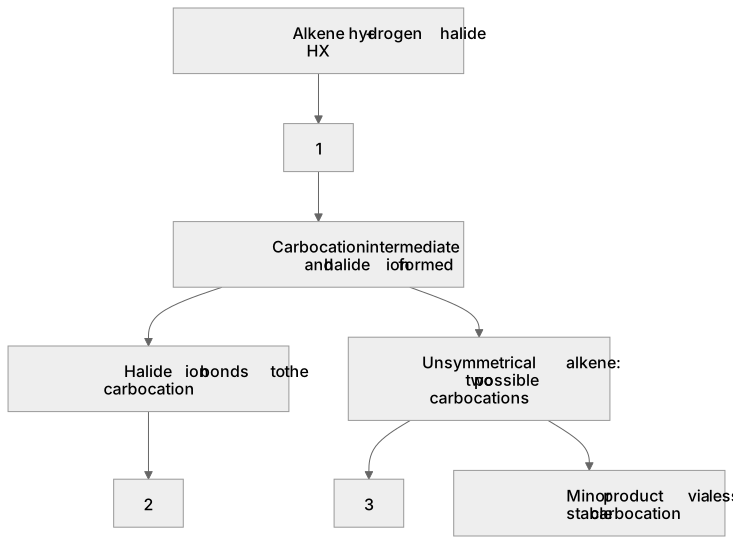
1Box 1
2Box 2
3Box 3
There is more to this lesson
The full lesson goes on to check your understanding and help you earn the marks. Create a free account to carry on, with your progress saved.
A week of Premium from your first lesson · Then the free plan continues · No card, no charge
Test your understanding of Alkenes: (iii) hydrogen halides to form haloalkanes
Active recall beats re-reading. Take an instant quiz now to test what you’ve learned and lock it into long-term memory.
A week of Premium from your first lesson · Then the free plan continues · No card, no charge