OCR · A-Level · Chemistry
Course version: H432 · Version from Sept 2017
(l) the benefits to the environment of development of biodegradable and…
Full specification wording
Alkenes: (l) the benefits to the environment of development of biodegradable and photodegradable polymers.
Addition polymerisation makes polymers such as poly(ethene) and poly(propene) from alkene monomers, and these polymers are generally unreactive and persist in landfill for a very long time.
- Point 27 of 27
- 4 key terms
Study notes
From the teaching notes for this specification point.
The idea
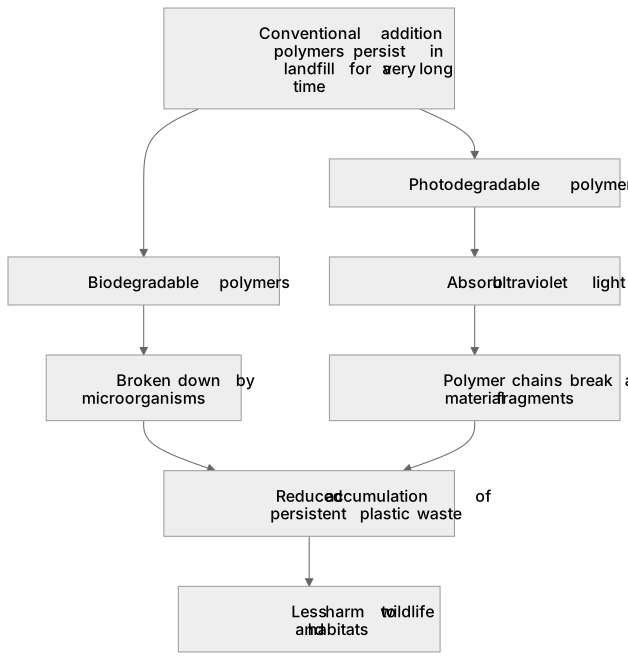
Addition polymerisation makes polymers such as poly(ethene) and poly(propene) from alkene monomers, and these polymers are generally unreactive and persist in landfill for a very long time. Biodegradable polymers are broken down by microorganisms, so they decompose in soil and reduce the volume of persistent plastic waste. Photodegradable polymers contain groups that absorb ultraviolet light, so sunlight breaks the polymer chains and the material fragments, again reducing long-lived litter. Both routes lessen the accumulation of waste and the harm to wildlife and habitats that persistent plastics cause. A good answer links each polymer type to its specific breakdown mechanism and to the environmental benefit, rather than claiming that all plastics simply disappear.
What earns the marks
- Identifies that biodegradable polymers are broken down by microorganisms such as bacteria and fungi.
- Explains that photodegradable polymers absorb ultraviolet light, which breaks the polymer chains.
- Links each type of polymer to a reduced accumulation of persistent plastic waste in landfill or the environment.
- Distinguishes the biological breakdown mechanism of biodegradable polymers from the light-driven breakdown of photodegradable polymers.
Common mistakes and how to put them right
States that biodegradable polymers break down in sunlight.
Put it right by linking biodegradation to microorganisms and photodegradation to ultraviolet light.
Claims that photodegradable polymers are digested by bacteria.
Put it right by explaining that light, not organisms, initiates chain breakdown.
Assumes all polymers decompose quickly in landfill.
Put it right by noting that conventional addition polymers persist for a very long time.
Exam tips
- Read the question stem to check whether it asks about biodegradable, photodegradable or both types before choosing an option.
- Reject any option that swaps the breakdown mechanism between the two polymer types.
- Look for the option that names a specific environmental benefit, such as reduced persistent waste, rather than a vague claim.
Try the lesson
The start of the Alkenes: (l) the benefits to the environment of development of biodegradable and photodegradable polymers. lesson, made from teaching notes for this specification point.
Listen
Addition polymerisation makes polymers such as poly(ethene) and poly(propene) from alkene monomers, and these polymers are generally unreactive and persist in landfill for a very long time. Biodegradable polymers are broken down by microorganisms, so they decompose in soil and reduce the volume of persistent plastic waste. Photodegradable polymers contain groups that absorb ultraviolet light, so sunlight breaks the polymer chains and the material fragments, again reducing long-lived litter. Both routes lessen the accumulation of waste and the harm to wildlife and habitats that persistent plastics cause. A good answer links each polymer type to its specific breakdown mechanism and to the environmental benefit, rather than claiming that all plastics simply disappear. A strong answer earns marks for these points. Identifies that biodegradable polymers are broken down by microorganisms such as bacteria and fungi. Explains that photodegradable polymers absorb ultraviolet light, which breaks the polymer chains. Links each type of polymer to a reduced accumulation of persistent plastic waste in landfill or the environment. Distinguishes the biological breakdown mechanism of biodegradable polymers from the light-driven breakdown of photodegradable polymers. A common slip: States that biodegradable polymers break down in sunlight. Instead, linking biodegradation to microorganisms and photodegradation to ultraviolet light. Exam tip: Read the question stem to check whether it asks about biodegradable, photodegradable or both types before choosing an option.
See it
Key words
Say what each word means before you turn the card.
Biodegradable polymers
Try answering aloud or in your head before turning the card.
Photodegradable polymers
Try answering aloud or in your head before turning the card.
Persistent plastic waste
Try answering aloud or in your head before turning the card.
Environmental benefits
Try answering aloud or in your head before turning the card.
See every definition
- Biodegradable polymers
- Polymers that are broken down by microorganisms, so they decompose in soil and reduce the volume of persistent plastic waste.
- Photodegradable polymers
- Polymers that contain groups which absorb ultraviolet light, so sunlight breaks the polymer chains and the material fragments.
- Persistent plastic waste
- Unreactive polymers that persist in landfill for a very long time, and whose accumulation is lessened by both breakdown routes.
- Environmental benefits
- A reduced accumulation of waste and less harm to wildlife and habitats that persistent plastics cause.
Label the diagram
Some boxes have lost their names. Pick the right name for each number.
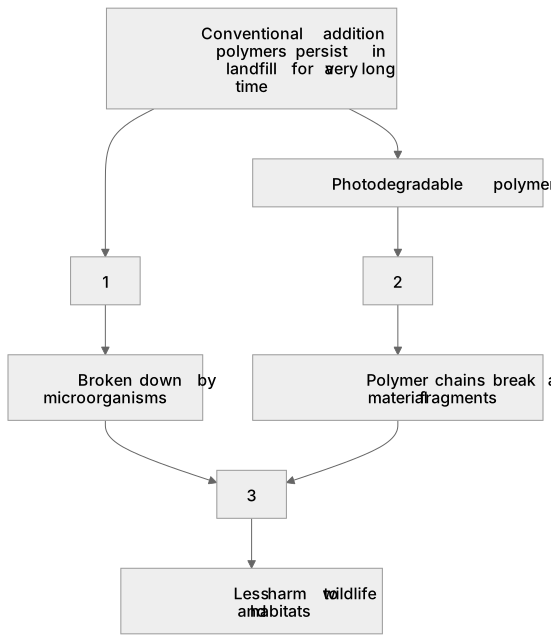
1Box 1
2Box 2
3Box 3
There is more to this lesson
The full lesson goes on to check your understanding and help you earn the marks. Create a free account to carry on, with your progress saved.
A week of Premium from your first lesson · Then the free plan continues · No card, no charge
Test your understanding of Alkenes: (l) the benefits to the environment of development of biodegradable and photodegradable polymers.
Active recall beats re-reading. Take an instant quiz now to test what you’ve learned and lock it into long-term memory.
A week of Premium from your first lesson · Then the free plan continues · No card, no charge