OCR · A-Level · Chemistry
Course version: H432 · Version from Sept 2017
(a) the basicity of amines in terms of proton acceptance by the nitrogen…
Full specification wording
Amines: (a) the basicity of amines in terms of proton acceptance by the nitrogen lone pair and the reactions of amines with dilute acids, e.g. HCl(aq), to form salts
An amine behaves as a Brønsted–Lowry base because the nitrogen atom has a lone pair that accepts a proton.
- Point 2 of 5
- 4 key terms
Study notes
From the teaching notes for this specification point.
The idea
An amine behaves as a Brønsted–Lowry base because the nitrogen atom has a lone pair that accepts a proton. When a primary amine such as methylamine reacts with dilute hydrochloric acid, the lone pair forms a dative bond to H⁺ and the product is the substituted ammonium salt, for example CH₃NH₂ + HCl → CH₃NH₃⁺Cl⁻. The salt is ionic, so it is soluble in water but insoluble in non-polar organic solvents. Adding aqueous sodium hydroxide to the salt reverses the reaction by removing the proton, regenerating the free amine; this is used to liberate phenylamine from its salt after reduction of nitrobenzene. The same proton-acceptance idea explains why amines turn damp red litmus paper blue and why their aqueous solutions have a pH above 7. Base strength depends on how available the lone pair is: alkyl groups increase availability, whereas delocalisation into an aromatic ring decreases it.
What earns the marks
- States that the nitrogen lone pair accepts a proton from the acid to form a dative bond.
- Writes the equation for a named amine reacting with dilute hydrochloric acid to give the alkylammonium chloride salt.
- Identifies the salt as ionic and therefore water-soluble, contrasting it with the less polar free amine.
- Explains that adding aqueous alkali to the salt removes the proton and regenerates the free amine.
- Links the availability of the lone pair to the relative base strength of aliphatic amines and phenylamine.
Common mistakes and how to put them right
Writes the salt as a covalent molecule rather than an ionic compound.
Put it right by showing the ammonium cation and the chloride anion separately.
Claims that the amine is neutralised to give an amide.
Put it right by stating that protonation gives an ammonium salt, not an amide.
Forgets the charge on the nitrogen in the product.
Put it right by writing the cation with a single positive charge, for example CH₃NH₃⁺.
States that adding acid liberates the free amine.
Put it right by explaining that alkali, not acid, removes the proton from the salt.
Exam tips
- Show the lone pair on nitrogen in a displayed formula before and after protonation to make the mechanism of basicity explicit.
- Balance the salt equation and include state symbols where the question rewards them.
- When asked why the salt dissolves in water, refer to ion–dipole interactions with water rather than to hydrogen bonding alone.
- Use the phrase 'proton acceptor' to tie the answer directly to the definition of a base.
Try the lesson
The start of the Amines: (a) the basicity of amines in terms of proton acceptance by the nitrogen lone pair and the reactions of amines with dilute acids, e.g. HCl(aq), to form salts lesson, made from teaching notes for this specification point.
Listen
An amine behaves as a Brønsted–Lowry base because the nitrogen atom has a lone pair that accepts a proton. When a primary amine such as methylamine reacts with dilute hydrochloric acid, the lone pair forms a dative bond to H⁺ and the product is the substituted ammonium salt, for example CH₃NH₂ + HCl → CH₃NH₃⁺Cl⁻. The salt is ionic, so it is soluble in water but insoluble in non-polar organic solvents. Adding aqueous sodium hydroxide to the salt reverses the reaction by removing the proton, regenerating the free amine; this is used to liberate phenylamine from its salt after reduction of nitrobenzene. The same proton-acceptance idea explains why amines turn damp red litmus paper blue and why their aqueous solutions have a pH above 7. Base strength depends on how available the lone pair is: alkyl groups increase availability, whereas delocalisation into an aromatic ring decreases it. A strong answer earns marks for these points. States that the nitrogen lone pair accepts a proton from the acid to form a dative bond. Writes the equation for a named amine reacting with dilute hydrochloric acid to give the alkylammonium chloride salt. Identifies the salt as ionic and therefore water-soluble, contrasting it with the less polar free amine. Explains that adding aqueous alkali to the salt removes the proton and regenerates the free amine. A common slip: Writes the salt as a covalent molecule rather than an ionic compound. Instead, showing the ammonium cation and the chloride anion separately. Exam tip: Show the lone pair on nitrogen in a displayed formula before and after protonation to make the mechanism of basicity explicit.
See it
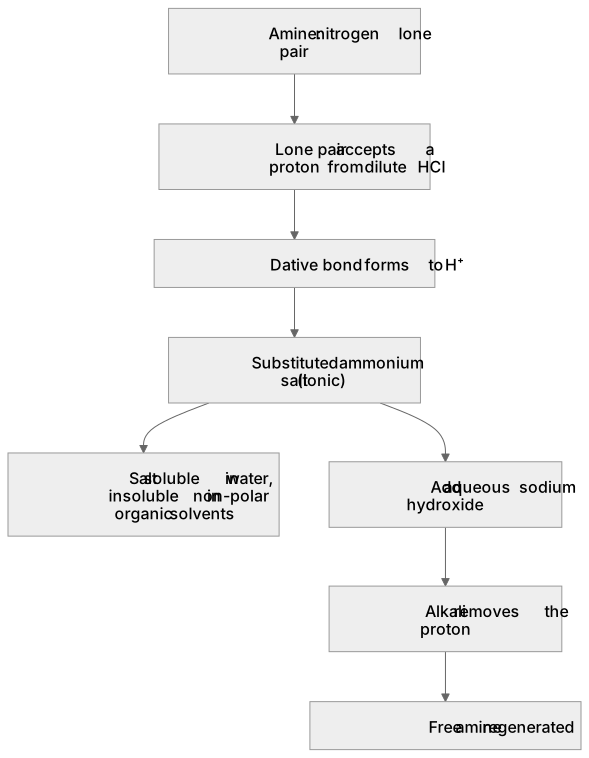
Key words
Say what each word means before you turn the card.
Brønsted–Lowry basicity of amines
Try answering aloud or in your head before turning the card.
Proton acceptance by the nitrogen lone pair
Try answering aloud or in your head before turning the card.
Formation of ammonium salts with dilute acids
Try answering aloud or in your head before turning the card.
Regeneration of the free amine by alkali
Try answering aloud or in your head before turning the card.
See every definition
- Brønsted–Lowry basicity of amines
- An amine behaves as a Brønsted–Lowry base because the nitrogen atom has a lone pair that accepts a proton.
- Proton acceptance by the nitrogen lone pair
- The nitrogen lone pair accepts a proton from the acid to form a dative bond.
- Formation of ammonium salts with dilute acids
- When an amine reacts with dilute hydrochloric acid, the lone pair forms a dative bond to H⁺ and the product is the substituted ammonium salt.
- Regeneration of the free amine by alkali
- Adding aqueous sodium hydroxide to the salt reverses the reaction by removing the proton, regenerating the free amine.
Label the diagram
Some boxes have lost their names. Pick the right name for each number.
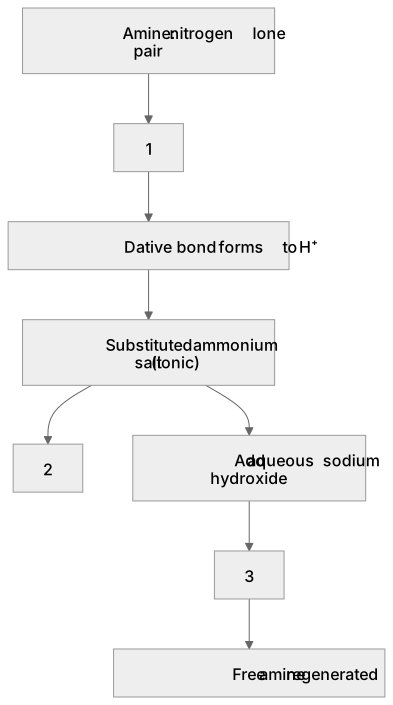
1Box 1
2Box 2
3Box 3
There is more to this lesson
The full lesson goes on to check your understanding and help you earn the marks. Create a free account to carry on, with your progress saved.
A week of Premium from your first lesson · Then the free plan continues · No card, no charge
Test your understanding of Amines: (a) the basicity of amines in terms of proton acceptance by the nitrogen lone pair and the reactions of amines with dilute acids, e.g. HCl(aq), to form salts
Active recall beats re-reading. Take an instant quiz now to test what you’ve learned and lock it into long-term memory.
A week of Premium from your first lesson · Then the free plan continues · No card, no charge