OCR · A-Level · Chemistry
Course version: H432 · Version from Sept 2017
Amines: Basicity and preparation of amines
Amines are organic derivatives of ammonia in which one or more hydrogen atoms are replaced by alkyl or aryl groups.
- Point 1 of 5
- 3 key terms
Study notes
From the teaching notes for this specification point.
The idea
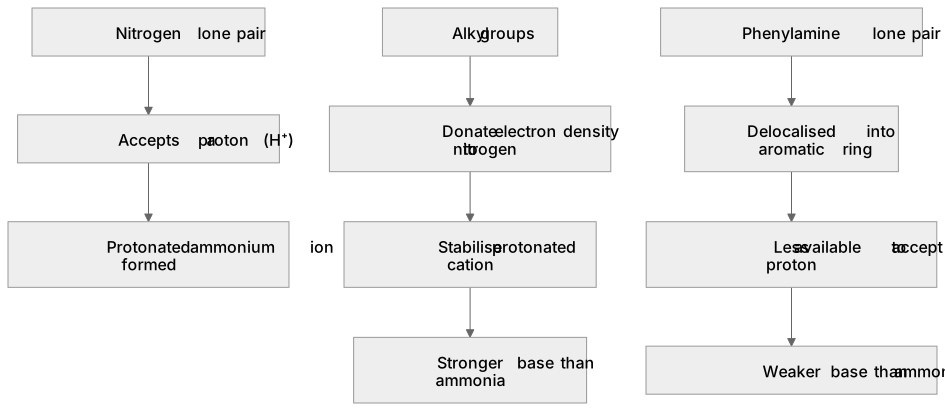
Amines are organic derivatives of ammonia in which one or more hydrogen atoms are replaced by alkyl or aryl groups. Their basicity arises because the nitrogen atom carries a lone pair that can accept a proton (H⁺), forming a positively charged alkylammonium or arylammonium ion. In aqueous solution the equilibrium RNH₂ + H₂O ⇌ RNH₃⁺ + OH⁻ produces hydroxide ions, so amines act as weak bases. Alkyl groups release electron density towards nitrogen and stabilise the protonated cation, so primary, secondary and tertiary aliphatic amines are generally stronger bases than ammonia, while phenylamine is weaker because the lone pair is delocalised into the aromatic ring.
What earns the marks
- Identifies the nitrogen lone pair as the site that accepts a proton from an acid or water.
- Explains that alkyl groups donate electron density and stabilise the protonated ammonium ion, raising basicity relative to ammonia.
- States that the lone pair on phenylamine is delocalised into the benzene ring, reducing availability for proton acceptance and lowering basicity.
- Describes preparation of a primary amine by heating a halogenoalkane with excess ammonia in a sealed tube.
- Describes reduction of a nitrile using LiAlH₄ in dry ether or hydrogen with a nickel catalyst to form a primary amine.
- Describes reduction of nitrobenzene using tin and concentrated hydrochloric acid, followed by addition of alkali to liberate phenylamine.
Common mistakes and how to put them right
Claims that amines are acidic because they contain N–H bonds.
Put it right by stating that the lone pair on nitrogen accepts protons, making amines basic.
Assumes phenylamine is a stronger base than ammonia because it contains an aromatic ring.
Put it right by explaining delocalisation of the lone pair into the ring reduces basicity.
Writes that reduction of a nitrile produces a secondary amine.
Put it right by stating that a nitrile RCN is reduced to the primary amine RCH₂NH₂.
Omits the alkali step when preparing phenylamine from nitrobenzene.
Put it right by adding that alkali liberates the free amine from its ammonium salt.
Exam tips
- Link basicity directly to the availability of the nitrogen lone pair rather than to the number of hydrogen atoms.
- Compare amines with ammonia explicitly when asked about relative base strength, naming the electron-donating or delocalising effect.
- For preparation questions, name the reagent, the essential condition and the functional group change in one sentence.
- Check that the product of nitrile reduction has one more hydrogen on the carbon than the starting nitrile.
Try the lesson
The start of the Amines: Basicity and preparation of amines lesson, made from teaching notes for this specification point.
Listen
Amines are organic derivatives of ammonia in which one or more hydrogen atoms are replaced by alkyl or aryl groups. Their basicity arises because the nitrogen atom carries a lone pair that can accept a proton (H⁺), forming a positively charged alkylammonium or arylammonium ion. In aqueous solution the equilibrium RNH₂ + H₂O ⇌ RNH₃⁺ + OH⁻ produces hydroxide ions, so amines act as weak bases. Alkyl groups release electron density towards nitrogen and stabilise the protonated cation, so primary, secondary and tertiary aliphatic amines are generally stronger bases than ammonia, while phenylamine is weaker because the lone pair is delocalised into the aromatic ring. A strong answer earns marks for these points. Identifies the nitrogen lone pair as the site that accepts a proton from an acid or water. Explains that alkyl groups donate electron density and stabilise the protonated ammonium ion, raising basicity relative to ammonia. States that the lone pair on phenylamine is delocalised into the benzene ring, reducing availability for proton acceptance and lowering basicity. Describes preparation of a primary amine by heating a halogenoalkane with excess ammonia in a sealed tube. A common slip: Claims that amines are acidic because they contain N–H bonds. Instead, stating that the lone pair on nitrogen accepts protons, making amines basic. Exam tip: Link basicity directly to the availability of the nitrogen lone pair rather than to the number of hydrogen atoms.
See it
Key words
Say what each word means before you turn the card.
Proton acceptance by the nitrogen lone pair
Try answering aloud or in your head before turning the card.
Electron-donating alkyl groups and base strength
Try answering aloud or in your head before turning the card.
Delocalisation of the lone pair in phenylamine
Try answering aloud or in your head before turning the card.
See every definition
- Proton acceptance by the nitrogen lone pair
- The nitrogen atom carries a lone pair that can accept a proton (H⁺), forming a positively charged alkylammonium or arylammonium ion.
- Electron-donating alkyl groups and base strength
- Alkyl groups release electron density towards nitrogen and stabilise the protonated cation, so aliphatic amines are generally stronger bases than ammonia.
- Delocalisation of the lone pair in phenylamine
- The lone pair is delocalised into the aromatic ring, reducing its availability for proton acceptance and lowering basicity.
Label the diagram
Some boxes have lost their names. Pick the right name for each number.
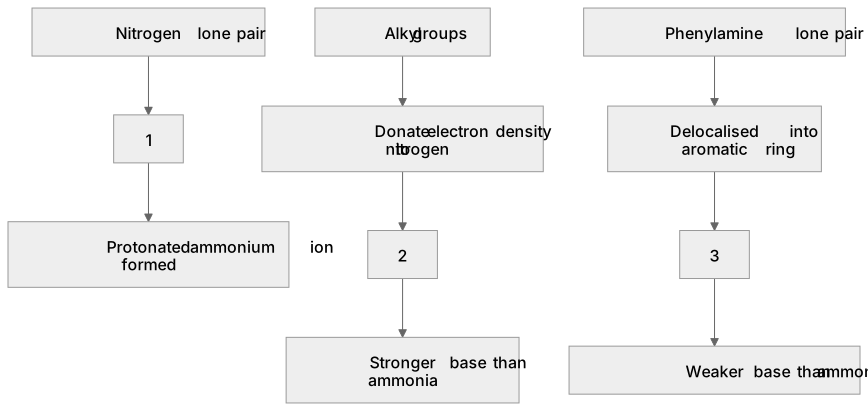
1Box 1
2Box 2
3Box 3
There is more to this lesson
The full lesson goes on to check your understanding and help you earn the marks. Create a free account to carry on, with your progress saved.
A week of Premium from your first lesson · Then the free plan continues · No card, no charge
Test your understanding of Amines: Basicity and preparation of amines
Active recall beats re-reading. Take an instant quiz now to test what you’ve learned and lock it into long-term memory.
A week of Premium from your first lesson · Then the free plan continues · No card, no charge