OCR · A-Level · Chemistry
Course version: H432 · Version from Sept 2017
Amino acids, amides and chirality: Amides
An amide contains a carbonyl group (C=O) directly bonded to a nitrogen atom, giving the functional group –CONH₂ in a primary amide.
- Point 5 of 9
- 4 key terms
Study notes
From the teaching notes for this specification point.
The idea
An amide contains a carbonyl group (C=O) directly bonded to a nitrogen atom, giving the functional group –CONH₂ in a primary amide. The lone pair on the amide nitrogen is delocalised into the carbonyl group, so an amide is much less basic than an amine and does not readily accept a proton in the same way. Amides are formed when a carboxylic acid derivative such as an acyl chloride or acid anhydride reacts with ammonia or an amine, and they can be hydrolysed by heating with aqueous acid or alkali to release the carboxylic acid (or its salt) and ammonia or an amine. Recognise the –CONH– linkage, distinguish it from an amine, and link the structure to its lower basicity and its hydrolysis products.
What earns the marks
- Identifies the amide functional group as a carbonyl group bonded directly to a nitrogen atom.
- Explains that delocalisation of the nitrogen lone pair into the carbonyl group makes an amide much less basic than an amine.
- Describes the formation of an amide from a carboxylic acid derivative reacting with ammonia or an amine.
- States that hydrolysis of an amide with aqueous acid or alkali gives a carboxylic acid or its salt together with ammonia or an amine.
Common mistakes and how to put them right
Confuses an amide with an amine by placing the nitrogen away from the carbonyl carbon.
Put it right by bonding the nitrogen directly to the C=O carbon.
Assumes the amide nitrogen is strongly basic like an amine.
Put it right by explaining delocalisation of the lone pair into the carbonyl group.
Claims hydrolysis gives only one organic product.
Put it right by naming both the carboxylic acid or its salt and the ammonia or amine released.
Exam tips
- Check that the nitrogen is bonded directly to the carbonyl carbon before calling a group an amide.
- Use delocalisation of the nitrogen lone pair to justify the low basicity of amides.
- Name both products of amide hydrolysis and state whether acid or alkali conditions are used.
Try the lesson
The start of the Amino acids, amides and chirality: Amides lesson, made from teaching notes for this specification point.
Listen
An amide contains a carbonyl group (C=O) directly bonded to a nitrogen atom, giving the functional group –CONH₂ in a primary amide. The lone pair on the amide nitrogen is delocalised into the carbonyl group, so an amide is much less basic than an amine and does not readily accept a proton in the same way. Amides are formed when a carboxylic acid derivative such as an acyl chloride or acid anhydride reacts with ammonia or an amine, and they can be hydrolysed by heating with aqueous acid or alkali to release the carboxylic acid (or its salt) and ammonia or an amine. Recognise the –CONH– linkage, distinguish it from an amine, and link the structure to its lower basicity and its hydrolysis products. A strong answer earns marks for these points. Identifies the amide functional group as a carbonyl group bonded directly to a nitrogen atom. Explains that delocalisation of the nitrogen lone pair into the carbonyl group makes an amide much less basic than an amine. Describes the formation of an amide from a carboxylic acid derivative reacting with ammonia or an amine. States that hydrolysis of an amide with aqueous acid or alkali gives a carboxylic acid or its salt together with ammonia or an amine. A common slip: Confuses an amide with an amine by placing the nitrogen away from the carbonyl carbon. Instead, bonding the nitrogen directly to the C=O carbon. Exam tip: Check that the nitrogen is bonded directly to the carbonyl carbon before calling a group an amide.
See it
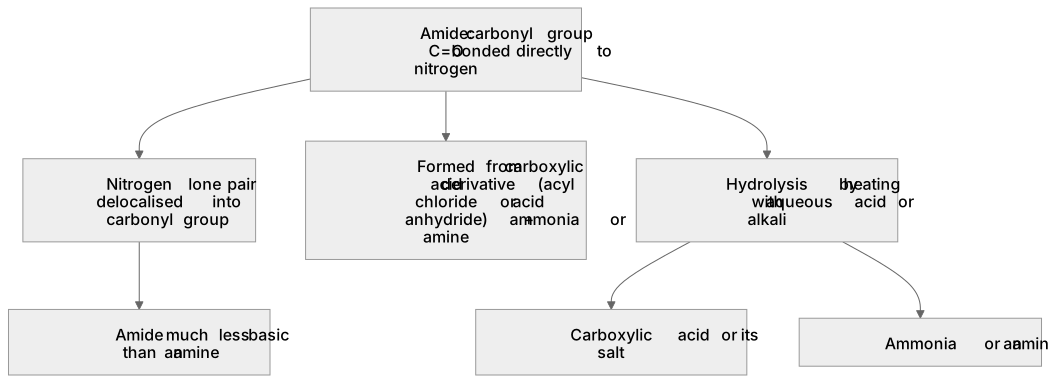
Key words
Say what each word means before you turn the card.
Amide functional group
Try answering aloud or in your head before turning the card.
Delocalisation and reduced basicity of the amide nitrogen
Try answering aloud or in your head before turning the card.
Formation of amides
Try answering aloud or in your head before turning the card.
Hydrolysis of amides
Try answering aloud or in your head before turning the card.
See every definition
- Amide functional group
- A carbonyl group (C=O) directly bonded to a nitrogen atom, giving the functional group –CONH₂ in a primary amide.
- Delocalisation and reduced basicity of the amide nitrogen
- The lone pair on the amide nitrogen is delocalised into the carbonyl group, so an amide is much less basic than an amine and does not readily accept a proton in the same way.
- Formation of amides
- Amides are formed when a carboxylic acid derivative such as an acyl chloride or acid anhydride reacts with ammonia or an amine.
- Hydrolysis of amides
- Amides can be hydrolysed by heating with aqueous acid or alkali to release the carboxylic acid (or its salt) and ammonia or an amine.
Label the diagram
Some boxes have lost their names. Pick the right name for each number.
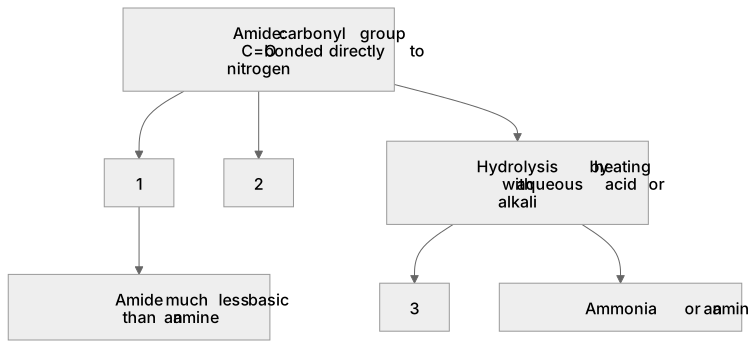
1Box 1
2Box 2
3Box 3
There is more to this lesson
The full lesson goes on to check your understanding and help you earn the marks. Create a free account to carry on, with your progress saved.
A week of Premium from your first lesson · Then the free plan continues · No card, no charge
Test your understanding of Amino acids, amides and chirality: Amides
Active recall beats re-reading. Take an instant quiz now to test what you’ve learned and lock it into long-term memory.
A week of Premium from your first lesson · Then the free plan continues · No card, no charge