OCR · A-Level · Chemistry
Course version: H432 · Version from Sept 2017
(ii) reaction of the amine group with acids
Full specification wording
Amino acids, amides and chirality: (ii) reaction of the amine group with acids
Amino acids contain both a basic amine group (–NH₂) and an acidic carboxyl group (–COOH).
- Point 4 of 9
- 4 key terms
Study notes
From the teaching notes for this specification point.
The idea
Amino acids contain both a basic amine group (–NH₂) and an acidic carboxyl group (–COOH). The lone pair on the nitrogen of the amine group accepts a proton from an acid, so the amine behaves as a Brønsted–Lowry base and is protonated to form an ammonium-type cation, –NH₃⁺. With a strong mineral acid such as HCl, the –NH₂ group becomes –NH₃⁺ and a chloride salt forms; the carboxyl group is left unchanged by this reaction. The product is described as the hydrochloride of the amino acid, and the reaction is a simple acid–base neutralisation. Recognise that the amine group, not the carboxyl group, is the site of protonation, and that the resulting species carries a positive charge on nitrogen.
What earns the marks
- Identifies the amine group as the basic site that accepts a proton from the acid.
- Shows the amine group converted to a protonated ammonium-type group bearing a positive charge on nitrogen.
- States that the carboxyl group is not the group protonated in this reaction.
- Describes the product as a salt formed by acid–base neutralisation of the amine group.
Common mistakes and how to put them right
Protonates the carboxyl group instead of the amine group.
Put it right by protonating the nitrogen lone pair to give the –NH₃⁺ group.
Omits the positive charge on the protonated nitrogen.
Put it right by showing the ammonium-type cation with a 1⁺ charge on nitrogen.
Treats the reaction as producing water only with no salt.
Put it right by naming the ammonium-type salt formed with the acid's conjugate base.
Exam tips
- Locate the lone pair on the amine nitrogen before deciding which group reacts with the acid.
- Write the protonated group explicitly as –NH₃⁺ with the charge on nitrogen.
- Check that the carboxyl group is shown unchanged so the answer stays focused on the amine group.
Try the lesson
The start of the Amino acids, amides and chirality: (ii) reaction of the amine group with acids lesson, made from teaching notes for this specification point.
Listen
Amino acids contain both a basic amine group (–NH₂) and an acidic carboxyl group (–COOH). The lone pair on the nitrogen of the amine group accepts a proton from an acid, so the amine behaves as a Brønsted–Lowry base and is protonated to form an ammonium-type cation, –NH₃⁺. With a strong mineral acid such as HCl, the –NH₂ group becomes –NH₃⁺ and a chloride salt forms; the carboxyl group is left unchanged by this reaction. The product is described as the hydrochloride of the amino acid, and the reaction is a simple acid–base neutralisation. Recognise that the amine group, not the carboxyl group, is the site of protonation, and that the resulting species carries a positive charge on nitrogen. A strong answer earns marks for these points. Identifies the amine group as the basic site that accepts a proton from the acid. Shows the amine group converted to a protonated ammonium-type group bearing a positive charge on nitrogen. States that the carboxyl group is not the group protonated in this reaction. Describes the product as a salt formed by acid–base neutralisation of the amine group. A common slip: Protonates the carboxyl group instead of the amine group. Instead, protonating the nitrogen lone pair to give the –NH₃⁺ group. Exam tip: Locate the lone pair on the amine nitrogen before deciding which group reacts with the acid.
See it
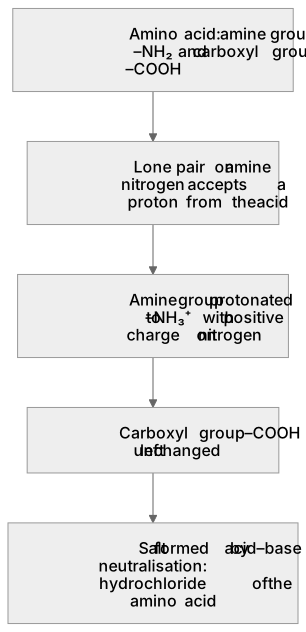
Put it in order
Put these steps in the order they happen.
- 1. Lone pair on amine nitrogen accepts a proton from the acid
- 2. Amine group protonated to –NH₃⁺ with positive charge on nitrogen
- 3. Amino acid: amine group –NH₂ and carboxyl group –COOH
- 4. Salt formed by acid–base neutralisation: hydrochloride of the amino acid
- 5. Carboxyl group –COOH left unchanged
Key words
Say what each word means before you turn the card.
Brønsted–Lowry base
Try answering aloud or in your head before turning the card.
Protonation
Try answering aloud or in your head before turning the card.
Hydrochloride
Try answering aloud or in your head before turning the card.
Acid–base neutralisation
Try answering aloud or in your head before turning the card.
See every definition
- Brønsted–Lowry base
- The amine group behaves as this because the lone pair on the nitrogen accepts a proton from an acid.
- Protonation
- The amine group is protonated to form an ammonium-type cation, –NH₃⁺, with a positive charge on nitrogen.
- Hydrochloride
- The product is described as this when the –NH₂ group becomes –NH₃⁺ with HCl and a chloride salt forms.
- Acid–base neutralisation
- The reaction of the amine group with an acid is a simple one of these, forming a salt.
Label the diagram
Some boxes have lost their names. Pick the right name for each number.
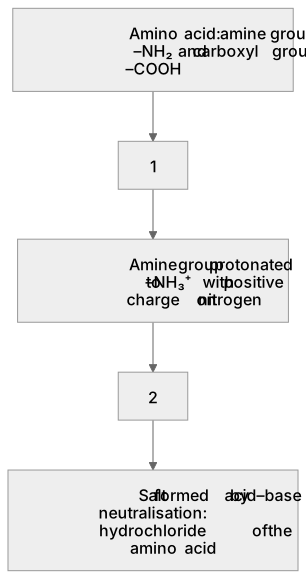
1Box 1
2Box 2
There is more to this lesson
The full lesson goes on to check your understanding and help you earn the marks. Create a free account to carry on, with your progress saved.
A week of Premium from your first lesson · Then the free plan continues · No card, no charge
Test your understanding of Amino acids, amides and chirality: (ii) reaction of the amine group with acids
Active recall beats re-reading. Take an instant quiz now to test what you’ve learned and lock it into long-term memory.
A week of Premium from your first lesson · Then the free plan continues · No card, no charge