OCR · A-Level · Chemistry
Course version: H432 · Version from Sept 2017
(i) reaction of the carboxylic acid group with alkalis and in the…
Full specification wording
Amino acids, amides and chirality: (i) reaction of the carboxylic acid group with alkalis and in the formation of esters (see also 6.1.3 c)
The COOH group of an amino acid behaves like any carboxylic acid.
- Point 3 of 9
- 4 key terms
Study notes
From the teaching notes for this specification point.
The idea
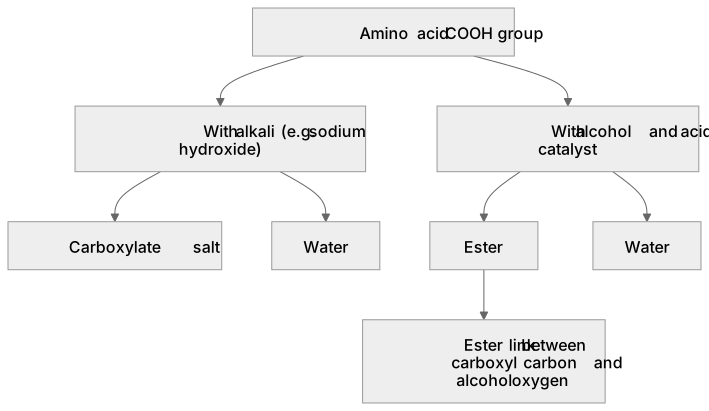
The COOH group of an amino acid behaves like any carboxylic acid. With an alkali such as sodium hydroxide it is neutralised to give a carboxylate salt and water: RCH(NH₂)COOH + NaOH → RCH(NH₂)COONa + H₂O. The amine group may also react with acid, so an amino acid can form salts with both acids and alkalis depending on conditions. With an alcohol and an acid catalyst the carboxylic acid group undergoes esterification to give an ester and water, for example RCH(NH₂)COOH + R'OH ⇌ RCH(NH₂)COOR' + H₂O. Recognise the reagents, the products and the balanced equation, and note that the ester link forms between the carboxyl carbon and the alcohol oxygen.
What earns the marks
- States that the carboxylic acid group reacts with an alkali to form a carboxylate salt and water.
- Writes a balanced equation for neutralisation of the COOH group by sodium hydroxide.
- States that the carboxylic acid group reacts with an alcohol to form an ester and water.
- Identifies the ester linkage formed between the carboxyl carbon and the alcohol oxygen.
Common mistakes and how to put them right
Omits water as a product of neutralisation.
Put it right: Include H₂O alongside the carboxylate salt.
Forms the ester at the amine group.
Put it right: Attach the alcohol-derived group to the carboxyl carbon.
Forgets that esterification is reversible and needs an acid catalyst.
Put it right: Show the equilibrium and catalyst.
Exam tips
- Balance the neutralisation equation and check the salt formula carefully.
- Show the ester functional group clearly and name the alcohol used.
- Recall that the COOH group is the reactive site in both reactions.
Try the lesson
The start of the Amino acids, amides and chirality: (i) reaction of the carboxylic acid group with alkalis and in the formation of esters (see also 6.1.3 c) lesson, made from teaching notes for this specification point.
Listen
The COOH group of an amino acid behaves like any carboxylic acid. With an alkali such as sodium hydroxide it is neutralised to give a carboxylate salt and water: RCH(NH₂)COOH + NaOH → RCH(NH₂)COONa + H₂O. The amine group may also react with acid, so an amino acid can form salts with both acids and alkalis depending on conditions. With an alcohol and an acid catalyst the carboxylic acid group undergoes esterification to give an ester and water, for example RCH(NH₂)COOH + R'OH ⇌ RCH(NH₂)COOR' + H₂O. Recognise the reagents, the products and the balanced equation, and note that the ester link forms between the carboxyl carbon and the alcohol oxygen. A strong answer earns marks for these points. States that the carboxylic acid group reacts with an alkali to form a carboxylate salt and water. Writes a balanced equation for neutralisation of the COOH group by sodium hydroxide. States that the carboxylic acid group reacts with an alcohol to form an ester and water. Identifies the ester linkage formed between the carboxyl carbon and the alcohol oxygen. Exam tip: Balance the neutralisation equation and check the salt formula carefully.
See it
Key words
Say what each word means before you turn the card.
Acid–base reaction of the COOH group
Try answering aloud or in your head before turning the card.
Carboxylate salt formation
Try answering aloud or in your head before turning the card.
Esterification of amino acids
Try answering aloud or in your head before turning the card.
Reagents and conditions
Try answering aloud or in your head before turning the card.
See every definition
- Acid–base reaction of the COOH group
- The carboxylic acid group of an amino acid reacts with an alkali such as sodium hydroxide to be neutralised, giving a carboxylate salt and water.
- Carboxylate salt formation
- Neutralisation of the COOH group by an alkali produces a carboxylate salt and water, as in the balanced equation with sodium hydroxide.
- Esterification of amino acids
- With an alcohol and an acid catalyst the carboxylic acid group reacts reversibly to give an ester and water, the ester link forming between the carboxyl carbon and the alcohol oxygen.
- Reagents and conditions
- Esterification requires an alcohol and an acid catalyst, and the reaction is reversible, so the equilibrium and catalyst should be shown.
There is more to this lesson
The full lesson goes on to check your understanding and help you earn the marks. Create a free account to carry on, with your progress saved.
A week of Premium from your first lesson · Then the free plan continues · No card, no charge
Test your understanding of Amino acids, amides and chirality: (i) reaction of the carboxylic acid group with alkalis and in the formation of esters (see also 6.1.3 c)
Active recall beats re-reading. Take an instant quiz now to test what you’ve learned and lock it into long-term memory.
A week of Premium from your first lesson · Then the free plan continues · No card, no charge