OCR · A-Level · Chemistry
Course version: H432 · Version from Sept 2017
(c) calculations of empirical and molecular formulae, from composition by…
Full specification wording
Amount of substance: (c) calculations of empirical and molecular formulae, from composition by mass or percentage compositions by mass and relative molecular mass
Empirical formula gives the simplest whole-number ratio of atoms in a compound; molecular formula gives the actual number of atoms per molecule.
- Point 9 of 21
- 2 key terms
Study notes
From the teaching notes for this specification point.
The idea
Empirical formula gives the simplest whole-number ratio of atoms in a compound; molecular formula gives the actual number of atoms per molecule. To find the empirical formula from percentage composition by mass, treat each percentage as a mass in grams (so 100 g of compound), divide each mass by the element's relative atomic mass to get moles, then divide every mole value by the smallest to obtain the ratio, multiplying to clear fractions. For example, 40.0% C, 6.7% H and 53.3% O gives 3.33 : 6.7 : 3.33, which simplifies to CH₂O. To find the molecular formula, divide the relative molecular mass by the empirical formula mass and multiply the empirical formula by that whole number; with Mr = 180 and CH₂O (mass 30), the factor is 6, giving C₆H₁₂O₆. Composition by mass works identically using the given masses instead of percentages.
What earns the marks
- Divides each element's mass or percentage by its relative atomic mass to obtain the amount in moles.
- Divides every mole value by the smallest mole value to obtain the simplest ratio.
- Multiplies the ratio by a whole number to clear fractional subscripts and reach the empirical formula.
- Divides the relative molecular mass by the empirical formula mass to obtain the multiplying factor.
- Multiplies the empirical formula subscripts by that factor to give the molecular formula.
Common mistakes and how to put them right
Divides the percentage by the relative atomic mass but forgets to divide through by the smallest value.
Put it right: Reduce the mole ratio to its simplest whole-number form.
Uses the relative molecular mass in place of the relative atomic mass when converting mass to moles.
Put it right: Use Ar for each element and reserve Mr for the whole-compound step.
Rounds a ratio such as 1.
Put it right: 1.5 to 1 : 2 instead of doubling to 2 : 3; multiply through to clear the fraction.
Exam tips
- Lay out a table of element, mass or percentage, Ar, moles and simplest ratio so each step is visible and checkable.
- Check that the empirical formula mass multiplied by your factor equals the given Mr before committing to the molecular formula.
- Keep two decimal places in intermediate mole values and only round at the final ratio to avoid drift.
Try the lesson
The start of the Amount of substance: (c) calculations of empirical and molecular formulae, from composition by mass or percentage compositions by mass and relative molecular mass lesson, made from teaching notes for this specification point.
Listen
Empirical formula gives the simplest whole-number ratio of atoms in a compound; molecular formula gives the actual number of atoms per molecule. To find the empirical formula from percentage composition by mass, treat each percentage as a mass in grams (so 100 g of compound), divide each mass by the element's relative atomic mass to get moles, then divide every mole value by the smallest to obtain the ratio, multiplying to clear fractions. For example, 40.0% C, 6.7% H and 53.3% O gives 3.33 : 6.7 : 3.33, which simplifies to CH₂O. To find the molecular formula, divide the relative molecular mass by the empirical formula mass and multiply the empirical formula by that whole number; with Mr = 180 and CH₂O (mass 30), the factor is 6, giving C₆H₁₂O₆. Composition by mass works identically using the given masses instead of percentages. A strong answer earns marks for these points. Divides each element's mass or percentage by its relative atomic mass to obtain the amount in moles. Divides every mole value by the smallest mole value to obtain the simplest ratio. Multiplies the ratio by a whole number to clear fractional subscripts and reach the empirical formula. Divides the relative molecular mass by the empirical formula mass to obtain the multiplying factor. Exam tip: Lay out a table of element, mass or percentage, Ar, moles and simplest ratio so each step is visible and checkable.
See it
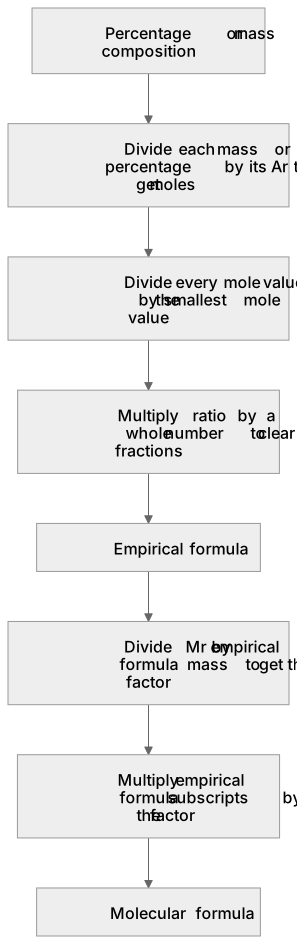
Put it in order
Put these steps in the order they happen.
- 1. Empirical formula
- 2. Molecular formula
- 3. Divide Mr by empirical formula mass to get the factor
- 4. Percentage or mass composition
- 5. Divide each mass or percentage by its Ar to get moles
- 6. Multiply empirical formula subscripts by the factor
- 7. Divide every mole value by the smallest mole value
- 8. Multiply ratio by a whole number to clear fractions
Key words
Say what each word means before you turn the card.
Empirical formula
Try answering aloud or in your head before turning the card.
Molecular formula
Try answering aloud or in your head before turning the card.
See every definition
- Empirical formula
- The simplest whole-number ratio of atoms in a compound, obtained by dividing every mole value by the smallest to obtain the ratio.
- Molecular formula
- The actual number of atoms per molecule, found by dividing the relative molecular mass by the empirical formula mass and multiplying the empirical formula by that whole number.
Label the diagram
Some boxes have lost their names. Pick the right name for each number.
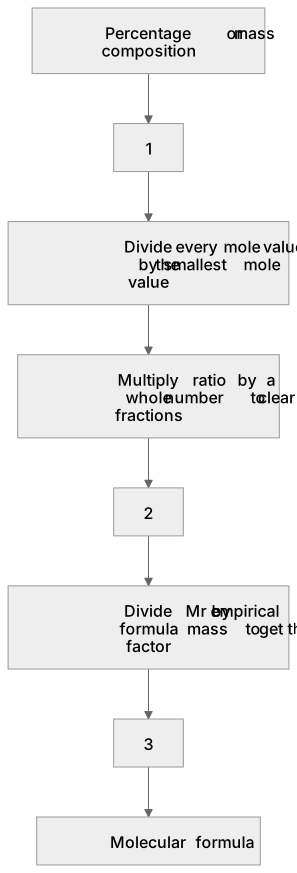
1Box 1
2Box 2
3Box 3
There is more to this lesson
The full lesson goes on to check your understanding and help you earn the marks. Create a free account to carry on, with your progress saved.
A week of Premium from your first lesson · Then the free plan continues · No card, no charge
Test your understanding of Amount of substance: (c) calculations of empirical and molecular formulae, from composition by mass or percentage compositions by mass and relative molecular mass
Active recall beats re-reading. Take an instant quiz now to test what you’ve learned and lock it into long-term memory.
A week of Premium from your first lesson · Then the free plan continues · No card, no charge