OCR · A-Level · Chemistry
Course version: H432 · Version from Sept 2017
(d) the terms anhydrous, hydrated and water of crystallisation and…
Full specification wording
Amount of substance: (d) the terms anhydrous, hydrated and water of crystallisation and calculation of the formula of a hydrated salt from given percentage composition, mass composition or based on experimental results
An anhydrous salt contains no water of crystallisation; a hydrated salt contains water of crystallisation, the fixed amount of water built into its crystal lattice, written after a dot as in…
- Point 10 of 21
- 3 key terms
Study notes
From the teaching notes for this specification point.
The idea
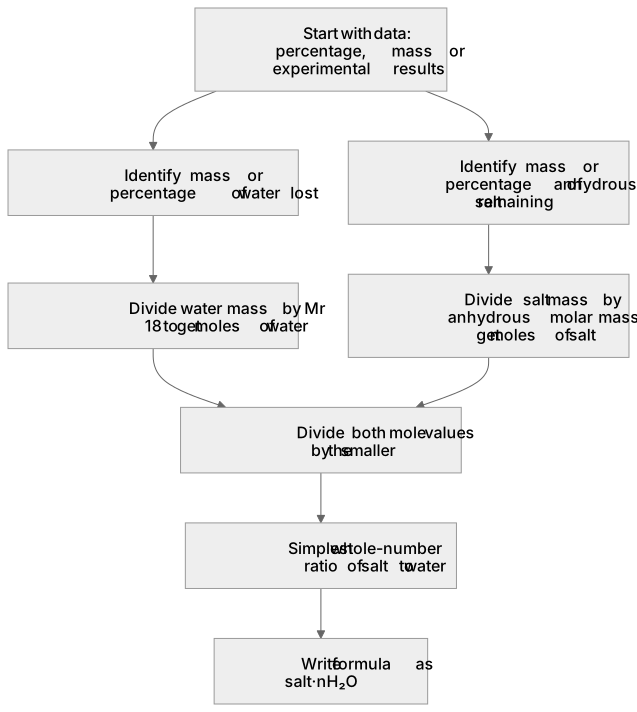
An anhydrous salt contains no water of crystallisation; a hydrated salt contains water of crystallisation, the fixed amount of water built into its crystal lattice, written after a dot as in CuSO₄·5H₂O. To find the formula of a hydrated salt, determine the moles of anhydrous salt and the moles of water separately, then divide both by the smaller to obtain the ratio. From percentage composition, treat percentages as masses in 100 g: subtract the water percentage to get the anhydrous salt mass, divide each by its molar mass, and simplify. From experimental results, use the mass lost on heating as the mass of water and the residual mass as the anhydrous salt.
For example: If heating leaves 0.80 g of anhydrous salt (Mr 160) and loses 0.90 g of water (Mr 18), the moles are 0.0050 and 0.050, giving a ratio of 1 : 10, so the formula is salt·10H₂O.
What earns the marks
- Defines anhydrous as containing no water of crystallisation and hydrated as containing water of crystallisation within the crystal lattice.
- Identifies the mass or percentage of water lost and the mass or percentage of anhydrous salt remaining.
- Divides each mass by the appropriate molar mass to obtain moles of anhydrous salt and moles of water.
- Divides both mole values by the smaller to obtain the simplest whole-number ratio of salt to water.
- Writes the formula with the correct number of water molecules after the dot, for example salt·nH₂O.
Common mistakes and how to put them right
Treats the whole hydrated mass as the anhydrous salt.
Put it right: Subtract the water mass first so the two components are separated.
Uses the molar mass of the hydrated salt when converting the water to moles.
Put it right: Use 18 for H₂O and the anhydrous molar mass for the salt.
Assumes the ratio is always 1.
Put it right: 1 without dividing through; always reduce the two mole values to their simplest whole-number ratio.
Exam tips
- Record the mass before heating, after heating and the loss, then assign the loss to water and the residue to the anhydrous salt.
- Show the moles of water and moles of salt as separate lines before forming the ratio so the method is clear.
- Check the final formula by confirming the water of crystallisation value is a whole number.
Try the lesson
The start of the Amount of substance: (d) the terms anhydrous, hydrated and water of crystallisation and calculation of the formula of a hydrated salt from given percentage composition, mass composition or based on experimental results lesson, made from teaching notes for this specification point.
Listen
An anhydrous salt contains no water of crystallisation; a hydrated salt contains water of crystallisation, the fixed amount of water built into its crystal lattice, written after a dot as in CuSO₄·5H₂O. To find the formula of a hydrated salt, determine the moles of anhydrous salt and the moles of water separately, then divide both by the smaller to obtain the ratio. From percentage composition, treat percentages as masses in 100 g: subtract the water percentage to get the anhydrous salt mass, divide each by its molar mass, and simplify. From experimental results, use the mass lost on heating as the mass of water and the residual mass as the anhydrous salt. For example, if heating leaves 0.80 g of anhydrous salt (Mr 160) and loses 0.90 g of water (Mr 18), the moles are 0.0050 and 0.050, giving a ratio of 1 : 10, so the formula is salt·10H₂O. A strong answer earns marks for these points. Defines anhydrous as containing no water of crystallisation and hydrated as containing water of crystallisation within the crystal lattice. Identifies the mass or percentage of water lost and the mass or percentage of anhydrous salt remaining. Divides each mass by the appropriate molar mass to obtain moles of anhydrous salt and moles of water. Divides both mole values by the smaller to obtain the simplest whole-number ratio of salt to water. Exam tip: Record the mass before heating, after heating and the loss, then assign the loss to water and the residue to the anhydrous salt.
See it
Key words
Say what each word means before you turn the card.
Hydrated
Try answering aloud or in your head before turning the card.
Water of crystallisation
Try answering aloud or in your head before turning the card.
Formula of a hydrated salt
Try answering aloud or in your head before turning the card.
See every definition
- Hydrated
- Contains water of crystallisation within the crystal lattice.
- Water of crystallisation
- The fixed amount of water built into a crystal lattice, written after a dot as in CuSO₄·5H₂O.
- Formula of a hydrated salt
- Found by determining the moles of anhydrous salt and the moles of water separately, then dividing both by the smaller to obtain the ratio.
Label the diagram
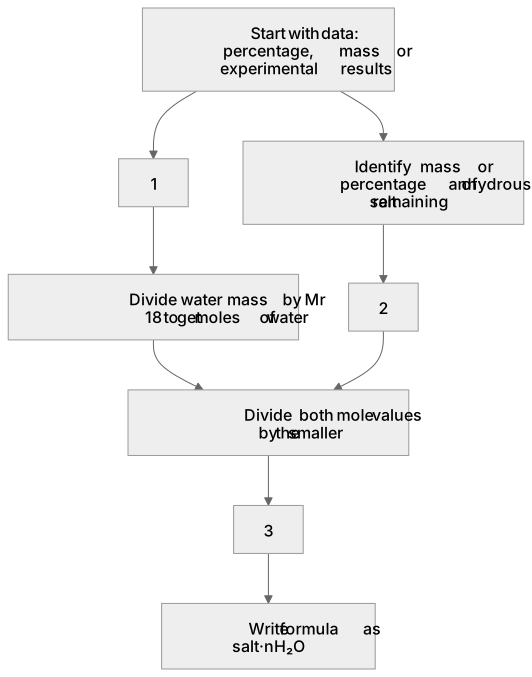
Some boxes have lost their names. Pick the right name for each number.
1Box 1
2Box 2
3Box 3
There is more to this lesson
The full lesson goes on to check your understanding and help you earn the marks. Create a free account to carry on, with your progress saved.
A week of Premium from your first lesson · Then the free plan continues · No card, no charge
Test your understanding of Amount of substance: (d) the terms anhydrous, hydrated and water of crystallisation and calculation of the formula of a hydrated salt from given percentage composition, mass composition or based on experimental results
Active recall beats re-reading. Take an instant quiz now to test what you’ve learned and lock it into long-term memory.
A week of Premium from your first lesson · Then the free plan continues · No card, no charge