OCR · A-Level · Chemistry
Course version: H432 · Version from Sept 2017
Amount of substance: (g) use of stoichiometric relationships in calculations
Stoichiometry links a balanced equation's mole ratio to measurable quantities.
- Point 16 of 21
- 4 key terms
Study notes
From the teaching notes for this specification point.
The idea
Stoichiometry links a balanced equation's mole ratio to measurable quantities. Read the equation, confirm it is balanced, then convert what you are given into moles: mass ÷ molar mass, concentration × volume in dm³, or gas volume ÷ 24.0 dm³ at room temperature and pressure. Apply the mole ratio from the coefficients to find moles of the target substance, then convert back to the requested unit.
For example: In 2H₂ + O₂ → 2H₂O, burning 4.0 g of H₂ (2 mol) needs 1 mol O₂ and gives 2 mol H₂O. Keep units consistent and use the limiting reagent when two reactants are given.
What earns the marks
- Converts the given mass, concentration and volume, or gas volume into moles using the correct relationship before applying any ratio.
- Applies the mole ratio from the coefficients of the balanced equation to find moles of the required substance.
- Identifies the limiting reagent when amounts of two reactants are supplied and bases the calculation on it.
- Converts the final number of moles back into the requested unit, such as mass, concentration or gas volume, with consistent units.
Common mistakes and how to put them right
Uses the equation coefficients as a mass ratio rather than a mole ratio.
Put it right: Convert masses to moles first, apply the ratio, then convert back.
Ignores the limiting reagent and uses the excess reactant.
Put it right: Compare mole ratios to find which reactant runs out first.
Uses a gas molar volume of 24.0 dm³ without checking the stated conditions.
Put it right: Apply 24.0 dm³ mol⁻¹ only at room temperature and pressure.
Mixes cm³ and dm³ in a concentration calculation.
Put it right: Divide the volume in cm³ by 1000 to obtain dm³ before multiplying by concentration.
Exam tips
- Write the balanced equation and underline the substances you are linking before starting any arithmetic.
- Show the moles of each substance at every stage so method marks are visible even if the final value slips.
- Check significant figures and units at the end, and state the limiting reagent explicitly when two reactants are given.
Try the lesson
The start of the Amount of substance: (g) use of stoichiometric relationships in calculations lesson, made from teaching notes for this specification point.
Listen
Stoichiometry links a balanced equation's mole ratio to measurable quantities. Read the equation, confirm it is balanced, then convert what you are given into moles: mass ÷ molar mass, concentration × volume in dm³, or gas volume ÷ 24.0 dm³ at room temperature and pressure. Apply the mole ratio from the coefficients to find moles of the target substance, then convert back to the requested unit. For example, in 2H₂ + O₂ → 2H₂O, burning 4.0 g of H₂ (2 mol) needs 1 mol O₂ and gives 2 mol H₂O. Keep units consistent and use the limiting reagent when two reactants are given. A strong answer earns marks for these points. Converts the given mass, concentration and volume, or gas volume into moles using the correct relationship before applying any ratio. Applies the mole ratio from the coefficients of the balanced equation to find moles of the required substance. Identifies the limiting reagent when amounts of two reactants are supplied and bases the calculation on it. Converts the final number of moles back into the requested unit, such as mass, concentration or gas volume, with consistent units. Exam tip: Write the balanced equation and underline the substances you are linking before starting any arithmetic.
See it
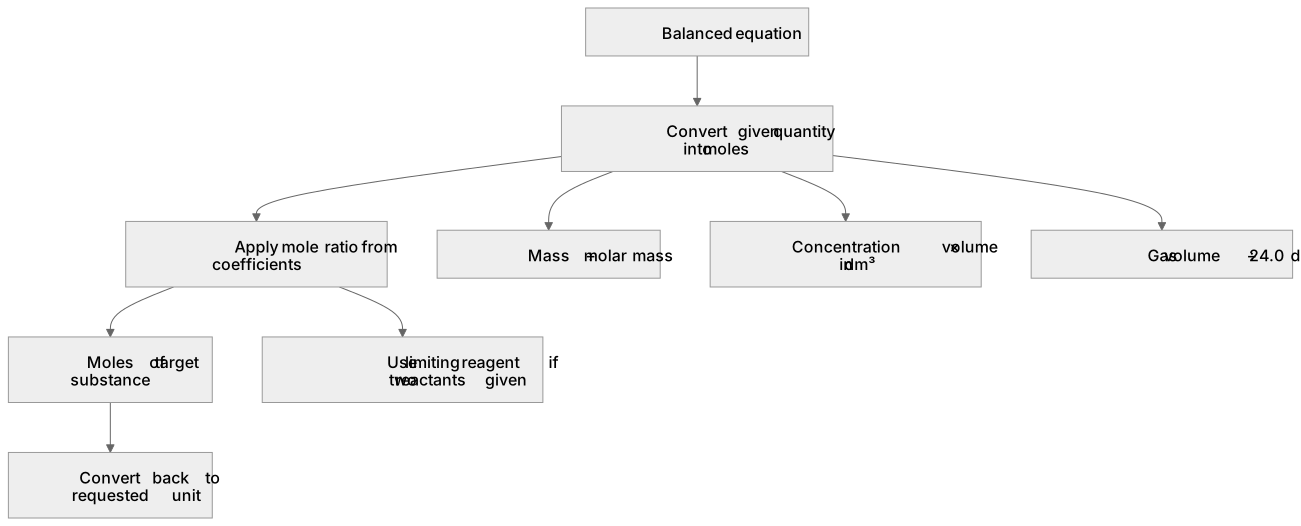
Key words
Say what each word means before you turn the card.
Balanced equations and mole ratios
Try answering aloud or in your head before turning the card.
Molar mass and mass–mole conversion
Try answering aloud or in your head before turning the card.
Concentration, volume and amount in solution
Try answering aloud or in your head before turning the card.
Limiting reagents and gas volumes
Try answering aloud or in your head before turning the card.
See every definition
- Balanced equations and mole ratios
- A balanced equation's coefficients give the mole ratio that links the substances being calculated.
- Molar mass and mass–mole conversion
- Mass is converted into moles by dividing by molar mass before any ratio is applied.
- Concentration, volume and amount in solution
- Concentration multiplied by volume in dm³ gives the amount in moles in solution.
- Limiting reagents and gas volumes
- When two reactants are given, the limiting reagent is used, and gas volume is divided by 24.0 dm³ at room temperature and pressure.
Label the diagram
Some boxes have lost their names. Pick the right name for each number.
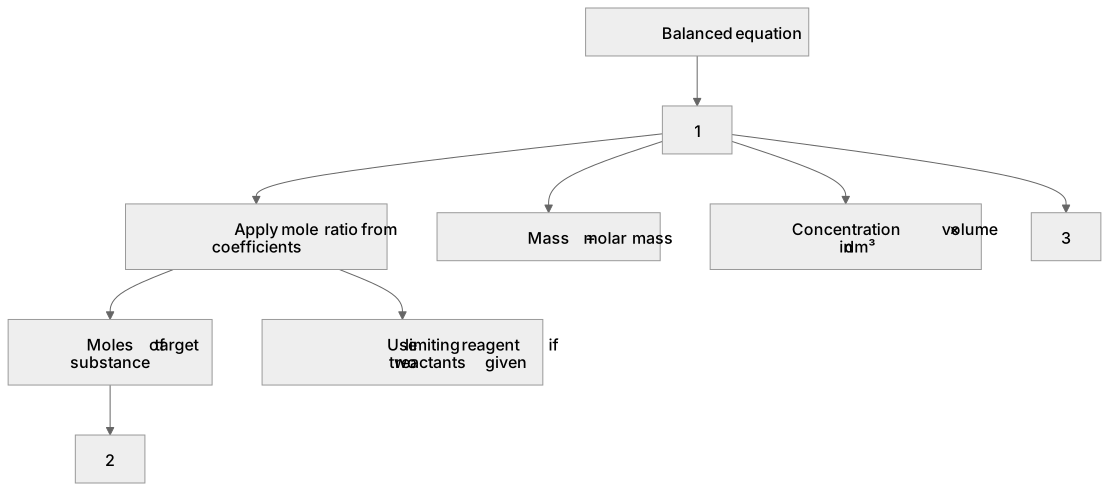
1Box 1
2Box 2
3Box 3
There is more to this lesson
The full lesson goes on to check your understanding and help you earn the marks. Create a free account to carry on, with your progress saved.
A week of Premium from your first lesson · Then the free plan continues · No card, no charge
Test your understanding of Amount of substance: (g) use of stoichiometric relationships in calculations
Active recall beats re-reading. Take an instant quiz now to test what you’ve learned and lock it into long-term memory.
A week of Premium from your first lesson · Then the free plan continues · No card, no charge