OCR · A-Level · Chemistry
Course version: H432 · Version from Sept 2017
Amount of substance: (f) the ideal gas equation: pV = nRT
The ideal gas equation pV = nRT relates the pressure p, volume V, amount n and temperature T of a gas through the gas constant R. Pressure is in pascals (Pa), where 1 kPa = 1000 Pa and 1 atm ≈ 101…
- Point 15 of 21
- 4 key terms
Study notes
From the teaching notes for this specification point.
The idea
The ideal gas equation pV = nRT relates the pressure p, volume V, amount n and temperature T of a gas through the gas constant R. Pressure is in pascals (Pa), where 1 kPa = 1000 Pa and 1 atm ≈ 101 kPa; volume is in cubic metres (m³), where 1 dm³ = 1 × 10⁻³ m³ and 1 cm³ = 1 × 10⁻⁶ m³; temperature must be in kelvin, so add 273 to the Celsius value. R = 8.314 J K⁻¹ mol⁻¹. Rearranging gives n = pV ÷ RT, p = nRT ÷ V, V = nRT ÷ p and T = pV ÷ nR. A gas occupying 2.00 × 10⁻³ m³ at 100 kPa and 300 K contains n = (100000 × 2.00 × 10⁻³) ÷ (8.314 × 300) ≈ 0.0802 mol. Questions test unit conversion, rearrangement and correct substitution.
What earns the marks
- Converts pressure to pascals and volume to cubic metres before substituting into pV = nRT.
- Converts temperature in degrees Celsius to kelvin by adding 273.
- Rearranges pV = nRT to make the required quantity the subject before substituting values.
- Substitutes values with the correct gas constant R = 8.314 J K⁻¹ mol⁻¹ and evaluates the answer with a sensible unit.
- Uses the equation to find the relative molecular mass by dividing mass by the calculated number of moles.
Common mistakes and how to put them right
Substitutes pressure in kPa or volume in dm³ without converting to Pa and m³.
Put it right: Convert both units first.
Uses a Celsius temperature in the equation.
Put it right: Add 273 to obtain kelvin.
Rearranges the equation incorrectly and inverts a term.
Put it right: Isolate the required quantity step by step before substituting.
Exam tips
- List the converted values of p, V and T with units before substituting to catch unit errors early.
- Keep R as 8.314 J K⁻¹ mol⁻¹ and check that the units of p, V and T match it.
- Carry out the rearrangement symbolically first, then substitute numbers, to avoid arithmetic mistakes.
Try the lesson
The start of the Amount of substance: (f) the ideal gas equation: pV = nRT lesson, made from teaching notes for this specification point.
Listen
The ideal gas equation pV = nRT relates the pressure p, volume V, amount n and temperature T of a gas through the gas constant R. Pressure is in pascals (Pa), where 1 kPa = 1000 Pa and 1 atm ≈ 101 kPa; volume is in cubic metres (m³), where 1 dm³ = 1 × 10⁻³ m³ and 1 cm³ = 1 × 10⁻⁶ m³; temperature must be in kelvin, so add 273 to the Celsius value. R = 8.314 J K⁻¹ mol⁻¹. Rearranging gives n = pV ÷ RT, p = nRT ÷ V, V = nRT ÷ p and T = pV ÷ nR. A gas occupying 2.00 × 10⁻³ m³ at 100 kPa and 300 K contains n = (100000 × 2.00 × 10⁻³) ÷ (8.314 × 300) ≈ 0.0802 mol. Questions test unit conversion, rearrangement and correct substitution. A strong answer earns marks for these points. Converts pressure to pascals and volume to cubic metres before substituting into pV = nRT. Converts temperature in degrees Celsius to kelvin by adding 273. Rearranges pV = nRT to make the required quantity the subject before substituting values. Substitutes values with the correct gas constant R = 8.314 J K⁻¹ mol⁻¹ and evaluates the answer with a sensible unit. Exam tip: List the converted values of p, V and T with units before substituting to catch unit errors early.
See it
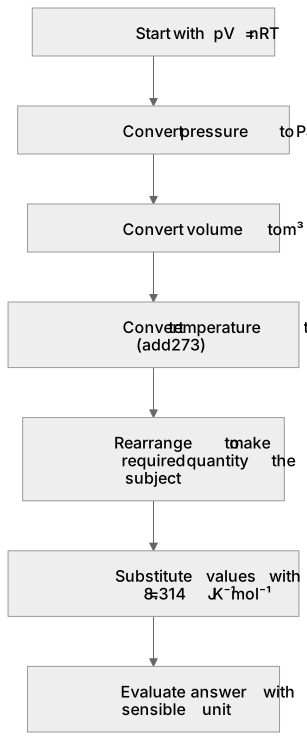
Put it in order
Put these steps in the order they happen.
- 1. Evaluate answer with sensible unit
- 2. Substitute values with R = 8.314 J K⁻¹ mol⁻¹
- 3. Convert volume to m³
- 4. Rearrange to make required quantity the subject
- 5. Start with pV = nRT
- 6. Convert pressure to Pa
- 7. Convert temperature to K (add 273)
Key words
Say what each word means before you turn the card.
The ideal gas equation and its variables
Try answering aloud or in your head before turning the card.
Unit conversion for pressure, volume and temperature
Try answering aloud or in your head before turning the card.
Rearranging equations
Try answering aloud or in your head before turning the card.
Using the gas constant R
Try answering aloud or in your head before turning the card.
See every definition
- The ideal gas equation and its variables
- The equation pV = nRT relates the pressure p, volume V, amount n and temperature T of a gas through the gas constant R.
- Unit conversion for pressure, volume and temperature
- Pressure is in pascals, volume is in cubic metres, and temperature must be in kelvin, so add 273 to the Celsius value.
- Rearranging equations
- Rearranging gives n = pV ÷ RT, p = nRT ÷ V, V = nRT ÷ p and T = pV ÷ nR.
- Using the gas constant R
- R = 8.314 J K⁻¹ mol⁻¹, and values are substituted with the correct gas constant to evaluate the answer with a sensible unit.
Label the diagram
Some boxes have lost their names. Pick the right name for each number.
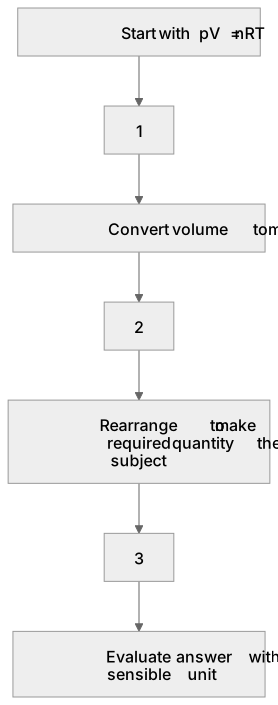
1Box 1
2Box 2
3Box 3
There is more to this lesson
The full lesson goes on to check your understanding and help you earn the marks. Create a free account to carry on, with your progress saved.
A week of Premium from your first lesson · Then the free plan continues · No card, no charge
Test your understanding of Amount of substance: (f) the ideal gas equation: pV = nRT
Active recall beats re-reading. Take an instant quiz now to test what you’ve learned and lock it into long-term memory.
A week of Premium from your first lesson · Then the free plan continues · No card, no charge